Cuban trade union federation CTC leader OSNAY MIGUEL COLINA speaks to Ben Chacko about life and work under a crippling US siege


 Latest editorial
The convenient crisis at Cueta
The border spat is a useful turning of the screw against Spain for US interests, says ROGER McKENZIE
A part of the British empire’s network of slavery, today the Caribbean island of Nevis faces a new form of exploitation in the form of crypto-colonialism, CLAUDIA WEBBE writes
A new book by Victoria Holmes illuminates the many hidden histories of the oppression experienced by Gypsy/Roma/Traveller community, writes ROGER McKENZIE
Even the oligarchs of the artificial intelligence industries are warning that their creations have the capacity for the ultimate destruction of the planet and its population. ANDREW MURRAY suggests that there might just be other solutions
The Labour government must deliver on its commitment to bring back privatised services into the public sector. This not only saves money but also creates accountability and generates wider social benefits, argues ANDY MCDONALD MP
Public ownership of Great British Railways has enormous potential to improve our railway network, but that can’t happen unless jobs, employee rights and union recognition is at the heart of the transition, argues MARYAM ESLAMDOUST
Challenges from the unscrupulous misuse of AI to steal actors’ voice and physical likenesses is being met with a firm union response, writes LYNDA ROOKE





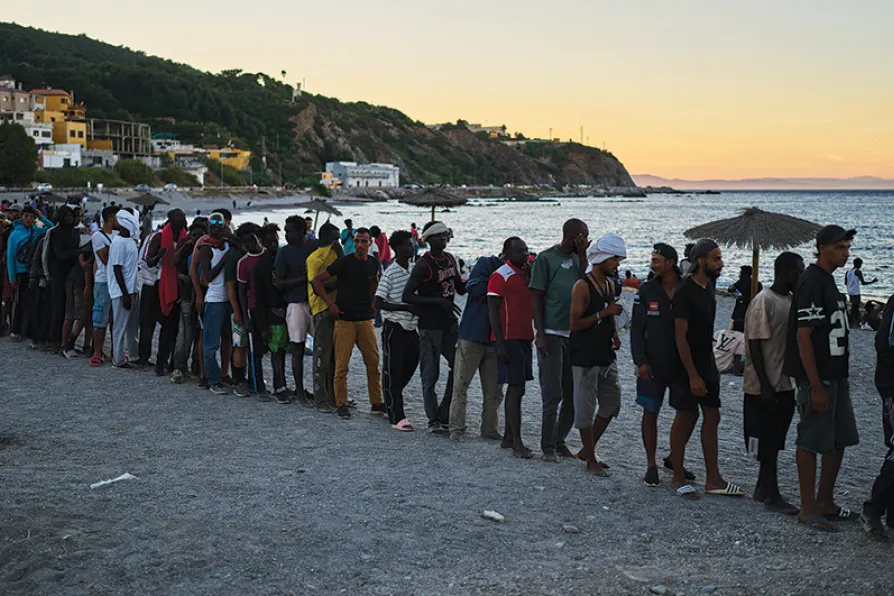
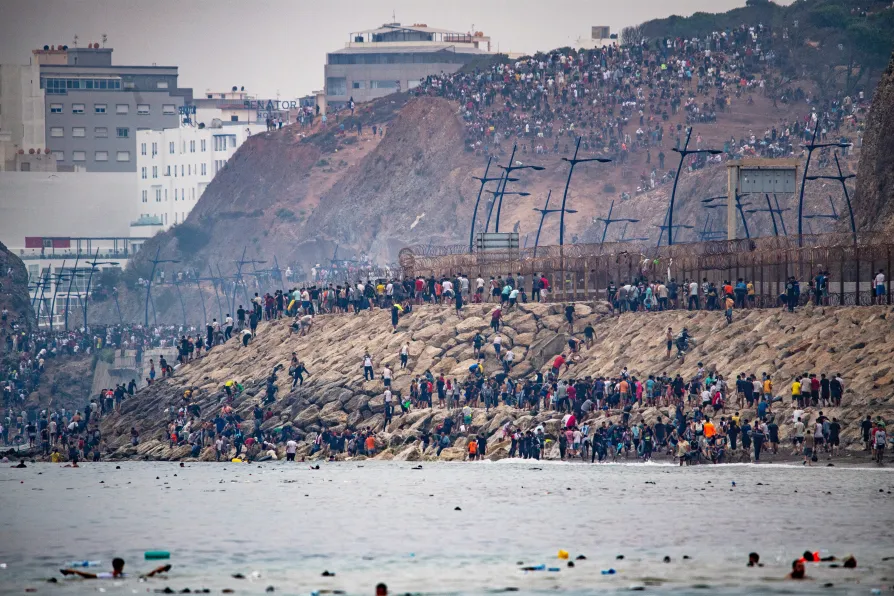
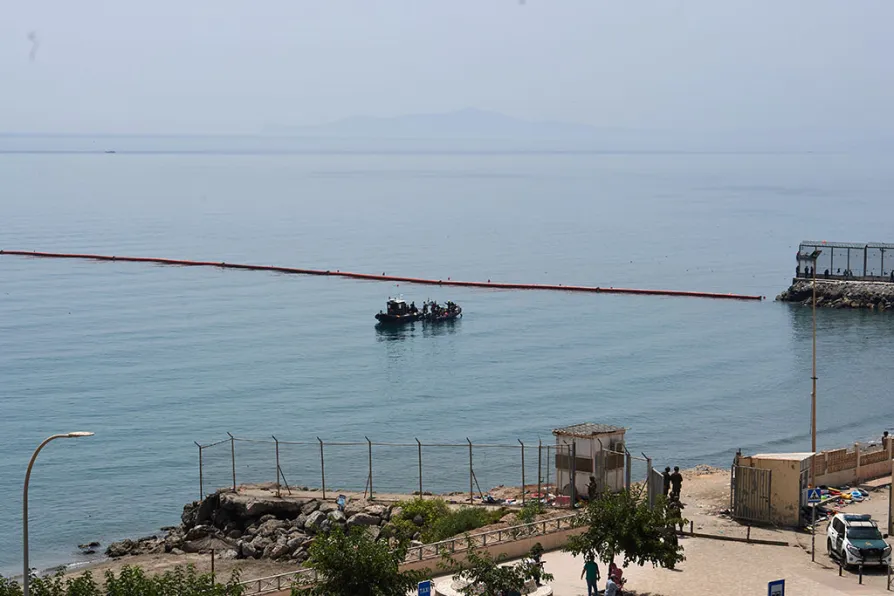
THE least surprising thing about the clearly manufactured episode at the “border” between Spain and Morocco at Ceuta last week is that Moroccan intelligence were found to be amongst the “migrants.”
Perhaps running it a close second was the fact that there was hardly any discussion about the fact that Spain is brazenly occupying the African continent.
The very legitimate sympathy that everyone should have with the Moroccans for their land being occupied by the Spanish since around 1580 – and before that by the Portuguese – is more than tempered by Rabat’s own brutal occupation of Western Sahara.
Morocco rightly refers to Ceuta as occupied lands and demands an end to the Spanish presence in their country but, at the same time, claims sovereignty over Western Sahara, itself a former Spanish colony, since becoming independent from France in 1956.
In the late 1970s the kingdom annexed around 80 per cent of Western Sahara.
This annexation flew in the face of decisions of the International Court of Justice in October 1975 that concluded that there was no right to sovereignty by either Morocco or its other neighbour Mauritania.
The court also found there were no legal obstacles to the decolonisation of Western Sahara and underlined the right of the territory to self-determination.
I am not arguing that one wrong alters a right. I am merely pointing out that Morocco’s claims of sovereignty and being occupied ring somewhat hollow given their own occupational activities.
Spain should leave Africa. Plain and simple. But I will say something below about why they are still there.
Having said that, it is obvious that there was something much more to last week’s incursion of Ceuta by tens of thousands of Moroccans.
I don’t have access to the intelligence information that the Spanish have no doubt seen and analysed. But there are a number of factors that are crystal clear and in the public record.
The footage of the Moroccans arriving and disembarking from authority-escorted trucks was instructive on many levels.
Firstly, the Moroccan authorities were clearly involved. Many of the Moroccans who went to Ceuta have since spoken of being approached by the authorities to “go to Spain.” Pretty odd behaviour, to say the least, for any country to tell their own citizens to leave.
There is no doubt that there is deep seated anger in Morocco over poor public services and rampant poverty.
Last year saw waves of protests over the soaring cost of living and the fact that, according to official figures, more than a quarter of Moroccans aged 15 to 24 are not in education, employment or training.
But it is hard to believe that the rush into Ceuta was a fully fledged attempt at migration.
The footage showed none of the Moroccans entering Ceuta with even the most minor of possessions. Nothing. Even the most desperate migrant will have some possessions with them, no matter how small.
It was also clear that just about all the Moroccans who went into Ceuta went back home within hours under pretty minimal pressure. Again – very odd behaviour.
So, if these Moroccans were not migrants, something else was going on.
The incident bears all the hallmarks of the alignment of interests of a number of players to embarrass the Spanish.
Spain has gained many plaudits for not allowing the United States to use its territory to attack Iran. This has led to a very public row between Washington and the Pedro Sanchez led Socialist Party government in Madrid.
Two weeks before last week’s incursion Trump’s Republican-controlled Congress passed a bill with $40 million (around £30m) for Morocco and a committee report which said Ceuta was “located in Moroccan territory and remained the subject of Morocco’s longstanding claim.”
The Spanish government has also been outspoken in its opposition to the genocide being carried out by Israel on the Palestinians in Gaza.
International relations are never based on sentiment. They are always based on interests. Here we have a convergence of interests to mount an attack on Spain that goes far beyond embarrassment.
The move helps to destabilise the Socialist government not only domestically, where it has come under predictable fire from its opponents, but also across other members of “Fortress Europe” otherwise known as the European Union.
Another interest is in the Strait of Gibraltar, which separates Ceuta from Spain.
One look at the map shows the strategic importance of where Ceuta sits on the Strait given the current geopolitical crisis.
The Strait is a mere nine miles wide at its narrowest point.
Its location makes it a critical choke point for migration, maritime traffic, trade and naval power projection.
The Strait is a key artery for the movement of goods between Europe, Africa, and Asia. It’s a crucial link in the global supply chain, handling a significant percentage of the world’s maritime trade.
It’s a major route for container ships, oil tankers, and other cargo vessels and is already a focal point for geopolitical competition.
Control of the Strait allows a nation to project naval power, influence regional stability, and potentially control access to the Mediterranean Sea.
Nato already maintains a strong presence in the region.
Spain, a Nato member, derives much of its strategic importance from its location either side of the entrance (or exit) of the strait. This is one of the strongest reasons why Spain wants to keep control of Ceuta.
The illegal and unprovoked war launched by the US and Israel on Iran on February 28 has clearly demonstrated the importance of control over shipping lanes.
Iran has been able to cripple the world’s economy by restricting access to oil but also other traded goods.
Israel has long sought to create an alternative route from the Suez Canal, which is controlled by Egypt.
Named after Israel’s founder, the Ben Gurion Canal project envisions a new waterway connecting Eilat on the Red Sea to Ashkelon on the Mediterranean Sea.
Its champions want a route that would circumvent traditional bottlenecks and alleviate congestion plaguing the Suez Canal. More importantly, it changes the balance of economic power and control in the region.
With Saudi Arabia as the world’s top oil exporter and the United Arab Emirates serving as the financial hub of the Middle East, both nations have long sought to secure their vital commercial and energy corridors against potential disruptions.
Israel’s war on the Palestinians in Gaza and assaults on vessels in the Red Sea by Yemen’s Houthi led government have heightened concerns over shipping routes in the region.
The Ben Gurion Canal would have a worldwide impact and would enhance Israel’s status in the global economy.
The Canal project makes even more sense for Tel Aviv if its control was wrested away from Spain and in the hands of a power friendly to Israel and, of course, the US.
The incursion into Ceuta was in my view a stunt sparked by the US and Israel with the compliant Moroccan regime. But rather than being a one-off, it should be seen as the start of what is likely to be a serious and ongoing destabilisation campaign against Spain.

Similar stories

CARLOS MARTINEZ shows how EU, Israel and US shenanigans were used in an attempt to destabilise Spain’s mildly socialist government
Claiming to ease a fertiliser shortage, the Trump administration has suspended tariffs on Moroccan phosphate imports – deepening US support for the Morocco’s control over Sahrawi territory, writes LUKE ROTELLO