Cuban trade union federation CTC leader OSNAY MIGUEL COLINA speaks to Ben Chacko about life and work under a crippling US siege


 Latest editorial
Scrapyard Vanguard: a Roma voice that needs to be heard
A new book by Victoria Holmes illuminates the many hidden histories of the oppression experienced by Gypsy/Roma/Traveller community, writes ROGER McKENZIE
 Scrapyard Vanguard offers a unique perspective on GRT history [Pic: Flora Livingstone, commissioned by Manifesto Press]

A part of the British empire’s network of slavery, today the Caribbean island of Nevis faces a new form of exploitation in the form of crypto-colonialism, CLAUDIA WEBBE writes
Even the oligarchs of the artificial intelligence industries are warning that their creations have the capacity for the ultimate destruction of the planet and its population. ANDREW MURRAY suggests that there might just be other solutions
The Labour government must deliver on its commitment to bring back privatised services into the public sector. This not only saves money but also creates accountability and generates wider social benefits, argues ANDY MCDONALD MP
Public ownership of Great British Railways has enormous potential to improve our railway network, but that can’t happen unless jobs, employee rights and union recognition is at the heart of the transition, argues MARYAM ESLAMDOUST
Challenges from the unscrupulous misuse of AI to steal actors’ voice and physical likenesses is being met with a firm union response, writes LYNDA ROOKE





GROWING up in Walsall in the Black Country, I was mostly exposed to negative views and abuse towards the Gypsy/Roma/Traveller community.
It was always important to me not to get involved in any of the abuse that was taking place. Why would I? After all, we were facing our own abuse, harassment and attacks as a black family and as a black community.
It never made any sense to me that we — my family — would ever think it would make life easier for us or that we might get some sort of cheap thrill out of stepping on the GRT community.
Thankfully nobody else in the family did either.
One of the biggest problems that I have had during most of my life is having the knowledge and language to be able to stand next to the GRT community.
My first real contact with the GRT community was as a housing officer where, particularly in one area of the town, I was responsible for housing a particular family and dealing with the abuse that they routinely experienced.
After a “sparky” start to the relationship I got on well with the family because I didn’t bullshit them or speak to them as if they were something that I had scraped off the bottom of my shoes.
But I can never claim to know enough to speak more than rarely about the plight of the GRT community. In any case, they didn’t need me as an anti-racist campaigner of many years to speak on their behalf.
I just needed to support giving them the space to speak for themselves — which we always did when I was co-chair of the Anti-Racist Alliance.
That’s why this book, Scrapyard Vanguard (published by Manifesto Press), by my friend and comrade Victoria Holmes is so important, because it does just that.
Having said that, and not unlike my own experience, there will be lots of people who will become very uncomfortable reading this book and some who will even take umbrage as it challenges them to rethink their views.
That’s no bad thing, of course. Books should sometimes make us question our established views or stereotypes.
This sometimes gets presented as if simply by writing such a book one is attempting to suggest that one form of racial oppression is more important than another.
I have never really understood that very narrow and wrong view.
There is no question of a hierarchy of oppression here — just a brilliant explanation by Holmes about how they have routinely been excluded from the discourse on race and class and why that injustice should end.
It was the great James Baldwin who said: “Not everything that is faced can be changed, but nothing can be changed until it is faced.”
So goes it when we confront what we understand by race and class and the relationship to it of the GRT community.
Rather than the usual ordeal of being lectured at by often well-meaning folks about what this is from a textbook understanding — so much better to have those of us that have to survive what it means in practice to speak with our own unfiltered voice.
This, Holmes’s first book, does just that. Not only does she give us an insight into the deliberately ignored history and voices of the GRT community, she shines a light on the pathway to widening our community of resistance to capitalist exploitation to include a much misunderstood, maligned and exploited people.
Even the most liberal of communities fall prey to labelling the GRT community as a “problem” to be sorted out.
Just recently a group of GRT people parked up for a few days on a field nearby where I used to live. The vitriol that emerged from these often mild-mannered and polite people via a local WhatsApp group was something to behold.
All the old disgusting stereotypes about what GRT people are and what they do or were about to do came spewing out. All rational arguments went out of the window when a few people tried to inject some sanity into the discussion.
To a few locals in the group, only the harshest treatment against the GRT folks would do.
The GRT folks had been on that land for perhaps three days, but to many of the locals, it seemed to me it mattered not where they were but, rather, that they existed at all.
Holmes has done us all a massive favour not only with what is a superbly crafted first book but by getting us all to stop and think further about what we really understand by that thorny relationship known as race and class.
This book is an excellent contribution to the debate about racial capitalism and how the GRT community has largely been excluded from that discourse. In that sense, it is long overdue.
Holmes brings to bear her experience as a music journalist, a sharp culture critic, a committed activist and as a Romani woman to this important book.
She takes the history and experiences of GRT as her starting point, but the arguments she makes resonate far beyond that.
The weaving together of historical analysis with sharp political insight is both refreshing and a reminder to other writers, such as myself, that you must be fearless in passing on your message even though it is inevitable that you will face criticism from both outside and within your own community.
She shows how GRT communities have been among the world’s great survivors, first facing down attempts at forced inclusion as capitalism expanded and then enduring the horrors of the attempted Nazi genocide, known as the Porajmos.
For Holmes, the very act of travelling, the “Drom” or the road, was always an act of resistance against the tightening grip of the state.
Holmes argues that the state creates slums through neglect and then uses the existence of those slums as an excuse to bulldoze them, which she calls the perfect loop of racial capitalism.
She also makes the chilling point that genocide did not begin with a bullet but with a clerk, which is one of the reasons why GRT communities have always kept officialdom at arm’s length.
One of the most compelling sections deals with gender. Holmes argues that European patriarchy had to destroy the Romani goddess traditions, figures like Kali and Durga, because they gave women spiritual authority, economic independence and genuine autonomy.
That process threatened both the church and the emerging capitalist order, yet it has been largely absent from feminist research.
Given the recent passing of feminist activist Gloria Steinem, I am reminded of how the questions of race and class have deliberately and systematically been erased from the fight for women’s liberation.
This book presents those issues front and centre.
This is one of those rare books that leaves you seeing society and politics quite differently. It is a book that is long overdue not just as some sort of additional contribution to a neutral literary world where it can gather dust on a shelf.
It should be — must be — a tool that promotes discussion and challenges all of us to reconsider our views, whether we identify as socialist or communist or neither.
Morning Star readers can buy Scrapyard Vanguard from the Star’s online shop here. Use the discount code SCRVAN40 to get 40 per cent off the RRP (not inc P&P)

Similar stories

Deprivation is a fundamental factor in criminal behaviour that must be addressed but, KENNY MacASKILL argues, there needs to a major rethink in sentencing to tackle overcrowding
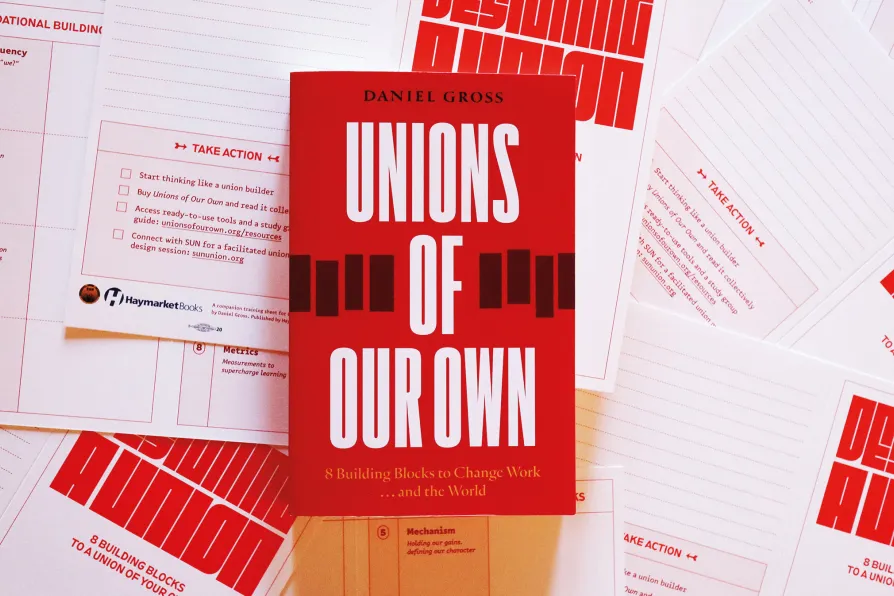
US-based labour and social movements authors and organisers Robert Ovetz and James Tracy interview DANIEL GROSS about his new book, Unions of Our Own: Eight Building Blocks to Change Work and the World

The pioneering activist understood that freedom could only be won through solidarity across communities. Her legacy offers vital lessons at a time when progressive politics risks losing that shared purpose
The Morning Star republishes PRAGNA PATEL’s speech at the annual commemoration of Claudia Jones on February 22 2026

KAY GREEN explains how the Middle East and colonialism were explored at at last weekend’s FiLiA conference