Nothing, says ANDY HEDGECOCK, can rescue this undistinguished amalgam of ponderous melodrama and shallow philosophical speculation



Catholic faith, community service and football
DAVID McKINSTRY welcomes the republication of a meticulous portrait of Brother Walfrid, the founder of Celtic FC
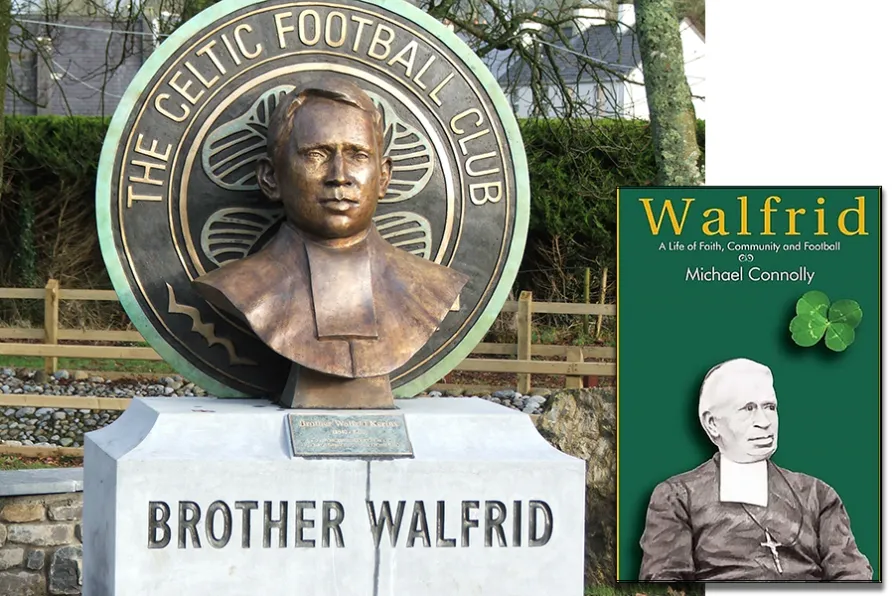
 Brother Walfrid Memorial Sculpture Ballymote Sligo Ireland [Pic: The.Q/CC]

JAMIE BRITTON invites readers to visit 3,500 locals as part of a marathon artistic pub crawl
JOHN GREEN welcomes a valuable and incisive analysis of a world become hyperpolitical but without the mass movement institutions to represent it
JAMES WALSH is moved by a provocative and original take on the relationship between ecology and architecture, and a plea to work with, not against, the materials and minerals of our world
An immersive, participatory display by a queer Australian Aboriginal performer, and a rebellious unravelling of traditional Scottish dance





Walfrid: A Life of Faith, Community and Football
Michael Connolly, Argyll Press, £20
ON November 6 next year, Celtic Football Club will mark the 140th anniversary of its founding. To commemorate the occasion, Argyll Press is publishing the second paperback edition of Michael Connolly’s Walfrid. Connolly’s book is essential reading for anyone seeking to understand the origins of Celtic and the extraordinary life of the Sligo-born Andrew Kerins: Brother Walfrid (1840-1915).
More than the founder of the club, Walfrid was a pioneering educator, charity organiser and community leader whose influence extended well beyond sport.
Kerins was born on May 18 1840 in Ballymote, Co Sligo. As a young child, he witnessed the devastation of An Gorta Mor, the Great Hunger, which had a catastrophic impact on western Ireland. In 1855 he emigrated to Glasgow, joining thousands of Irish people seeking a future beyond famine and poverty. The suffering he had witnessed, particularly among children, left a lasting impression that shaped his lifelong commitment to charitable work.
Like many younger sons of Irish farming families, Kerins entered religious life, joining the Marist Brothers. An exceptional scholar, he became Brother Walfrid and rose to become headmaster of Sacred Heart Secondary School in Bridgeton, Glasgow, serving from 1874 to 1892. During this period, he established the “Poor Children’s Dinner Tables,” a charitable initiative that would ultimately inspire the creation of Celtic.
Connolly shows that three defining themes shaped Walfrid’s life: Catholic faith, community service and football. One of the book’s greatest strengths is its exploration of Walfrid’s lesser-known achievements. Connolly demonstrates that Walfrid played a pioneering role in introducing organised school football to Glasgow, believing the game promoted physical wellbeing, discipline and moral development while strengthening Irish identity and community spirit among immigrant children.
Walfrid’s contribution to Catholic education and the founding of Celtic is at the heart of the book. At the club’s inaugural meeting in St Mary’s Hall, Calton, on November 6 1887, he was joined by five former pupils who became founding fathers of Celtic. Their education had enabled them to achieve financial security, allowing them to support Walfrid’s vision of creating a football club rooted in charity.
Connolly’s meticulous research highlights just how distinctive Celtic’s original purpose was. While football clubs across Britain donated around 1 per cent of their expenditure to charitable causes, Celtic devoted approximately 11 per cent of its spending during its first two years to supporting the poor of Glasgow, including non-Catholic organisations. Charity was not simply an ideal but the club’s central mission.
Celtic’s longest-serving manager, Willy Maley, later described Walfrid as the “binding force” behind the club during its formative years. His leadership ensured Celtic developed not only into a successful football club but also into an important social institution.
Connolly also traces how that founding vision gradually changed. Walfrid’s transfer to London by the Marist Brothers in 1892 coincided with the rise of professionalism in Scottish football. From 1893, donations to the Poor Children’s Dinner Tables disappeared from Celtic’s balance sheets, and a struggle emerged between those wishing to preserve Walfrid’s charitable ideals and those advocating commercial expansion. By 1897, Celtic had become a limited company, marking a decisive shift away from its original philanthropic purpose.
Although he left Glasgow, Walfrid never lost his affection for Celtic, receiving weekly telegrams reporting the club’s results. After decades of service with the Marist Brothers, he retired to Dumfries, where he died on April 17 1915. He was buried in St Joseph’s cemetery in Dumfries.
Connolly has produced a compelling portrait of a man whose significance reaches far beyond football. Walfrid helped expand Catholic education, strengthened Glasgow’s Irish community in the aftermath of the Great Famine, and founded a football club built upon charity and public service.
Scholarly yet highly accessible, Walfrid is an absorbing and often moving study. It reminds readers that Celtic’s history is about more than sporting success. At its heart lies Walfrid’s enduring vision of faith expressed through education, compassion, and service to the community — a legacy that remains as relevant today with its fanbase as it was at the club’s foundation.

Similar stories


In the second part of LAYTH YOUSIF’S history of the New York Cosmos, he reflects on their stunning reboot
TOM GALLAHUE argues that asking what role Irish diaspora educators can play in shaping Irish unity is to ask a deeper question about democracy itself

The independent TD’s campaign has put important issues like Irish reunification and military neutrality at the heart of the political conversation, argues SEAN MacBRADAIGH