
The US administration is endangering lives by reversing environmental protection laws, CHAUNCEY K ROBINSON argues

The West isn’t watching but Bishkek summit may offer a glimpse of revived diplomacy
The 25th anniversary meeting of the Shanghai Co-operation Organisation in the Kyrgyz capital may offer a glimmer of hope that international relations do not need to be defined by endless confrontation, writes KENNY COYLE
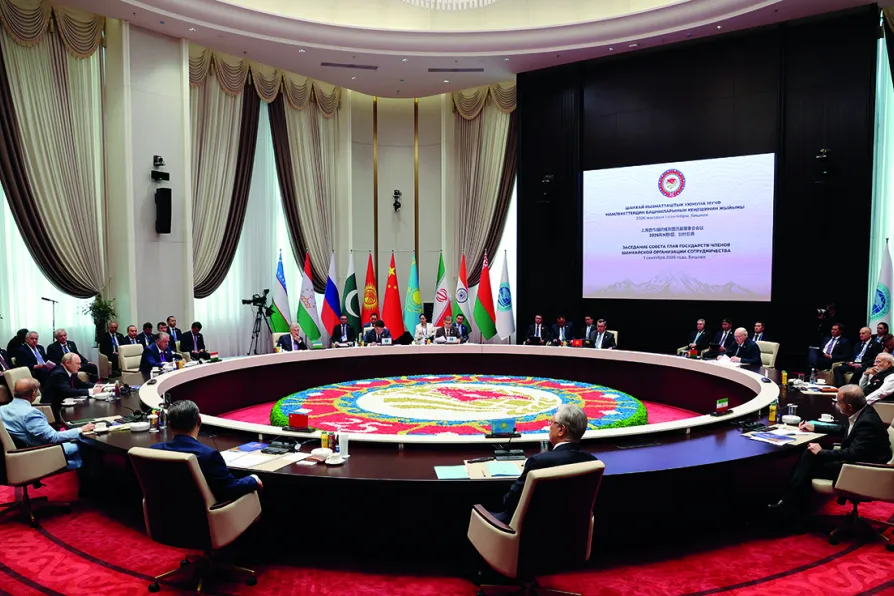
 A view of the Shanghai Cooperation Organization (SCO) summit in Bishkek, Kyrgyzstan, Tuesday, Sept. 1, 2026. (Vyacheslav Prokofyev, Sputnik, Kremlin Pool Photo via AP)

It’s time to stop retreating and go on the offensive to promote working-class interests, argues DOUG NICHOLLS
Marco Rubio wants to defeat socialism in Nicaragua, not restore ‘democracy,’ writes JOHN PERRY
Believe it or not, there was a time when the US government built beautiful homes for working‑class Americans to deal with a housing shortage, writes ERAN BEN-JOSEPH
DIANE ABBOTT provides an analysis of the reasons for EU and British voters’ dramatic swing to the right
Train drivers’ union Aslef general secretary DAVE CALFE speaks to Ben Chacko about his hopes that Burnham’s devolution agenda will include the importance of the railway





IF YOU wondered where world leaders were this past week, you certainly wouldn’t have found them in London, Brussels or Washington, not even Kiev. In fact, many of the most significant leaders were in Bishkek, capital of Kyrgyzstan, a former Soviet republic, from August 31 to September 1 at the summit of the Shanghai Co-operation Organisation (SCO).
The gathering, which marked the SCO’s 25th anniversary, brought together heads of state from powers such as China, India, Pakistan and Russia, as well as the UN secretary-general and the Turkish premier.
Despite disagreements on many critical issues, a joint statement, the “Bishkek Declaration,” was signed by Chinese President Xi Jinping, Russian President Vladimir Putin, Indian Prime Minister Narendra Modi, Pakistani Prime Minister Shehbaz Sharif, as well as other leaders of SCO member nations.
The SCO is one of a number of multilateral networks that have sprung up outside of the post-1945 Western-created international organisations. Its importance should neither be underestimated despite the West’s unwillingness to acknowledge its status, nor discounted due to its internal frictions. This, like many of the structures of the emerging multipolar world, is still partial and incomplete, but most importantly a work in progress.
Attendees included Kyrgyzstan, as chair and host, China, Russia, India, Pakistan, Iran, Belarus, as well as the Central Asian states of Kazakhstan, Tajikistan, and Uzbekistan. UN secretary-general Antonio Guterres and Turkish President Recep Tayyip Erdogan, also attended the event although neither the UN nor Turkey are members of the SCO and were not signatories to the final declaration.
The SCO was originally established as a non-Western based network for co-operation on non-contentious issues, such as cross-border terrorism and the international drugs trade, but also with an eye on a profoundly more ambitious project, namely the creation of international financial structures that would be independent of US-dominated trade and banking architecture.
Economic power
This central concern, over the past quarter century, has been to break the US stranglehold over international finance and trade. The Bishkek Declaration strongly promotes the transformation of existing structures. “Member states support reform of the international financial architecture aimed at increasing the representation and strengthening the role of developing countries in the governing bodies of international financial institutions, including the International Bank for Reconstruction and Development and the International Monetary Fund.”
Given the paucity of Western media coverage, it’s worth a reminder that the since the SCO began in 1996, its economic clout has grown massively. Its 10 member states now account for 43 per cent of the world’s population and nearly a quarter of the global economy.
Given Russia’s membership and the membership of several former Soviet states, it’s perhaps not surprising that the statement makes no mention of the Russia-Ukraine conflict. Although, in what is clearly a reference to the current rewriting of WWII because of the Ukraine war, the declaration says: “Member states will continue to preserve the memory of the outcome of World War II and oppose attempts to falsify history.”
It is, however, crystal clear on condemning the Israeli-US war against Iran, denying any role for a US-Israeli military solution. “Member states, reaffirming their support for the sovereignty and territorial integrity of the Islamic Republic of Iran, call for the conflict to be resolved exclusively through political and diplomatic means. In this regard, they welcome all efforts aimed at reducing tensions in the region.”
On Afghanistan, which is a neighbour to several SCO members, it was stated that: “Member states reiterate that only an inclusive government with broad representation from all ethnic and political groups can bring lasting peace,” and support “establishing Afghanistan as an independent, neutral and peaceful state free from terrorism, war and drugs.”
On nuclear weapons and disarmament, the declaration reaffirmed support for the Treaty on the Non-Proliferation of Nuclear Weapons by SCO “signatory members.” This is an important caveat, since neither India nor Pakistan are NPT signatories.
The statement also made clear members’ “inherent right to develop research, production and use of nuclear energy for peaceful purposes and to engage in equal, sustainable and mutually beneficial international co-operation in this area without discrimination.”
However, at the same time the SCO warned that “unilateral and unrestricted expansion of global missile defence systems by individual countries or groups undermines international security and stability. They consider it unacceptable for countries to pursue their own security at the expense of others.”
On the issue of whether the SCO should become a military alliance, the declaration states that SCO countries “adhere to an approach that excludes bloc-based and confrontational methods of addressing international and regional development issues.”
The SCO outlines its version of non-interference. “Member states emphasise the indivisibility, interdependence and interconnectedness of all human rights and recall the universal nature of obligations to respect rights and fundamental freedoms, oppose the use of ‘double standards,’ particularly on human rights, as well as interference in the internal affairs of sovereign states.”
The SCO further criticised illegal unilateral Western sanctions in general. It opposes “unilateral coercive measures that contradict the UN Charter and other norms of international law, as well as World Trade Organisation rules and principles, harm efforts to ensure international security, including its food, energy and humanitarian components, and negatively affect the global economy.”
While far from perfect, the Bishkek Declaration is an example of what used to be understood in the West as “diplomacy,” the focus on multilateral discussions and agreements, however limited, stands in stark contrast to what is currently on offer from Washington. More countries can now be expected to explore this alternative path.

Similar stories

Marking milestones in the histories of China and the United States, this week offers a chance to examine two very different visions of the international order, says CARLOS MARTINEZ
ZHANG HE highlights pressure coming from the global South for a more multilateral approach to global governance and a more equitable world order