TUC president and POA leader STEVE GILLAN speaks to Ben Chacko on the eve of Congress 2026


 Latest editorial
Ukraine’s fascist past cannot be buried so easily
Faced with crises in every direction, Volodymr Zelensky is rewriting his country’s complex history by paying homage to the founding fathers of Ukrainian ultra-nationalism and courting their modern heirs, writes KENNY COYLE
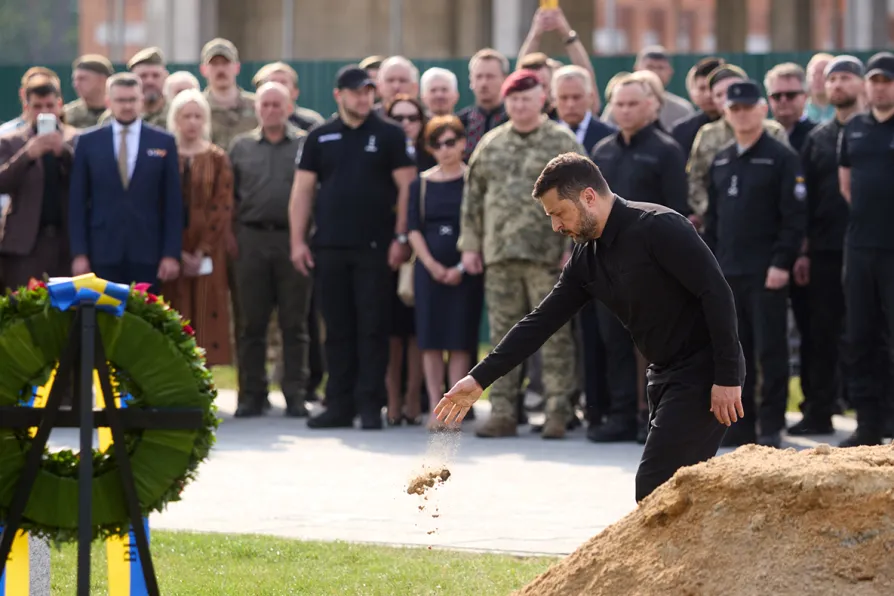 Volodymyr Zelensky throws earth on the grave of Yevhen Konovalets, Kyiv August 18, 2026. Credit: The Presidential Office of Ukraine.

DOUG NICHOLLS welcomes a turning point at this year’s Congress, where many motions call for a co-ordinated plan to revive British industry, a perspective outlined in his new book
HOPE VIRGO of campaign Dump the Scales warns MPs voting today they should be alert to the threat legalised assisted death poses to people with eating disorders
The Together Alliance is hosting two summits, North and South, to build power and plan action against the scourge of racism peddled by the right. DANIEL KEBEDE urges mass participation
The drift toward militarisation in Europe is not inevitable, left-wing and peace movements can preserve sovereignty and prevent war, says DÁIRE HUGHES MP
Whatever differences exist among international sympathisers of the Bolivarian revolution about its current trajectory, they should unite against the imperialist power that is the source of an enforced retreat, argues ROGER D HARRIS
Trade unions need to step up and force a turn in the policies of the labour movement to effectively confront the far-right threat, argues NICK WRIGHT





ON AUGUST 18, the remains of Yevhen Konovalets, founding father of the far-right Organisation of Ukrainian Nationalists (OUN), were temporarily interred at Kiev’s National Military Memorial Cemetery after their return from the Netherlands. The longer-term plan is to move Konovalets’s body to a Ukrainian National Pantheon.
The reburial was attended by current Ukrainian leader Volodomyr Zelensky and Yevhenii Khmara, who was appointed Defence Minister the following day, among other military and political members of Zelensky’s ever decreasing inner circles.
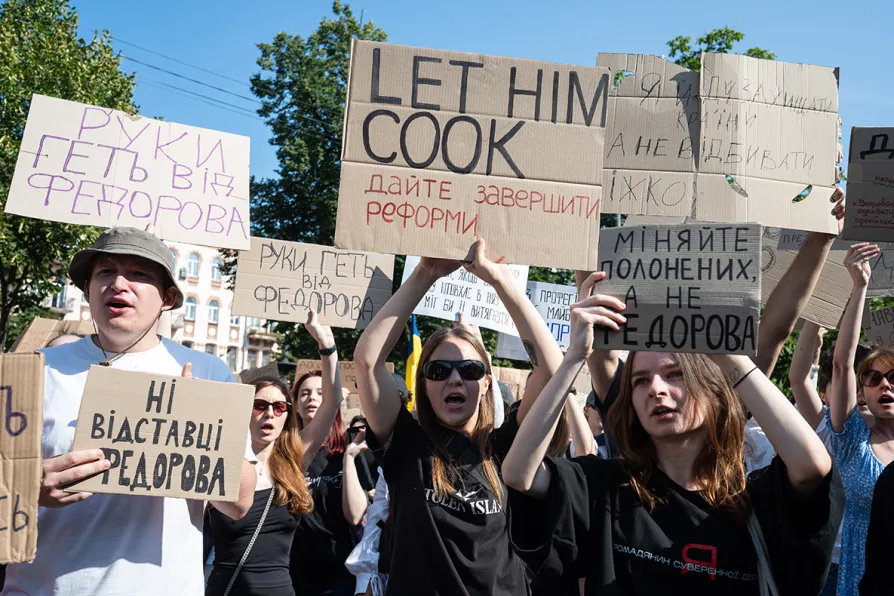
On August 16, there had been demonstrations in Kiev calling for the reinstatement of ousted Defence Minister Mykhailo Fedorov which pointed accusing fingers at Zelensky. The protesters’ appeal stated: “We want to put it on record: responsibility for the consequences of all these disgraceful decisions lies solely with you, Volodymyr Zelensky, as president of Ukraine. Given the duration, scale, and, in particular, the risks involved in holding protests during a full-scale war, we as a society believe that we have done everything we could to make ourselves heard.”
According to English-language media in Kiev protest slogans included “Corruption kills” and “Listening to the people – that’s powerful.” The president’s cronies were also subject to abuse with Rustem Umerov, the Muslim former defence minister, denounced as a “devil.”
However, Fedorov’s subsequent call for elections – suspended due to the war with Russia – has not been met with the same enthusiasm.
On August 19, Zelensky’s deputy chief of staff Iryna Mudra was arrested on charges of corruption involving Sense Bank. The Kyiv Post reported enticingly that: “Unidentified individuals from the President’s Office also tasked Mudra with bringing Sense Bank under the control of the President’s Office in order to prevent other government bodies from gaining control over it, according to the warrants.”
So far, Zelensky himself has not been charged. If Western corporate media is anything to go by, it is simply rotten luck and poor judgement that quite innocently led Zelensky to surround himself with a handpicked entourage of corrupt officials and oligarchic sponsors, several of whom have already fled the country.
An earlier story entirely ignored by Western media was Kiev’s sentencing on August 10 of anti-war socialist Bogdan Syrotiuk to a 15-year prison sentence, on trumped-up charges of working for Russia.
Right alignment
As the Morning Star has reported previously, despite his own Jewish origins, his family’s own suffering during the Nazi invasion as well as their participation in the victory of the Soviet Red Army, Zelensky has increasingly aligned himself with influential far-right forces embedded in the military. He has honoured them, allowed units to rename themselves after antisemitic and collaborationist predecessors, for example. Most importantly, he has put aside earlier equivocations and now publicly draws a direct line of succession from the fascist-leaning ultra-nationalist OUN to today’s Ukraine. Not even Giorgia Meloni, the one-time student fascist activist turned Italian prime minister, has been so brazen in revising 20th-century history to fit the agenda of today.
At the reburial, Zelensky said: “Today, all of us are participants in an event of national significance. An event in which Ukraine is once again restoring the highest form of historical justice – justice for itself. We are bringing home an outstanding son of the Ukrainian people – an exemplary warrior and a prominent Ukrainian statesman, Colonel Yevhen Konovalets.
“Colonel Konovalets has returned to the very Ukraine he fought for and wanted to see. A strong, sovereign, independent Ukraine. A Ukraine that honours and develops its army – one of the strongest not only in Europe, but also in the world. An army whose shoulder patches bear our coat of arms, our Trident. A Ukraine that has become the creator of its own history.”
Who was Konovalets?
Yevhen Konovalets was born in 1891 in the Galicia region of the Austro-Hungarian empire, now part of the Lviv oblast in western Ukraine. At the time, those who would today be identified as Ukrainians (there were other competing ethnic identities) were split between the tsarist empire (home to approximately 80 per cent of the Ukrainian population) with the remaining fifth in Austria-Hungary.
During World War I, Konovalets served as an officer in the Austro-Hungarian army but was taken prisoner by tsarist Russian forces in 1915. He escaped during the chaos after the Russian February Revolution in 1917 and headed to Kiev to work with the separatist Central Rada and short-lived Ukrainian People’s Republic (UPR), becoming a colonel in its armed forces.
Meanwhile, in what is now north-eastern Ukraine, pro-Bolshevik forces established the beginnings of Soviet power centred on the industrial city of Kharkiv. In January 1918, pro-Bolshevik workers in Kiev rose against the Rada in support of the advancing Red Army. Konovalets led anti-Soviet forces in crushing the Kiev Arsenal citadel, with the loss of several hundred workers’ lives, before retreating as Red Army units advanced.
In August 1920, recognising the collapse of the UPR project, Konovalets, by then in Prague, founded the Ukrainian Military Organisation (UVO) to carry out assassinations, sabotage and other attacks on both the Polish and Soviet states. Settling in Berlin in 1924, he established long-standing links between the UVO and German military intelligence, the Abwehr. Weimar Germany had no designs on Ukrainian territory but its elites were happy to support anti-Soviet and anti-Polish activities by funding, training and arming UVO militias.
By the end of the decade, recognising the need for a political arm of the UVO, Konovalets become the founding leader of the OUN at its birth in early 1929 in Vienna. In the course of unification, the League of Ukrainian Fascists (SUF) also joined the OUN.
The OUN continued to receive support from Berlin after the Nazi takeover, supplying intelligence to the Third Reich. It used the OUN as a proxy force primarily against Poland and the Soviet Union, while despising the Slavic origins of the Ukrainian people. Relations between the OUN and the Nazis were always dependent on the vagaries of Hitler’s foreign policy at any given moment. These reached a nadir when the OUN assassinated the Polish prime minister in Warsaw in 1934 just after the Poles had signed a non-aggression pact with Hitler. In addition to its Nazi sponsor, the OUN often hired out its services to other states, such as Lithuania and fascist Italy; the latter had been an early ideological influence on the Ukrainian far-right.
Germany also provided funds and premises for the OUN’s propaganda work. A Ukrainian Press Service was established in Berlin in 1931 and remained in operation until the outbreak of war, where it transferred to Mussolini’s Italy. Working through the Nazi-sponsored Ukrainian National Alliance, OUN supporters edited the Ukrainian Herald newspaper in Berlin during the late 1930s through to the last stages of the war.
While Konovalets was by no means the most extreme racist in the OUN leadership, he bitterly opposed Ukrainian “race-mixing.” In an infamous letter to a subordinate in 1934, he wrote: “If nationalism is waging war against mixed marriages insofar as conquerors (especially Poles and Russians) are concerned, then it cannot bypass the problem of mixed marriages with Jews, who are indisputably if not greater, then at least comparable, foes of our rebirth.”
Konovalets was assassinated in the Netherlands by an explosive device on May 23, 1938, more than a year before World War II began. The bomb, hidden in a box of chocolates, was a gift from a Soviet secret intelligence agent.
The death of Konovalets provoked a split within the OUN, which quickly broke into two wings, one led by Stepan Bandera known as the OUN (B) and Andrei Melnyk’s OUN (M). Melnyk was also reburied in the same military cemetery as Konovalets in May 2026, Yet again Zelensky delivered the main eulogy.
Zelensky appears desperate to save his own neck as Ukraine’s crises worsens on both military and home fronts. However, not even kneeling in reverence before the figureheads of Ukrainian antisemitism and fascism is likely to save him.

Similar stories
Andy Burnham offers unconditional support for Zelensky but no solutions to the underlying conflict between the Nato/EU bloc and Russia, says NICK WRIGHT
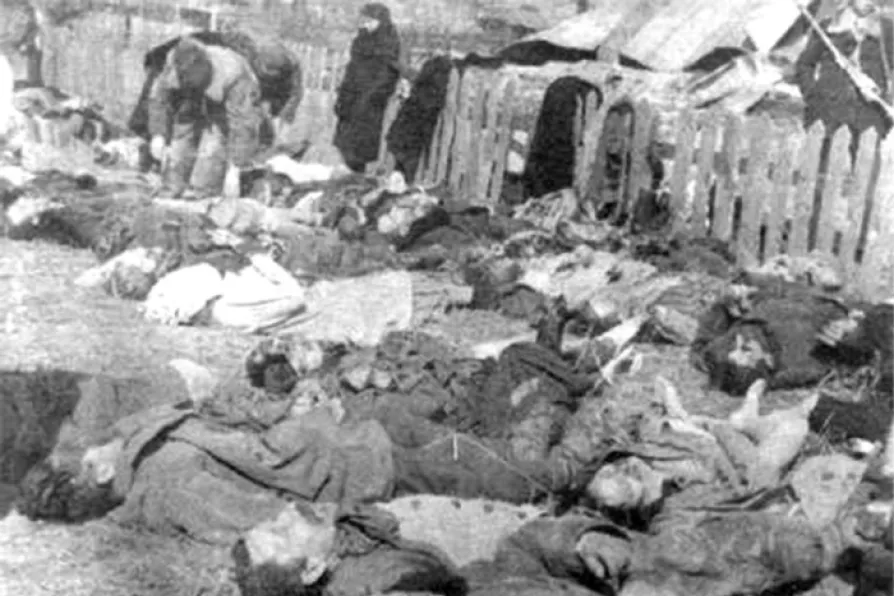
Poland’s anger over Ukraine’s celebration of the Nazi collaborationist UPA reflects more than historical grievance, says KENNY COYLE