CLAUDIA WEBBE speaks out against the lethal mechanics of Britain’s culture-war press


 Latest editorial

Twisting the truth for Starmer
Paul Holden’s book, The Fraud, exposes a hidden war inside Labour, where claims of anti-semitism, amplified by media power and factional networks, were used to break Corbynism and recast the party. JOHN ELLISON revisits the scandals, investigations and suppressed evidence from that era
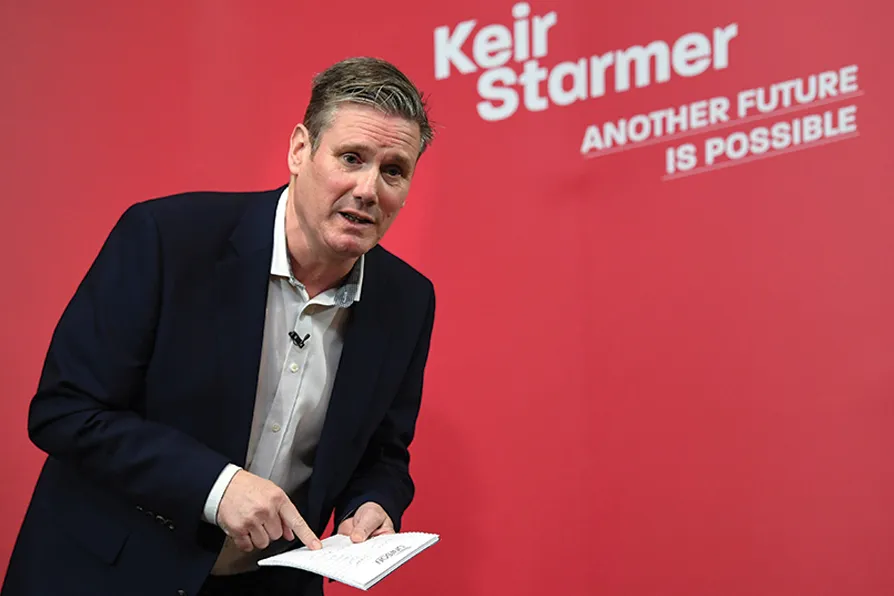 THE GREAT PRETENDER: Labour leadership contender Keir Starmer speaks on post-Brexit challenges at Westminster Cathedral Hall in London in Janruary 2020
Powerful agribusiness interests are trying to overturn efforts by the Lula government to protect the environment and indigenous peoples of the Amazon region, writes GABRIELA SA PESSOA
Trade unions and community groups are mobilising to push back against Trump’s racist raids after new revelations of spying on legal protesters. MARK GRUENBERG reports from the US state of Minnesota
The best wildfire service may begin with the community, argues KOMAL RAJ ARYAL
The evolution of the Scottish nationalist leadership into cheerleaders for Nato has led the party to betray its pledges on Palestine and social spending, writes COLL McCAIL
While riding the No 3 bus in Glasgow MATT KERR has ample time to dissect the moribund Scottish Labour decline into near oblivion and watch intriguing bus passenger dynamics





IN A PREVIOUS article, beating the drum for Paul Holden’s 2025 published The Fraud, I attempted to precis some of its elements.
I focused on the “Finish With Corbynism” roles of some Labour MPs, and especially on the Labour Together network (nicely fuelled by large donations kept unlawfully secret from the public), and its secret (as long as necessary) helpers, ie the Centre for Countering Digital Hate (CCDH) and Stop Funding Fake News (SFFN).
I now precis more from Holden’s book.
An early truth-twisting success by SFFN in late March 2019 was the withdrawal by the Macmillan cancer charity from involvement with the left-wing news-disseminating website The Canary in the light of an article which had asserted that a presentation in the US by a former Labour MP “smeared” Corbyn with claims of anti-semitism including the allegation that he was “friends” with Hamas and Hezbollah.
On this fragile basis, the cancer charity, which was said in summer 2016 to have attracted more than five million views monthly, was accused of “funding fake news” by supporting The Canary.
Although the outcome of the blitz against The Canary was its forced down-sizing, in 2021 a regulator investigation exonerated it from anti-semitism.
Fake news was also evidenced by Shabana Mahmood’s Labour List article of February 12, 2020 – during Starmer’s leadership election campaign – when she stated that “Labour Together is not supporting any particular leadership campaign.” Yet a few weeks later, in April, Labour Together (which I have renamed more realistically as “Together Against Corbynism”) was to claim credit for Starmer’s victory.
While secrecy about the anti-Corbynist purpose and ballooning purse of Labour Together, and its two ostensibly society-protective offspring, was maintained during 2019, media publicity, during the same year was relied on to prove the existence of an umbilical connection between the Corbyn project and anti-semitism.
Big, big publicity followed a Panorama programme film broadcast on July 10: “Is Labour Anti-Semitic?” — featuring a variety of Labour Party insiders, it told a story which was to be badly dented later.
The text of an interview with one contributor, Izzy Lenga, had read: “When I was a student … being quite a high-profile Jewish woman student, I was subjected to quite a lot of, like, nasty vitriol and abuse … Predictably, a lot of it came from the far right … neonazi abuse … telling me Hitler was right, telling me Hitler did not go far enough and even more.”
This Panorama interview, however, was edited so that it appeared that this appalling neonazi abuse had occurred since Izzy had joined the Labour Party, which hadn’t been suggested.
Holden points out “that her ‘Hitler-was-right’ experiences happened when she was a student, were unrelated to the Labour Party, and had nothing to do with Corbyn.”
Another distortion stemmed from an email from strategy and communications director Seumas Milne, referring to a particular complaint against a Jewish party member, stating: “If we’re more than very occasionally using disciplinary action against Jewish members for anti-semitism, something’s going wrong, and we’re muddling up political disputes with racism.”
Milne had gone on to conclude that “we need to review where and how we’re drawing the line if we’re going to have clear and defensible processes.”
The programme inferred, however, citing only a small part of this email, that this demonstrated that the leadership office had interfered in complaints. It didn’t.
The Panorama programme asserted “that Corbyn’s leadership team had problematically intervened in antisemitism-related complaints,” although the reality was that between February and April 2018, anti-Corbyn elements had been pressing for leadership input into such complaints, in line with the position taken by deputy leader Tom Watson as late as February 2019, when he submitted a dossier of complaints and called on Jeremy Corbyn to “take a personal lead in reviewing those cases.”
These developments tie in with the investigation carried out by the Equality and Human Rights Commission (EHRC), then chaired by a Conservative government appointee. In March 2019 it announced a preliminary investigation into the Labour Party pursuant to claims of anti-semitism. Then by the end of May it lifted the investigation into a statutory inquiry
Two days after the Panorama “revelations,” the commission wrote to the party’s executive director of legal affairs, stating: “The programme raised very serious issues about the approach taken to anti-semitism complaints – we will consider this evidence.”
The commission’s report was not published until October 29 2020.
But its investigation had come head to head with the party’s own internal investigation, which had resulted in a report of 800-plus pages completed in, Holden suggests, early March 2020 — and leaked to the public by April 12.
The leaked report, in Holden’s words, threw up “astonishing evidence of what it called ‘hyper-factionalism’ of party staff under (previous) general secretary Iain McNicol” (in office for almost seven years until March 20 2018).
Two core arguments were identified. The first, in the context of the huge rise in party membership, was that the party had become “host to a small number of members holding views which were unarguably hostile to Jewish people and in some cases frankly neonazi in their nature.”
The second was that the party’s bureaucracy had become, under McNicol, “profoundly dysfunctional,” with staff — well represented in the Panorama “exposure” — failing to investigate anti-semitism complaints between 2016 and April 2018, as well as having responsibility for nasty racist comments about first black woman Labour MP Diane Abbott.
Holden explains that the concerns identified were “comprehensively footnoted with evidence,” each supporting document being easily accessed.
But the “leaked report,” again quoting Holden, found that “a more rigorous and effective process for handling complaints” had increased substantially when Jennie Formby had become general secretary in April 2018.
Just as the Starmerites felt at risk from the open-eyed website The Canary, the leaked but official Labour Party report was, says Holden, “a potentially mortal threat” to them.
Corroborating this, on April 20 2020, a party letter to major media outlets warned of a risk of legal action for publishing the report or parts of it, a step not to be supported by a later backtracking admission to the Information Commissioner that publication was in the public interest.
The leaked report’s authors in any event survived the threat of legal proceedings, and the party’s response (now Starmer-led) to the evidence-led exposures of bullying, sexism and racism within the bureaucracy, was of the mildest and kindest character, in a context in which 20 individuals had brought libel and privacy proceedings not settled until 2025.
Holden digs deeply into the EHRC report, drawing attention to the commission’s dubious decision not “to require the Labour Party to provide the evidence underlying” the leaked report, despites its obvious relevance to the investigation and the easy access to the evidence cited.
The EHRC report, Holden summarises, found that the party “had committed ‘indirect discrimination’ through its ‘policy’ of political interference by LOTO (the Leader Of The Opposition’s office) in complaints and by neglecting to adequately train staff responsible for the complaints handling.”
The Starmer party was happy enough about this, but was far less happy with the independent inquiry into the leaked party report it commissioned in May 2020. This was carried out by black leading counsel Martin Forde, and three more panel members. But Forde’s report was not out until July 2022, and was then largely waved away by the Starmer party and the media.
Yet it made “findings on the general accuracy of the leaked report’s allegations.” It found credible in particular “allegations of racism and sexism” exposed by “the WhatsApp group chats,” and, crucially, found “that the issue of anti-semitism had become unhelpfully caught up in the war between the party’s factions.”
If that suggested that some on the party’s left were assuming too readily that no allegations fed through by the right could be well-founded, Forde also made explicit that there had been a refusal to engage with Jewish Voice for Labour alongside the Jewish Labour Movement. He concluded that measures to address anti-semitism should be matched by those “against all forms of discrimination.”
The Fraud can be explored for more, much more.
