

 Latest editorial
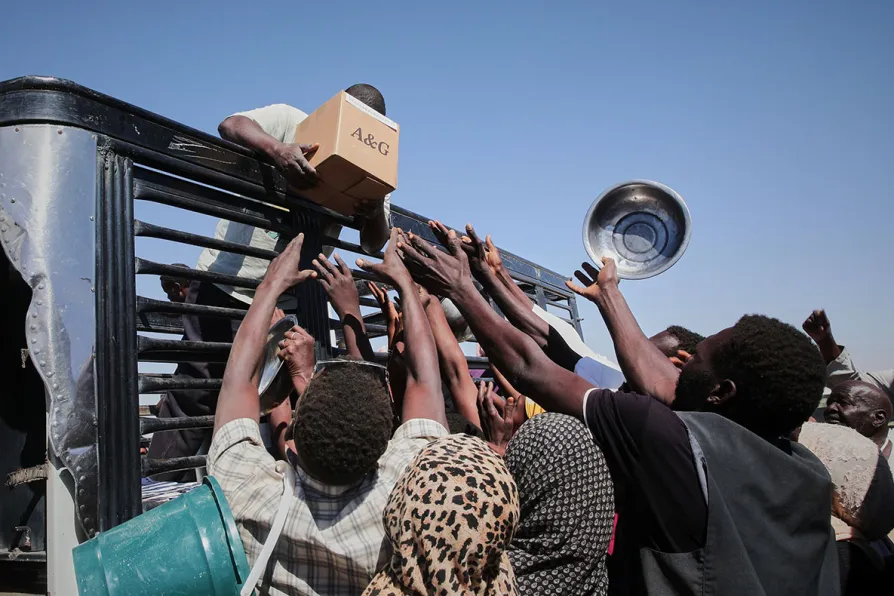 Sudanese families displaced from El-Fasher reach out as aid workers distribute food supplies at the newly established El-Afadh camp in Al Dabbah, Sudan's Northern State, November 16, 2025






THREE aid workers were killed by a paramilitary drone attack on Thursday in Sudan’s Kordofan.
The attack by the United Arab Emirates-backed Rapid Support Forces (RSF) paramilitary and its ally, the Sudan People’s Liberation Movement–North, also wounded four others during its attack on an aid convoy in Sudan’s South Kordofan state, according to the Sudan Doctors Network (SDN).
The UAE denies being involved in the conflict as do Egypt and Saudi Arabia, who are accused of backing the Sudanese military in the conflict that has raged since April 2023.
The convoy of trucks carrying food and humanitarian supplies was hit as it travelled through the Kartala area on the way to the cities of Kadugli and Dilling on Thursday.
The SDN took to social media to say: “The network strongly condemns the deliberate targeting of humanitarian convoys.”
They also said the move was “a blatant violation of international humanitarian law and of all norms prohibiting attacks on humanitarian workers.”
The medic said the attack was the “second such incident in less than a month, following the shelling of a United Nations aid convoy in the town of AL-Rahad.”
“This dangerous escalation threatens the safety of humanitarian operations and further exacerbates civilian suffering.”
The SDN said it was again calling on the “international community, the UN and human rights organisations to exert urgent and effective pressure on the leadership of the RSF to ensure the protection of aid convoys and their workers, to open safe and sustainable humanitarian corridors and to hold those responsible for targeting aid accountable.”
Dilling is around halfway between Kadugli, the state’s besieged capital, and el-Obeid, the capital of neighbouring North Kordofan province.
The proxy war being fought by the Sudanese military and the RSF has killed more than 40,000 people, according to UN figures, but aid groups say that is an undercount and the true number could be many times higher.
Both sides have been accused of war crimes, including sexual violence.
The war has left around 30.4 million people – over two-thirds of the total population – in need of assistance, from health to food and other forms of humanitarian support.
The fighting has led to an economic collapse, sending the prices of food, fuel and other basic goods soaring.
Over half the population faces high levels of acute food insecurity, and famine conditions have been confirmed in five locations in North Darfur and the eastern Nuba mountains.
Famine is expected to spread to more areas during the year.
