Latest editorial

 Prime Minister Keir Starmer takes part in a joint press conference with Prime Minister of Japan Sanae Takaichi after their bilateral meeting at the Prime Minister's Office in Tokyo during his visit to Japan, January 31, 2026






PRIME MINISTER Sir Keir Starmer’s push to transform Britain’s welfare state into a “warfare state” explains Labour’s plummet in the polls, a union leader has claimed.
Former RMT general secretary Alex Gordon blamed the British government’s “unending, insatiable, greed” for military spending as the reason the ruling party is so unpopular.
“The British government has committed us without any public discretion, without any parliamentary debate, to a new 5 per cent Nato pledge,” Mr Gordon said.
“Starmer, Merz and Macron have now achieved the lowest historical poll of any ruling party leaders in their respective countries.
“This indicates the failure of the ruling class in Europe to win popular support for the creation of warfare states.
“Keir Starmer’s attempts to cut welfare have already [been] met with a powerful pushback, from disabled campaign groups, from anti-austerity campaigns and the anti-war movement.”
He called attention to the lurch towards wide-scale rearmament and subsequent cuts to “healthcare, education, housing, civil construction projects in order to pay for military spending.”
The newly elected general secretary of the Communist Party accused leaders in the West of increasing military spending pledges as a means to “boost the share prices of the arms and technology firms in the US and European stock markets.”
Speaking at an event on Saturday entitled Challenging the War Machine, organised by the investigative news website Declassified UK, Mr Gordon said unions would be key in the rebuilding a strong British anti-war movement.
There have been “very sharp arguments and disagreements” in the trade union movement over the past five years, he said.
Mr Gordon pointed to a new rule from Unite, which organises many workers in arms factories, that would support staff who refuse to work with weapons of war.
While this has not yet borne “any fruit,” he said mobilising arms workers should be the next step for the anti-war movement.
“This is the next step, we’ve got to move from policy to action.”
He also called a “renewal” of movements seen in Britain in the 1980s in and outside of the workplace.
“US cruise missiles were stationed in this country and young people responded in their hundreds of thousands,” Mr Gordon said.
Other speakers included musician and campaigner Lowkey, CND general secretary Sophie Bolt, and author Peter Oborne, who said there wasn’t “any hope for legacy media” after it ran “atrocity denials” and “propaganda” for Israel’s genocide in Gaza.


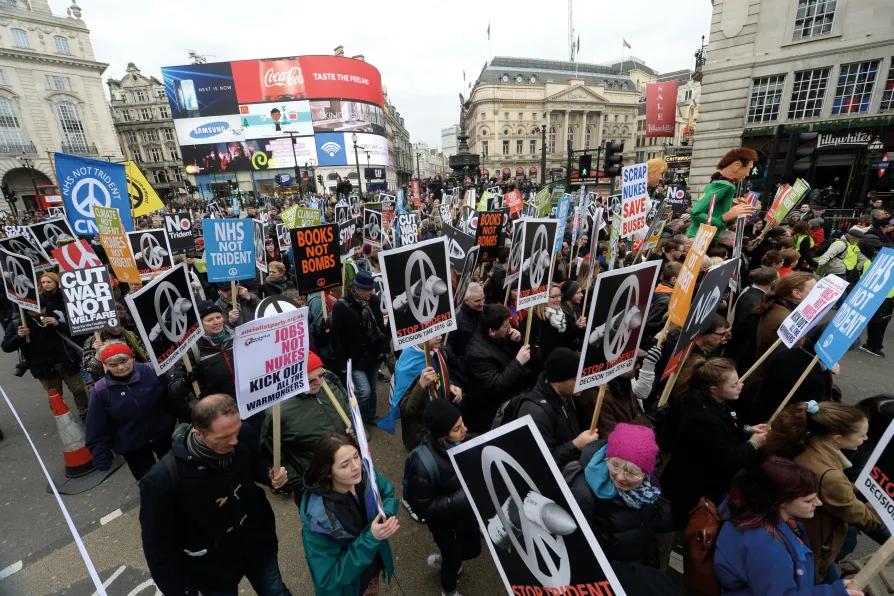
While working people face austerity, arms companies enjoy massive government contracts, writes ARTHUR WEST, exposing how politicians exaggerate the Russian threat to justify spending on a sector that has the lowest employment multiplier