TUC president and POA leader STEVE GILLAN speaks to Ben Chacko on the eve of Congress 2026


 Latest editorial
The storage of our struggles, strategies and lessons for today
National co-ordinator for General Strike 100, HENRY FOWLER, continues his nationwide tour of partner organisations by visiting the Modern Records Centre at Warwick University
 (c) Henry Fowler, GFTU

DOUG NICHOLLS welcomes a turning point at this year’s Congress, where many motions call for a co-ordinated plan to revive British industry, a perspective outlined in his new book
HOPE VIRGO of campaign Dump the Scales warns MPs voting today they should be alert to the threat legalised assisted death poses to people with eating disorders
The Together Alliance is hosting two summits, North and South, to build power and plan action against the scourge of racism peddled by the right. DANIEL KEBEDE urges mass participation
The drift toward militarisation in Europe is not inevitable, left-wing and peace movements can preserve sovereignty and prevent war, says DÁIRE HUGHES MP
Whatever differences exist among international sympathisers of the Bolivarian revolution about its current trajectory, they should unite against the imperialist power that is the source of an enforced retreat, argues ROGER D HARRIS
Trade unions need to step up and force a turn in the policies of the labour movement to effectively confront the far-right threat, argues NICK WRIGHT





IN 2011, I joined a packed audience at Warwick Arts Centre, eagerly awaiting a special event with the late Rodney Bickerstaffe and Tony Benn to mark the reopening of the Modern Records Centre (MRC) at the University of Warwick.
Before the event began, I was fortunate enough to spend some time with Rodney and Tony. We discussed the deepening austerity agenda of the then “Con-Dem” government, the urgent need for a co-ordinated response led by the workers’ movement, and whether Britain might once again witness a “Winter of Discontent” on the scale of 1979.
Fast forward more than a decade, and the MRC stands as a beacon for activists, researchers and anyone interested in the history of the workers’ movement and what it can teach us about our strategies today.
It is a repository of our struggles, victories and setbacks, accessible to all. Like many archives, libraries and museums across the country, the MRC has taken the centenary of the 1926 General Strike seriously. Its exhibition, now finished, has played an active role in supporting commemorative events nationwide, including Unite’s excellent event in Barnsley earlier this May.
Liz Wood, who has worked at the MRC for nearly 20 years, guides us through the exhibition displays in both the centre and the university library. As we move between cabinets filled with photographs of mass meetings, strike demonstrations and front pages of the Daily Mirror, what emerges is a battle of narratives: competing interpretations of the strike itself. Not only between the strikers and the government, but also between the leadership of the trade union movement and its rank-and-file members.
What distinguishes the MRC for me, particularly as I continue my road trip visiting General Strike 100 partners, is its remarkable collection of rank-and-file bulletins, newspapers and zines. These rare, often highly localised histories from below provided workers with information, humour and political analysis during the strike itself. They remain vivid and engaging nearly a century later.
One such publication is The Rufford Star, the organ of the communist group. Issue number four features a striking cartoon depicting the military, police and volunteers gathered beneath the banner of the Organisation for the Maintenance of Supplies, the government-backed body established to keep goods moving during the strike.
Opposite them stands a lone figure labelled “Labour,” carrying a huge sack marked “Profits — Supplies for the Bosses.” The strong class consciousness that shaped workers’ understanding of the dispute is evident throughout the collection.
Nearby sits another bulletin, this time from the Westminster Council of Action: The Westminster Worker. Printed on May 14 1926, after the TUC had officially called off the strike, it carried the headline: “Workers! Throw Their Offer Back In Their Faces.” It is a powerful reminder that, even after the strike was officially ended, many workers remained determined to continue the struggle and secure victory. That spirit would soon find expression in the support given to the miners during the lockout that followed those dramatic nine days in May.
Before heading down into the archives themselves, we are introduced to Jamie, a digitisation assistant. His role involves the vital work of preserving and making accessible the MRC’s collections through digitisation.
He demonstrates both the sophisticated technology and the expertise required to operate it, scanning before our eyes a copy of the government’s famous British Gazette. For those unable to visit the exhibition, the work of Jamie and his colleagues means that a substantial amount of material from the MRC’s collections is now available online.
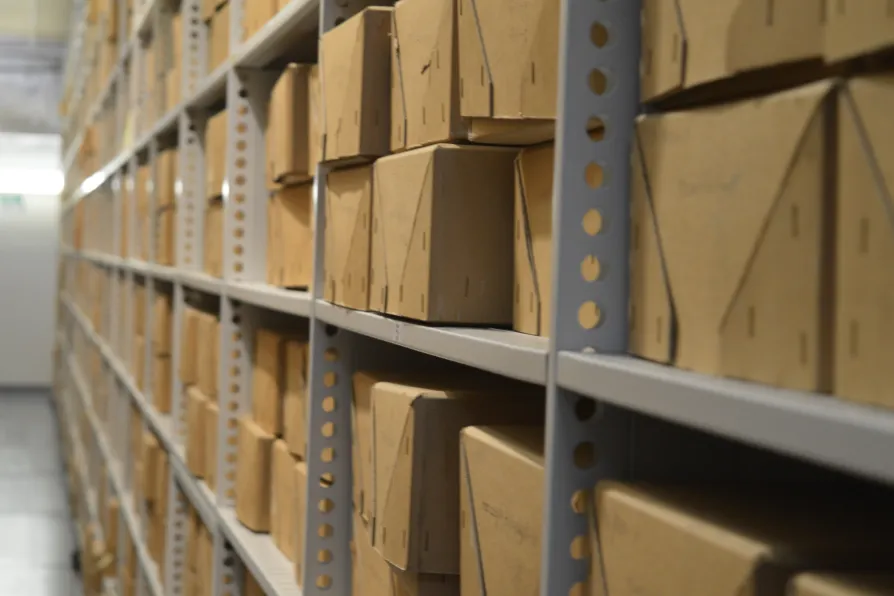
Liz then takes us downstairs into the archive itself. Shelf after shelf stretches into the distance: an extraordinary storehouse of our history, struggles and collective memory.
Walking through the aisles, we reflect on the sheer scale of the collection. Liz notes that even over the course of her career she will only ever examine a fraction of the material held here.
Nevertheless, she tells us with some pride that she has worked through the entirety of the National Union of Mineworkers (NUM) collection, one of the many significant holdings housed alongside extensive records from the TUC itself.
Back in the exhibition space, we meet Rachel, the MRC’s digital preservation officer. Rachel leads on the accessioning, appraisal, cataloguing and long-term preservation of the centre’s growing digital collections. She shows us one of her favourite items: a certificate issued by the London General Omnibus Company to one of the volunteers who drove buses during the strike.
What fascinates Rachel about the certificate is precisely how distant its celebration of strike-breaking volunteers is from her own understanding of the events of 1926. Just millimetres away in the same display cabinet sits a workers’ bulletin featuring the silhouette of a man pointing directly at the reader above the question: “Are You a Scab?”
These strikingly contradictory artefacts, representing opposing sides of the dispute, capture what makes the collection so compelling. They remind us that history is never simply a record of events, but a continuing struggle over how those events are understood and remembered.
We leave grateful to the entire team at the Modern Records Centre for their generosity and hospitality. In preserving and sharing these collections, they provide the labour movement with something invaluable: access to its own history. At a time when the lessons of the past are once again being debated, the MRC stands as an essential resource for understanding not only where we have come from, but where we might go next.
To explore the wider centenary programme and plan your own visit, head to GeneralStrike100.com.
