


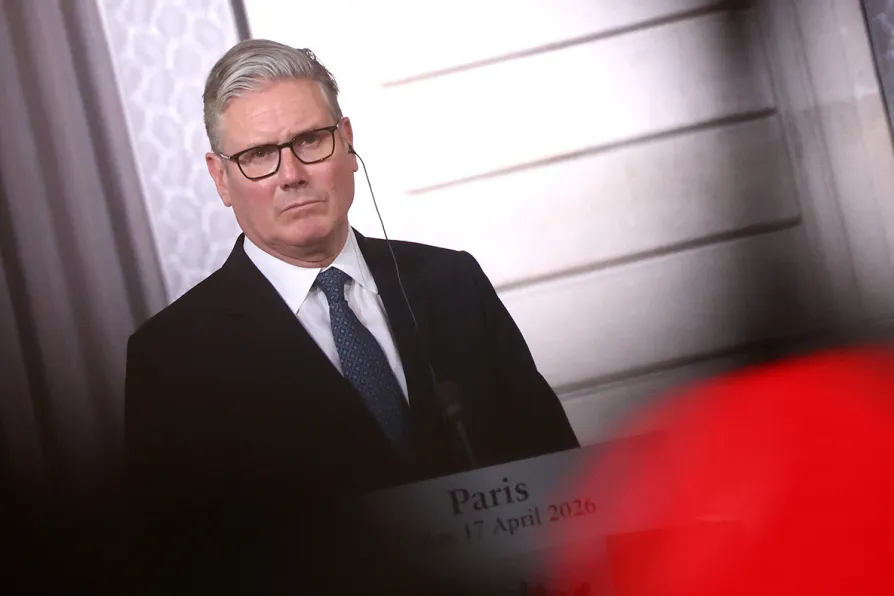
 Prime Minister Sir Keir Starmer at a press conference after a multinational coalition summit to facilitate shipping in the Strait of Hormuz once the US-Iran war ends, at the Elysee Presidential Palace in Paris, France, April 17, 2026





JUST as we had seen off Storm Dave, along comes Storm Keith — a bit more petulant and blustery, but capable of doing real damage to his own side.
The Epstein scandal with its trail of royal, corporate and state security intrigue and corruption, has now, courtesy of Lord Peter Mandelson, reached the highest elected office in the land — the primus inter pares — the Prime Minister of Great Britain and Northern Ireland.
For Sir Keir Starmer, April may prove to be the cruellest month, coming as it does seven days before elections for the Welsh Senedd, Scottish Parliament and English local authorities in which Labour is expected to suffer severe losses.
Although some predictions of a wipeout of Labour’s council control in England may be a result of expectation management — predicting the worst in an effort to make the eventual outcome seem not so bad — Starmer’s own leadership is a busted flush.
In early February this year, when Metropolitan Police launched an investigation into Peter Mandelson’s alleged misconduct in public office following the release of the first batch of Epstein files by the US Department of Justice, Starmer joined in the heaping of opprobrium on the head of the former ambassador, saying Mandelson had “let his country down.”
Starmer added: “For the public to see politicians saying they can’t recall receiving significant sums of money or not was just gobsmacking, causing them to lose faith in all politicians and weaken trust still further.”
Starmer may now regret making the question of public trust in politicians the litmus test of his support for Mandelson. As of March 30 2026, public trust in Starmer stood at minus 33 per cent. No doubt it has deteriorated since then.
Having lost his director of communications (the fourth since the 2024 general election), his chief of staff, Morgan McSweeney (who fortuitously had his government-issued mobile phone stolen a week after Mandelson was sacked as ambassador and a week before Parliament demanded release of government communications over his appointment) and now the senior Foreign Office mandarin who, if you can believe it, took it upon himself to override MI6’s security vetting procedures, Starmer is running out of people to blame.
What is remarkable amid this kaleidoscope of mediocrity is the small number of resignations from the Cabinet during this period of heightened political scandal.
Angela Rayner got out early in September 2025, just days before the Mandelson scandal first broke. She must now thank her lucky stars that the timing of the factional attack on her tax affairs has removed her from the despatch box, or from the need to defend the indefensible Starmer.
Only one minister so far has been embroiled in the escalating scandal to the extent that they have resigned. Cabinet Office minister Josh Simons, Morgan McSweeney’s former bag carrier at Labour Together, decided that the evidence that he used political donations to spy on journalists and then informed on them to security services, was causing a “distraction and potential reputational damage.”
This doesn’t seem to have provided quite the firebreak that Starmer may have hoped for.
As Starmer spends his weekend considering how to phrase his House of Commons statement to MPs on Monday, it seems vanishingly improbable that the mission to shore up Starmer’s leadership launched after the release of the Epstein files in February can succeed again.
Yet, the succession of dishonest and forgettable British political leaders in the past decade is evidence of something more profound than mere inadequate human resources.
The British state itself is locked into an intractable crisis that goes deeper than administrations of whatever political colour or composition.
The echo of the 2016 vote to leave the European Union shattered the complacent certainties of bourgeois political parties, the Civil Service, media and the City of London.
The British ruling class can no longer rule in the old way. The question is, who is willing to offer voters a real political and economic alternative?
