The 25th anniversary meeting of the Shanghai Co-operation Organisation in the Kyrgyz capital may offer a glimmer of hope that international relations do not need to be defined by endless confrontation, writes KENNY COYLE


 Latest editorial

‘Somebody had to do something’: The Britons who went to fight fascism in Spain
Driven by anti-fascism and anger at Britain’s policy of non-intervention, thousands volunteered to fight in the Spanish civil war. Historian RICHARD BAXELL reflects on their sacrifices and enduring significance
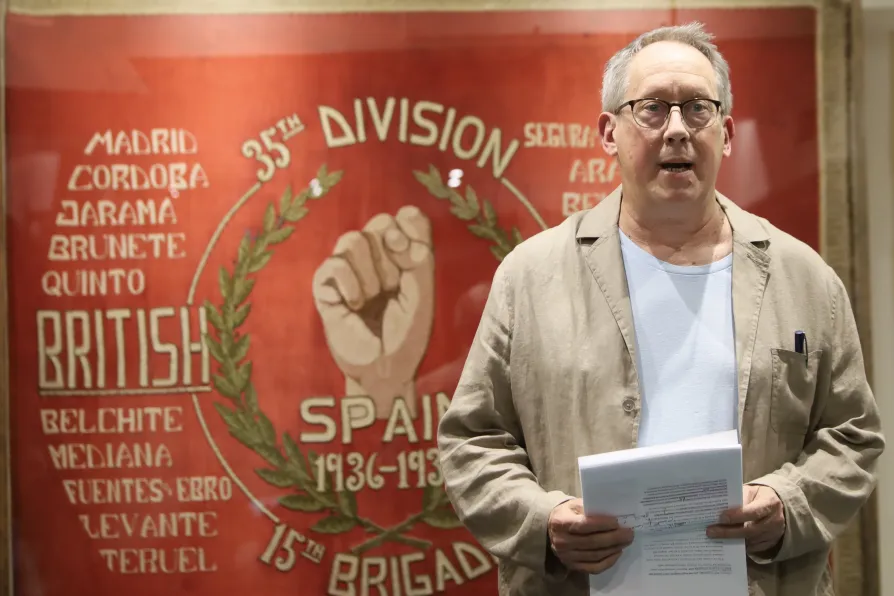 Richard Baxell speaking at the Marx Memorial Library in London [Pic: Karl Weiss]
The artist, who has just died, is embedded in the subconscious of the Palestinian people
The five young men killed in the A66 crash were responsible for a devastating tragedy — but the crash should force us to ask difficult questions about wider society, argues RENATA MEDEIROS MIRRA
Britain funds the policing of black culture 16 times better than the culture itself. The Diamond Jubilee is the moment to end that, argues CLAUDIA WEBBE
Despite Andy Burnham’s declaration defending the continued partition of the island, all major international and internal trends are converging to make Irish reunification inevitable
Humans are part of the ‘animal kingdom’ – and of nature in general – but also distinct from it and labour (work) is part of what makes us unique, declared Engels. His insights 150 years ago into how our species came to be and how we differ from the rest of nature, are as important today as they were then, says the MARX MEMORIAL LIBRARY
Committee for the Defence of the Iranian People’s Rights general secretary GAWAIN LITTLE discusses the impact of the US-Israeli war on the Iranian people and economy





Who were these volunteers who joined the International Brigades?
Between 1936 and 1939, some 2,400 to 2,500 men and women left Britain to fight for the Spanish Republic against Franco and his supporters from Nazi Germany and fascist Italy.
While referred to as British, their number included a large number of migrants. More than 250 were from Ireland, there were 40 Cypriots, together with others from various countries of the British empire and beyond.
And while the British Battalion was known by Spaniards as el Batallon Ingles, it wasn’t English either, for it contained around 200 Welsh volunteers and at least 500 Scots. Twenty to 30 per cent of the volunteers were Jewish, though exact numbers are difficult to establish, for the use of a nom de guerre was widespread in Spain, particularly among Jewish volunteers.
The volunteers were overwhelmingly working-class, single men (and a few women) from Britain’s major cities and industrial areas. Most worked in unionised occupations such as mining, construction and shipbuilding. Almost all were what was known as “progressive,” that is, of the left politically; perhaps 75 per cent were members of the Communist Party.
What made them take this extraordinary step of volunteering in a foreign war against the wishes of their own government?
The main motivation for volunteering for Spain was to help prevent the spread of fascism across Europe.
“Well, to me it was elementary,” explained Sam Wild from Manchester, who commanded the British Battalion in Spain, “here was fascism spreading all over the world, the rape of Abyssinia, the rise of fascism in Germany and the persecution of the Jews there, and the rise of the Blackshirts in Britain … I felt that somebody had to do something to try and stop it.”
Most saw the Spanish war as the latest episode in an international struggle against fascism that they had participated in at home, in often violent clashes with members of Sir Oswald Mosley’s British Union of Fascists.
The hatred of fascism was matched by disgust and fury that the British government, wedded to a strategy of appeasing the dictators, was determined to “keep out of it.” The British government’s farcical policy of non-intervention in the war, which essentially starved the democratically elected government of arms, was the impetus for many volunteers.
How would you characterise the contribution of the British Battalion towards the Spanish Republic’s war effort?
They were without doubt, astonishingly brave, in the face of frequently overwhelming odds.
Probably the most important contribution of the International Brigades as a whole was in November and December 1936 when Franco’s hitherto undefeated forces were thrown back at the gates of Madrid.
The key contribution of the British Battalion itself was at the Battle of Jarama in February 1937. There, despite having almost no training and lacking decent arms and ammunition, they “held the line,” preventing Franco’s forces from cutting the vital road linking Madrid and Valencia and encircling the Spanish capital. However, their success came at a terrible cost; over three days of brutal, desperate and sometimes hand-to-hand fighting, the battalion was essentially wiped out.
What happened to those who were lucky enough to return home from Spain? Did they continue the fight against fascism?
Some didn’t, not least the veterans carrying wounds which rendered them unfit for service. Others were turned down, reflecting a prejudice within the Security Services and War Office against the former brigaders, many of whom were viewed as dangerous Communist agitators.
At the outset of the war many former volunteers, still outraged at the British government’s betrayal of the Spanish Republic, refused to sign up for Chamberlain’s “imperialist war.”
This of course changed with Hitler’s of the invasion of the Soviet Union in June 1941, which allowed Communists to now see the conflict as an anti-fascist war, like Spain.
Many veterans served with distinction in the British forces. Sadly, and inevitably, a number were killed. Monty Rosenfield, killed fighting on the Italian front in 1944, was among several former International Brigaders to be decorated, though, ironically, he had only been accepted for foreign service after the Independent MP Eleanor Rathbone had raised his case with the War Office.
What impact did their experience in Spain have on the rest of their lives?
Some veterans complained of victimisation and prejudice, particularly during the cold war when a hostile view of the former volunteers as Stalin’s dupes became popular among anti-communists.
However, a great number went on to have long and successful careers in politics and the trade union movement, where having served in Spain was — and still is — seen as a badge of honour. Many forged a lifelong bond with Spain and its people, becoming involved in organisations and campaigns to fight for the overthrow of the Franco dictatorship and the return of democracy in Spain. For some, this developed a personal dimension, when they married Spanish refugees or exiles.
Spain undoubtedly maintained a great significance in the lives of the majority of the veterans who remained overwhelmingly positive about their experiences.
“The war was the biggest event in my life,” declared one Scottish former volunteer. “I’m glad I was there. I’m glad I came back, of course, but I’m glad I was there.”
A frequently held view is that the Republic lost the war because of internal divisions on the left. Is there any truth to that?
This is a popular view in Britain, where many people know little of the Spanish civil war, beyond what they have taken from George Orwell’s Homage to Catalonia and Ken Loach’s cinematic homage, Land and Freedom.
It’s true that the internecine fighting in May 1937 and the fratricidal purges which followed contributed to the demoralisation of government supporters and undoubtedly damaged the Republic’s reputation abroad. They were not, however, the primary cause of its defeat; ultimately, the most dangerous obstacle facing Republican Spain was not Stalin’s terror, but the colossal level of intervention in support of Franco by Italy and Germany, which was allowed to continue wholesale by Britain and France’s determination to maintain the non-intervention pact.
Why do you think there is still so much interest in the International Brigades?
In Britain, the International Brigades have become the touchstone for discussions on the involvement of Britons in subsequent wars, whether that be the Balkans, Ukraine or, controversially, Syria and Iraq. Their determination to “defend democracy with deeds,” despite the government’s staunch opposition, has long been admired; Labour Party leader Clement Attlee visited them in Spain and praised their “courage, self-sacrifice and devotion.”
During the two-minute silence of remembrance at a football match between England and Spain at Wembley on November 12 2011, a Spanish supporter held aloft a sign bearing the image of four bright red poppies.
Beneath the flowers, it bore a simple, poignant message: “We also remember. XVth International Brigade. British Battalion ’36.”
Understandably, for the descendants of Spanish Republicans, the gratitude memorably expressed by Pasionaria at their tearful farewell in Barcelona in October 1938 remains to this day.

Similar stories
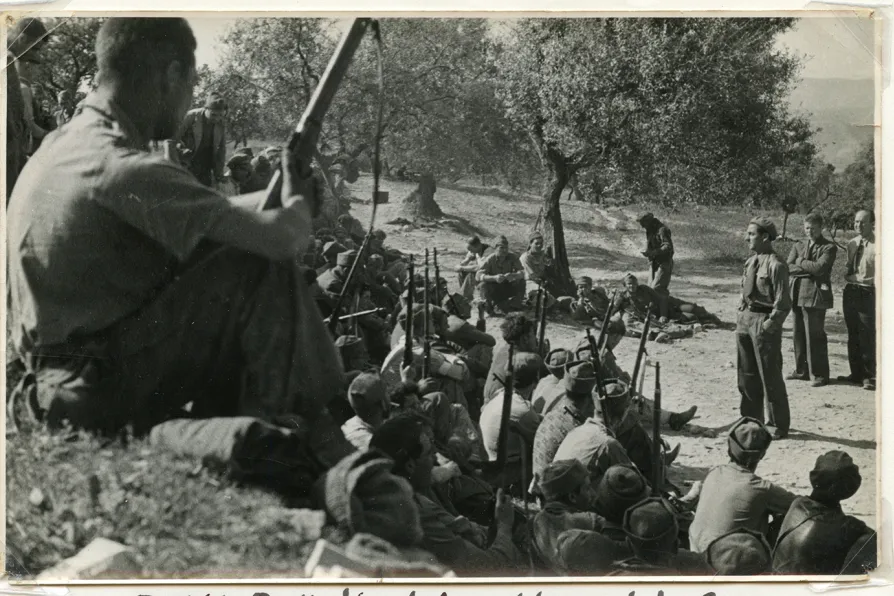
Thousands of remarkable Britons left ordinary lives behind to join the struggle against Franco. Here is a snapshot of those who answered the call
![Exhumation of a mass grave of 26 Spanish Republicans killed by the fascists at Estépar, near Burgos. They were among an estimated 2,500 executions carried out in the area [Pic: Mario Modesto Mata /Creative Commons]](https://msd11.gn.apc.org/sites/default/files/styles/desktop/public/2026-07/1280px-Spanish_Civil_War_-_Mass_grave_-_Este%CC%81par%2C_Burgos.jpg.webp?itok=CRZDhTXK)
Historical shame prevents the International Brigades and those Spaniards who supported the Republic from being properly recognised and honoured, writes NOELIA SANCHEZ
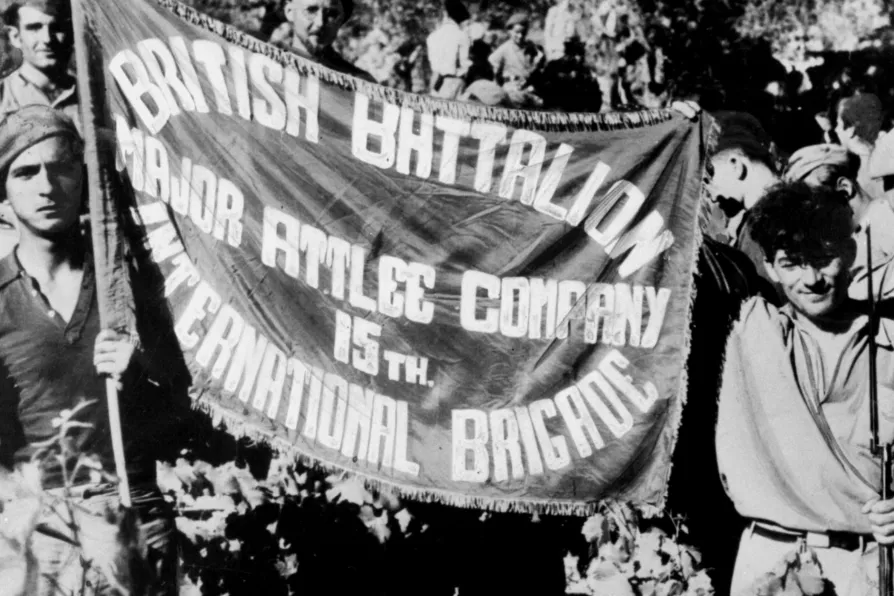
MAXINE PEAKE says the warnings of the International Brigades ring true today
![Harry Pollitt (right) with International Brigade volunteer David Guest, who was killed at the Ebro in July 1938 [Pic: Marx Memorial Library]](https://msd11.gn.apc.org/sites/default/files/styles/desktop/public/2026-07/a-2_a_50b_Harry%20Pollitt_David_Guest.jpg.webp?itok=Ag0u-8n5)
ALEX GORDON applauds the leading role played by Harry Pollitt and the Communist Party in the fight against fascism in Spain and salutes the memory of the International Brigades