DOUG NICHOLLS says the parasitic finance markets must be challenged or another British government could be toppled


 Latest editorial

SNP embraces militarism to pursue jobs mirage
The evolution of the Scottish nationalist leadership into cheerleaders for Nato has led the party to betray its pledges on Palestine and social spending, writes COLL McCAIL
 Palestinians walk amid the ruins of buildings destroyed by Israeli airstrikes during the war with Hamas, in Gaza City, August 17, 2026

The late country singer’s Imagination Library has put hundreds of millions of books into children’s hands. We should build on that legacy by defending the libraries at the heart of our communities, says BRENDA AITCHISON
Deprivation is a fundamental factor in criminal behaviour that must be addressed but, KENNY MacASKILL argues, there needs to a major rethink in sentencing to tackle overcrowding
MML director MEIRIAN JUMP outlines the recently refreshed library’s busy autumn schedule that ranges from book sales, archival exploration, community work with online education and the ever popular site tours
Some thinkers and authors on the right are openly discussing the possibility that the historically successful party of the British ruling class may be exhausted
Class struggle is the motor of history but the direction and detail of change at any time and place is the outcome of many factors, suggests the Marx Memorial Library and Workers’ School
TONY BURKE surveys the shifting political landscape and the challenges Labour needs to address if it is to prevail in the 2028 federal elections





IN SEPTEMBER 2025, the Scottish Parliament became the first in the world to endorse a comprehensive package of Boycott, Divestment and Sanctions (BDS) against Israel. The motion, which passed with the support of the SNP and the Scottish Greens, called on Bute House to take action against “companies complicit” in Israel’s military occupation of Palestine.
Less than one year later, however, what could have been a historic step forward for the Palestinian cause has amounted to anything but. The Scottish government continues to award public money to corporations upon whose weapons Israel’s genocide depends.
Scottish Enterprise, the government’s economic development agency, awarded more than £5.5 million to Israel-linked arms firms in the year ending March 31 2026.
BAE Systems, which manufactures core components for the F-35 warplane, received two taxpayer-funded grants totalling more than £2.3 million.
The “Genocide Jet,” as campaigners have dubbed the fighter, has registered more than 15,000 operational flight hours over the Gaza Strip since October 2023. The British arm of the French company Thales, which produces the British Watchkeeper drone through a joint venture with the IDF’s largest supplier, was supported to the tune of £467,401. Leonardo UK and Raytheon Systems each received more than £500,000 too.
Less of a boycott than an open embrace of the military-industrial complex, the SNP’s failure to act against complicity can be explained by the party’s enthusiastic support for rearmament — and, consequently, the welfare cuts required to pay for it.
In Westminster, SNP parliamentary leader Dave Doogan has criticised the British government’s £298 billion Defence Investment Plan for not going far enough. The initiative, which already hinges on £10.3bn worth of cuts to some road and energy projects, left Britain “further behind our allies,” he claimed. Scottish First Minister John Swinney, meanwhile, has thrown his weight behind increased “conventional defence spending.”
While the First Minister imposed an (evidently notional) block on new awards of public money to arms companies supplying Israel, Swinney also announced his government would lift a ban on state funding for other munitions in 2025. As one unnamed SNP official summarised the party’s trajectory: “We won’t be using ‘bairns, not bombs’ on leaflets now.”
In a desperate search for intellectual inspiration, the SNP has latched itself to the false promise of remilitarisation and the accompanying mirage of jobs and development. Swinney has even gone as far as to criticise “glaring weaknesses” in Britain’s Ministry of Defence.
The contradiction is obvious and, to the naked eye, absurd. Bluntly, why would the Scottish National Party demand the Royal Navy increase its presence north of the border and, in so doing, advance the national security case for the union? This is perhaps the best example of quite how far the party has strayed from its famous opposition to the decision to station Polaris nuclear submarines at the Holy Loch in the Firth of Clyde.
“I have as much attachment to being a citizen of the European Union as I have to being a citizen of Scotland,” Swinney told the BBC’s Nick Robinson earlier this year.
The First Minister’s comment embodies the SNP’s embrace of post-nationalism, an accommodation which helps to explain his party’s contemporary attraction to bombs and bullets.
Amid the ascendance of unbridled US power and neoliberal hegemony in the closing decades of the 20th century, the corporatism which had characterised the SNP’s early resource nationalism gave way to support for something altogether different — the delegation of national sovereignty to supranational and US-led intergovernmental organisations for the first time. In this context, the party offered its support to the Gulf war in 1990, the US-led invasion of Afghanistan a decade or so later and, ultimately, Nato membership in 2012.
Proponents of the latter position successfully argued that support for Nato was critical if Scotland were to take its place as a “civilised” and “responsible” European state — or “a Good Global Citizen” in a liberal international order.
The roots of such arguments, which continue to grip the upper echelons of the SNP, lie in the almost universal acceptance of the importance of shelter under the US security umbrella at the end of history.
With the independence referendum just two years away, the SNP’s Nato U-turn served as a signal to the international security Establishment that Alex Salmond and his cabinet were a group that, in the event of independence, they could work with.
Almost a decade-and-a-half later, times have changed — but attitudes have not. In its pursuit of Scottish independence, the SNP continues to acquiesce to, rather than challenge, the limitations on sovereign states imposed by globalisation. This is the outdated false logic which informs the party’s support for rearmament, regardless of its consequences at home and abroad.

Similar stories



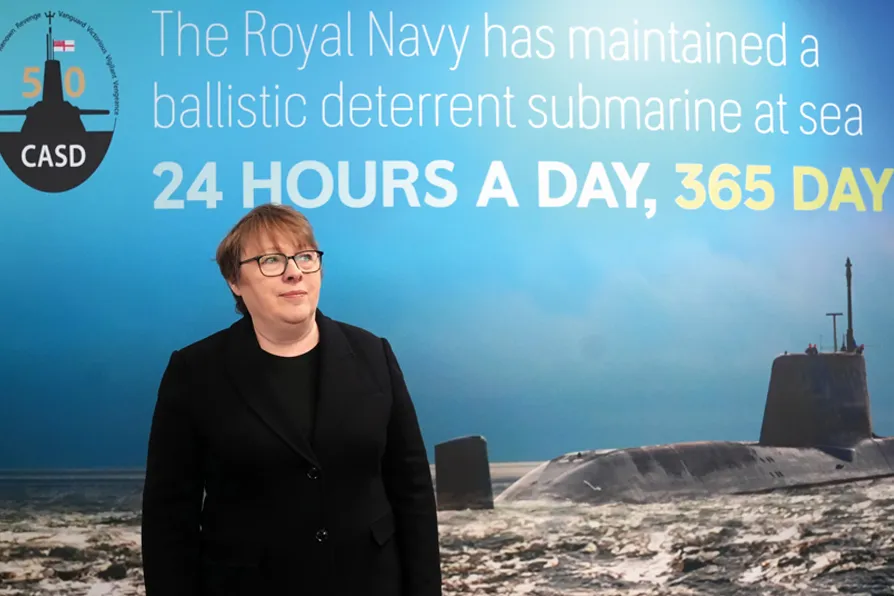
Expanding Britain’s nuclear capability increases the risk of nuclear confrontation. It does not keep us safe – it makes us a target, argues CAROL TURNER