Latest editorial

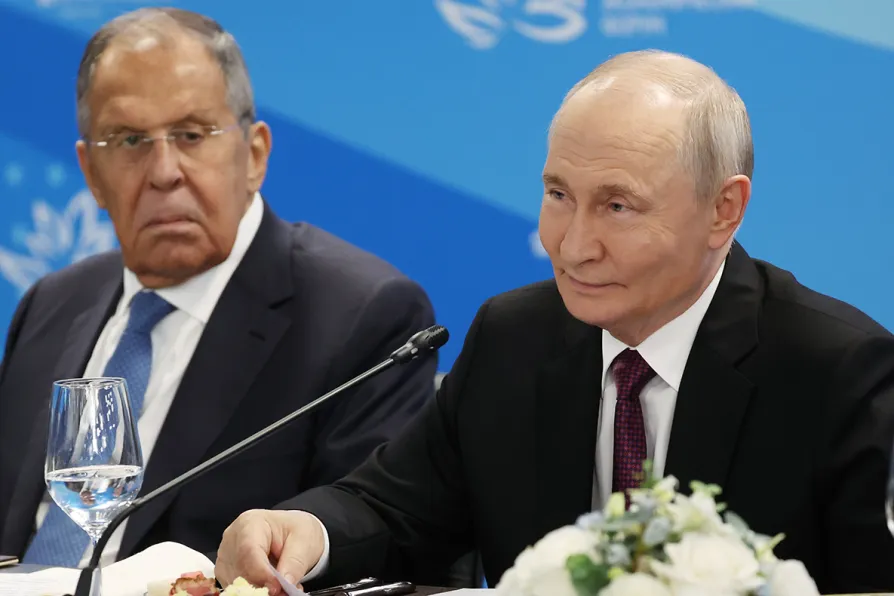 Russian President Vladimir Putin (right) and Russian Foreign Minister Sergey Lavrov attend talks with Indonesian President Prabowo Subianto on the sidelines of the Eastern Economic Forum in Vladivostok, Russia, September 3, 2026
Disaster prompts president to lift moratorium on death penalty, a move human rights groups say is ‘a retreat into barbarism’





RUSSIA will close German cultural centres across the country, Foreign Minister Sergey Lavrov said today, in a tit-for-tat measure reflecting rising tensions between Moscow and the European countries supporting Ukraine in its war with Russia.
Mr Lavrov’s announcement came after Berlin blamed Moscow for an attempted attack at Leipzig/Halle airport.
Germany said on Wednesday that, as a result, it would shut both the Russian consulate in Bonn and the Russian House cultural centre in the German capital.
Mr Lavrov said that cultural centres belonging to Germany’s Goethe Institute would be closed in Moscow, St Petersburg and Yekaterinburg, adding that any other response would show a lack of “self-respect” on Russia’s part.
Speaking at the Eastern Economic Forum in Vladivostok, Mr Lavrov said that Germany “could not have failed to understand” that the closure of Russian House would “signify the end of their cultural presence in Russia.”
A drone laden with explosives was found near a Ukrainian plane at Leipzig/Halle airport on August 4 and later defused. The airport is a major international freight hub that is used to provide support to Ukraine.
Russian President Vladimir Putin has dismissed the allegations, saying that the German government wants to distract from its own failings and growing voter dissatisfaction. Any proof being offered “has been planted,” Mr Putin said.
Western officials have repeatedly accused Moscow of running a campaign of sabotage and disruption in their countries with the aim of undermining support for Ukraine and destabilising European nations, something Russian officials deny.
The British government summoned the top Russian diplomat in London today to protest at what it called Russia’s “egregious and reckless attack” on the German airport last month.
In Finland, more than 2,000 people took part in the biggest civil defence exercise in Europe since the end of World War II. Among the threats envisaged were missile strikes from neighbouring Russia.
Meanwhile, Norwegian authorities seized a Russian vessel in the Arctic archipelago of Svalbard on Wednesday at the request of Ukraine’s Naftogaz.
The seizure was part of a global effort to enforce a $4.22 billion (£3.1bn) arbitration award and followed a European push to seize vessels belonging to Russia’s so-called shadow fleet, as the EU terms vessels shipping products it or the US has sanctioned. Such seizures are illegal under international law, as the sanctions in question are not authorised by the United Nations.