


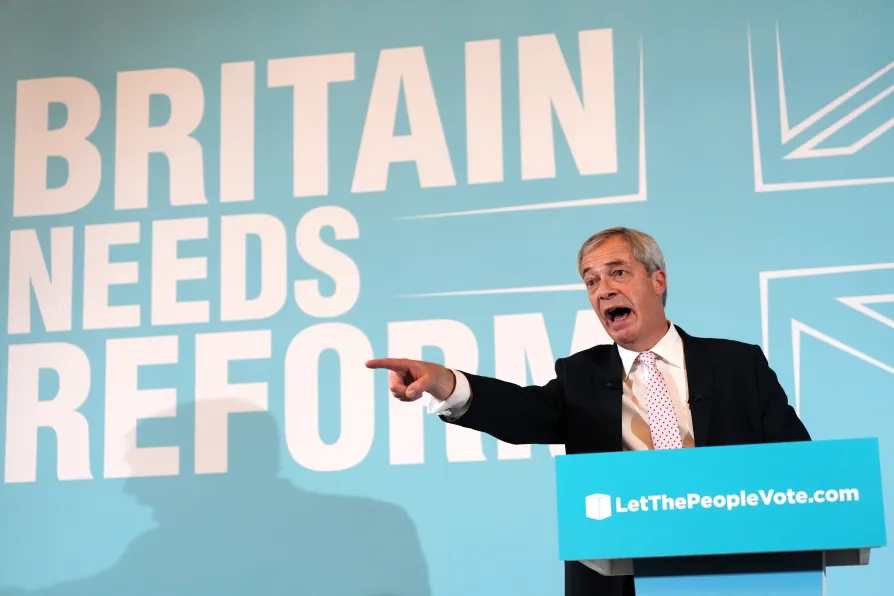
 Reform UK leader Nigel Farage speaks during a press conference at Institute of Directors in central London, December 4, 2025





ALARM bells should now be ringing across the labour movement about the rise of Reform. Already, Nigel Farage’s hard-right party has a considerable polling lead over Labour and all other parties.
It represents a deep threat to democracy and to social cohesion. It seeks to mobilise xenophobia, anti-Muslim hatred in particular, and distrust of the Establishment in order to pursue an authoritarian agenda designed to entrench Thatcherite neoliberalism.
What have been regarded for generations as the “major parties” have mounted scant resistance. Labour has appeared paralysed before Reform’s rise, only recently making even the most muted criticism of its values, while the Tories openly ape Farage’s agenda.
This week there have been three additional causes for alarm. First, Reform has secured a preposterous nine-million-pound donation from a cryptocurrency financier resident in Thailand. This exposes the anti-democratic nature of Britain’s political financing regime, wherein the rich can pervert the course of democracy with their resources.
It also propels Reform into the financial big time. Donations were the only field in which it lagged behind the Conservatives hitherto.
Farage will scarcely need to spend the new loot on publicity, since his malign message is amplified daily in the Telegraph, the Mail and on GB News, as well as on monopoly-controlled social media.
Nor is he spending much on candidate vetting. The second worrying revelation this week is of the disgusting racism attributed to Ian Cooper, the Reform leader of Staffordshire County Council.
Social media accounts attributed by Hope Not Hate to Cooper, and now being investigated by Reform, exhibit vile views against British Muslims and black people. Such attitudes are normalised in Farage’s party and it is deeply worrying that people espousing them could lead major local authorities.
The third development is perhaps of greatest concern of all – the growing signs that Reform and the Tories are inching towards some form of pact to fight the next general election.
Farage is reported to have said as much to key donors by the Financial Times. Denials on both sides appear to leave plenty of wriggle room, which will only enlarge if the cynical Robert Jenrick rides his populist bandwagon all the way to the Conservative leadership next year, as seems all too likely.
Between the two parties, they account for around 47 per cent of the electorate, according to opinion polls. Of course, that number may shrivel — any form of alliance could drive some Tories to switch to the Liberal Democrats.
But at any level over 40 per cent, such a right-wing bloc would be on course for a landslide. There is evidence that the anti-Reform majority would respond by voting for whichever candidate is most likely to defeat Farage – that is what happened when Plaid Cymru swept to victory in the Caerphilly by-election for the Welsh Senedd.
Such tactical voting cannot by relied upon. The stronger barrier is a fighting unity of the labour movement and broad progressive anti-fascist opinion, which may find expression in some form of democratic electoral front.
Such a project is speculative at present. The main obstacle is the role of the Labour government which is empowering Reform both through its ideological capitulation to nativism and through its inability to solve the pressing social and economic crises off which Farageism feeds.
Only a Labour Party transformed from its present disastrous course can play a full part in the fight to preserve democracy, and ally with other forces on the left.
That task has been given added urgency by this week’s events, and those who can initiate such a transformation must now consider their responsibilities as a matter of urgency.
