
The US administration is endangering lives by reversing environmental protection laws, CHAUNCEY K ROBINSON argues

A quarter century of determined resistance to war
KEITH FLETT pays tribute to the resilience of the peace and anti-imperialist movement in Britain that emerged after the September 11 attacks and is ever-more needed today
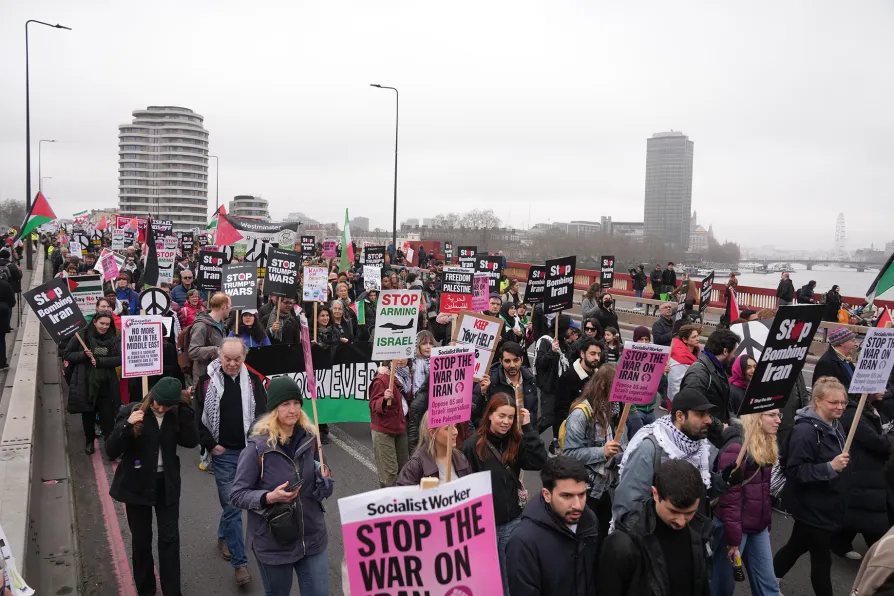
 Protesters join a national demonstration to the US Embassy in London to call for an end to attacks on Iran. Picture by: Maja Smiejkowska/PA Archive/PA Images Picture date: Saturday March 7, 2026.
It’s time to stop retreating and go on the offensive to promote working-class interests, argues DOUG NICHOLLS
Marco Rubio wants to defeat socialism in Nicaragua, not restore ‘democracy,’ writes JOHN PERRY
Believe it or not, there was a time when the US government built beautiful homes for working‑class Americans to deal with a housing shortage, writes ERAN BEN-JOSEPH
DIANE ABBOTT provides an analysis of the reasons for EU and British voters’ dramatic swing to the right
Train drivers’ union Aslef general secretary DAVE CALFE speaks to Ben Chacko about his hopes that Burnham’s devolution agenda will include the importance of the railway





AT THE 2026 TUC in Brighton a UCU motion calling for opposition to militarism and a drive to war was passed. It was an important reminder of a resilient tradition of anti-imperialist politics that stretches back exactly 25 years.
I was at the TUC on September 11 2001.
Transport and General Workers’ Union leader Bill Morris was chairing the proceedings. He announced that something had happened in New York. Tony Blair as prime minister was due to speak to the conference. He appeared, read a brief statement and departed.
The attack on the Twin Towers in New York was being shown on TV screens in the Brighton Centre. There was no other source of instant news then. The enormity of what had happened was, I still recall, very difficult to process.
Blair, of course, had a very distinct reaction to those events. Afghanistan was in the frame for the start of what became the “war on terror.”
Historically speaking, it remains too soon to draw a balance sheet of the impact and significance of George W Bush and Blair’s wars, although the many thousands who lost loved ones or were injured on all sides may feel that judgement has already to some extent been made.
Socialists are sometimes accused of being found wanting by events. This was not one of those occasions.
Within 10 days, on September 21 2001 the original forces that became the Stop the War Coalition had called a meeting to protest against an impending attack on Afghanistan at Friends House in central London. The meeting was packed to overflowing in the garden outside.
That led on October 13 2001 to what was in effect the first Stop the War demonstration, although not yet under that name, and that carried through to what remains the biggest demonstration in British history, against war with Iraq, on February 15 2003.
To recall that day in person one would need to be at least middle-aged now, yet the anti-war and anti-imperialist politics that came out of the events of September 11 2001 have proved resilient.
It is an impressive tradition, in terms of longevity and impact matched arguably only by CND, a key part of the Stop the War Coalition, since 1945.
Blair’s departure from office was due at least in part to his association with the Iraq war, something he has never been able to excuse away to this day. There was also a powerful impression on labour movement and Labour Party politics. The very strong view was that Britain should not get involved in illegal wars, perhaps particularly those touted by the US.
In 2013 then Labour leader Ed Miliband successfully led Labour to oppose intervention in Syria. However, that may be viewed in hindsight it reflected the strength of the anti-imperialism that came out of 2001.
That tide was also part of what led to the election of Jeremy Corbyn as Labour leader, but it also provoked a strong backlash from the warmongering right. With the appearance of Keir Starmer as Labour leader war was very much back on the agenda.
As with Blair however it became a key part in his downfall.
Starmer backed Netanyahu’s genocide in Gaza, providing arms to Israel and dragging his heels on criticism. It cost Labour votes and seats at the 2024 Election and eventually cost him his premiership.
Key to this were the huge mobilisations in support of the Palestinians from October 2023, not just in London but across the UK. Starmer tried to restrict the protests. He failed.
The Stop the War Coalition from 2001 and many others were and are an important part of this.
An historical reminder that while it’s not easy to keep on keepin’ on, it is vital in opposing imperialism and war.

Similar stories
Some British unions are making a strategic error in backing militarised solutions instead of working for a ceasefire and end to the war, argues LINDSEY GERMAN


Morning Star assistant business manager BERNADETTE KEAVENEY and international editor ROGER McKENZIE remember attending the 2001 TUC, suspended midweek after news of the World Trade Centre attacks

The attacks of September 2001 became the pretext for a new era of US-led intervention. Twenty-five years on, millions are dead and the promised ‘victories’ remain nowhere to be seen, says ANDREW MURRAY