KEN COCKBURN traces the one original language – that of the Yamnaya pastoral nomads – from which all European and Indian languages derive


 Latest editorial
PCS: A guide to action and a defence of socialist ideas
HELEN MERCER recommends a timely history of the Civil Service worker organisation that proposes a principled and strategic approach for the future
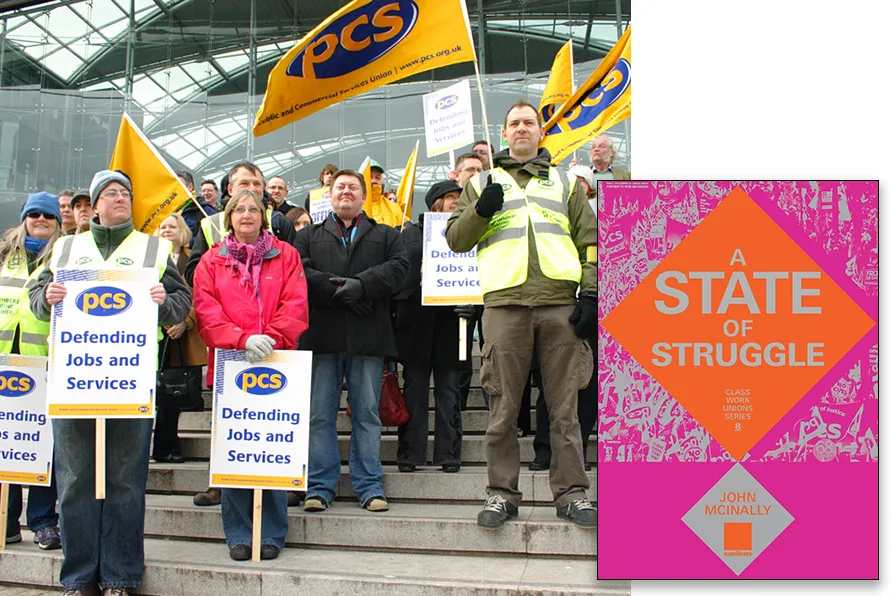 UNITY OF PURPOSE: PCS strikers, Norwich, on the first day of their strike, 2010 [Pic: Roger Blackwell/CC]

PAUL DONOVAN is fascinated by the debunking of the iconic British war hero
ALEX HALL recommends a searing panorama of our global predicament
Comics are not just superheroes and spandex – it can be public art, telling public stories, suggests HARRIET EARLE
ALEXEI SAYLE speaks to Angus Reid about a lifetime of protest, how to hone political art – and what to do now
The bard serenades the Diggers of Wigan and their festive followers





A State of Struggle
John McInally, Manifesto Press, £30
WORKERS in the Civil Service stand in an ambiguous position with regards to the state. They are essential tools for the delivery of policies that collectively are a weather vane of the balance of class forces, while as workers they have an interest in the effects of those policies.
On the one hand there will be a strong tendency to identify with other workers, both to defend their own pay and conditions against an extremely powerful employer and in support of progressive policies that benefit their own class. An equally strong tendency is loyalty to the government itself, whether out of personal advancement and opportunism, or a belief in an essentially benign and neutral state, or some simple nationalism.
Civil Service trade unionism therefore presents a fascinating picture of how these tendencies work out, formerly as governments were forced to grow a welfare state, and latterly as it was hollowed out and adopted a line of open class confrontation.
The opening chapters of the book trace the development of Civil Service trade unionism from the inception of the Civil Service Clerical Association in 1921, through the gradual merging with other unions to form first the CPSA (Civil and Public Services Association) and then today’s PCS in 1998. Its absorption of most grades and specialisms (just two other much smaller Civil Service unions exist for higher grades and specialists) across widely dispersed and differentiated departments stands as a great achievement in itself, and proof not only of the proletarianisation in society but also of the vision of the organised left to instil the value of unity.
The latter part of the book is in essence the story of how this huge potential strength, when pitted against the sustained and intense neoliberal onslaught from the 1980s onwards, could not hold the line in terms of protection of jobs and pay, nor its role as a public service that serves a social rather than a profit-making purpose. It is from the 1980s that John McInally’s period of union activity dates and his accounts of union responses are detailed and brim-full of lessons.
Two lessons stand out.
First, that the fights around pay or pensions, although never more than partially successful in this period, served to “challenge the slide towards class collaboration and compliance by the labour movement’s leaders.” The long history of struggle, including those periods of reaction and defeat, McInally argues, build “the foundation upon which the fight for a socialist society rests.”
The second lesson is more controversial but oh-so-familiar, namely: sectarianism. McInally describes “left” sectarianism as a “reverse image of right-wing opportunism.” The latter “sells any principle to seek a compromise”; the former will warn that any compromise of socialist principle will lead to a “sell-out before it happened” — a position which can demoralise and disunify the movement.
McInally gives a detailed account of the unsuccessful attempt by the Socialist Party to unseat Marl Serwotka and Janice Godrich. He argues that it “produced a seemingly irreconcilable element of instability within the PCS left wing and across the union more generally”, and created conditions for a potential right-wing resurgence.
Surveying the intensification of the current crisis McInally predicts that the class collaboration and reformism of the current batch of union leaders will continue, and considers how that it is to be countered. He poses the need for political representation, but leaves much to be discussed about the nature of a “new workers’ party” to replace Labour that he proposes, nor what exactly the “Marxist left” is these days, and therefore how it is to be “rebuilt.”
McInally’s detailed inside knowledge shows vividly the difficulties of weaving a principled and strategic approach, not only through persistent attacks from the government, ably supported by the media, but also poisonous divisions between left and right and within the left itself.
The Morning Star has already serialised key sections and future book launches will surely prompt still more discussions on how socialists organise within the trade union movement in the looming chaos.
