Andy Burnham could learn a few lessons from a previous Labour government in the pre-privatisation era on how to tackle water shortages, writes KEITH FLETT


 Latest editorial

From ‘Mission Accomplished’ to endless war: the US kidnapping of the President of Venezuela
RAINER RUPP examines former CIA analyst Larry Johnson’s description of the US operation to kidnap Nicolas Maduro as a tactically successful but strategically disastrous move, with shades of Bush’s disastrous intervention in Iraq
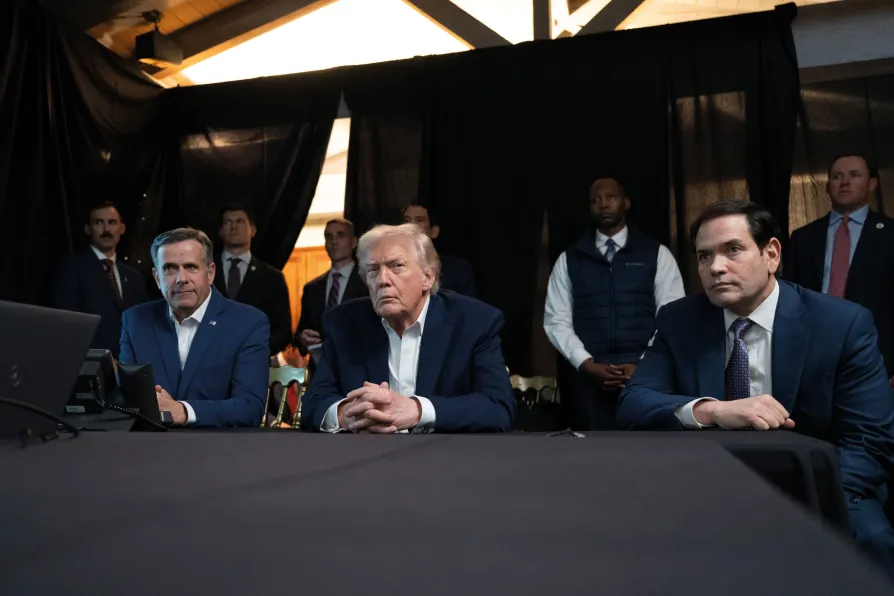 OVERREACH? In this photo released by the White House, President Donald Trump monitors US military operations in Venezuela, with CIA director John Ratcliffe, left, and Secretary of State Marco Rubio at Mar-a-Lago in Palm Beach, Florida, on Saturday
North East Volunteers for Liberty plan to mark a double anniversary in October for local heroes who stood firm against tyranny, writes TONY FOX
India’s monsoon is running below normal overall, yet extreme rainfall has already caused deadly flooding in Kerala, explains LIGIN JOSEPH
Renewed illusions in social democratic reformism are sprouting as a result of Andy Burnham’s rhetoric, but material conditions are already intruding into the debate, argues NICK WRIGHT
The US is hell-bent on dismantling the International Criminal Court as part of its assault on global legal systems, but others also have valid reasons to seek its demise. BEN CHACKO provides the analysis





ON January 3, the Norwegian political scientist Professor Glen Diesen interviewed former senior CIA official and counterterrorism expert Larry Johnson in a one-hour conversation on YouTube. Here, I summarise the most important points and have added some comments.
Comparison with historical US interventions
To kick off the discussion, entitled “US War on Venezuela has Global Ramifications,” Johnson emphasises that Trump, like Bush with his “Mission Accomplished” moment, believes he has “solved a problem, but instead has created new, bigger problems.”
Johnson draws parallels with previous operations in which the overthrow of a single head of state did not bring stability. Examples include Manuel Noriega in Panama (1989), Saddam Hussein in Iraq, Muammar Gadaffi in Libya and Bashar al-Assad in Syria.
“This idea in the West that we just need to replace one man to solve our problems has not worked in the past.” He goes on to warn against a repeat of this scenario.
He fears a repeat of the Vietnam scenario: at first, there are just a few US military boots on the ground in Venezuela, but in order to protect them against increasingly dangerous attacks, more and more US troops have to be sent in to “stabilise” the situation; an escalation that is difficult to stop and becomes a self-perpetuating cycle, especially since Venezuela is ideally suited for guerilla warfare for a number of geographical and logistical reasons, including its long and complex borders with Colombia and Brazil, two countries critical of the US.
On the internal situation in Venezuela and the risk of an insurgency, Johnson emphasises that the population of Venezuela is heavily armed and that the porous borders with Colombia and Brazil are conducive to guerilla warfare — similar to the situation with the Farc in Colombia since 1964.
Johnson predicts an increase in crime, assassinations and attacks on US interests in Venezuela: “The crime rate, the number of assassinations and the like will increase.” He expects a home-grown “resistance movement” that will destabilise Venezuela and warns that the US government may be forced to send more troops within the next two to three months. According to Johnson, opposition figures like Maria Corina Machado do not have broad popular support to ideologically “clean up” the country.
Author’s note: During a press conference on January 3, Trump was asked whether he was in contact with Machado or whether he considered her a viable leader following Maduro’s arrest. He replied dismissively: “I think it would be very difficult for her to be the leader. She has neither the support nor the respect within the country. She is a very nice woman, but she does not have the respect.”
According to Trump, the US will rule Venezuela for the time being, with Marco Rubio and Pete Hegseth being given this mission of ruling Venezuela as Trump’s viceroys, as in earlier times when the British empire ruled the oceans. That should be interesting. In this context, Johnson recalled the CIA’s historical control over Venezuela in the 1970s and ’80s under then-president Carlos Andres Perez, who was proven to have been on the CIA’s payroll. But through mismanagement and anti-social policies, he ultimately paved the way for the socialist revolutionary Hugo Chavez and his successor to come to power.
Role of the CIA and betrayal from within
The kidnapping of Maduro and his wife was carried out by a US special unit of the Delta Force. Johnson is convinced that the smooth running of the operation was only possible with the help of “insiders” from Maduro’s security detail and the apparatus protecting the president. This betrayal is likely to have made some people in Caracas filthy rich overnight. Johnson is certain that people were paid off, pointing out that the Venezuelan air defence systems were not activated and that Maduro’s security forces were either incompetent or bribed, comparable to the Bin Laden operation in Pakistan.
Geopolitical motives: oil and preparation for a war with Iran
Johnson sees access to Venezuelan oil as a central motive, especially as a safeguard against a possible war with Iran: “The attempt to seize Venezuela’s oil is preparation for an attack on Iran … contingency planning in case the Strait of Hormuz is closed.”
Venezuela is to serve as an alternative source of oil in case the Persian Gulf becomes blocked. This must be seen in conjunction with the current protests in Iran, which Johnson classifies as CIA-MI6-controlled, in order to prepare for regime change and to gain approval from the US population for renewed US bombing of Iran.
International reactions and global consequences
Undoubtedly, the US operation against Maduro is leading to increased mistrust of the US in Russia and China. Johnson links them to a failed drone attack on President Vladimir Putin’s residence and sees a Russian reassessment of negotiations regarding Ukraine, namely the “loss of all trust in the West.”
China, as an important buyer of oil from Venezuela, could counter economically, eg by dumping US Treasury notes or imposing export restrictions on critical rare earths. According to Johnson, the EU is displaying its usual hypocrisy: it condemns Russia for invading Ukraine, but is sympathetic to US action. Trump’s Monroe Doctrine 2.0 is a perversion of US foreign policy with negative consequences for Latin America as a whole, especially for Cuba, Colombia and Mexico.
Assessment of success and outlook
Johnson measures the success of the US operation by whether Venezuela will be stable under US control by March 2026, which he strongly doubts: “I think it is very likely that the United States will fail.” Instead, Venezuela faces chaos, a flood of refugees and attacks on the country’s oil infrastructure. He sees 2026 as the “year of war”: no end in Ukraine, war with Iran and now Venezuela.
“The lesson the US has taught the world is that there is no such thing as genuine US diplomacy, only deception, fraud and surprise attacks.”
Overall, Johnson paints a bleak picture: the operation is a return to imperial posturing, fuelling regional instability and bringing global powers such as Russia and China closer together. Instead of stability, the overthrow of Maduro will mean more conflict and huge costs for the US in the long term.
