



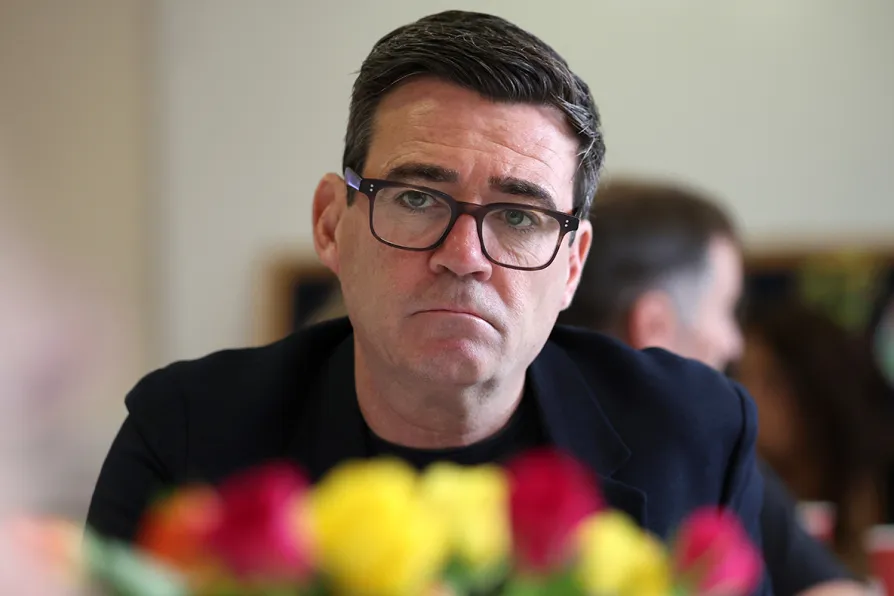
 First Minister Michelle O'Neill speaking to the Press Association in the offices of Sinn Fein at the Parliament Buildings, Stormont, head of the British Irish council meeting in Cardiff on Friday, December 4, 2025





IT HAS taken an Irish politician to confront Keir Starmer directly over his “warfare not welfare” politics.
Michelle O’Neill’s attack comes after Starmer announced a naval pact with Norway to “hunt Russian subs in the north Atlantic.” Her opportunity: today’s Cardiff meeting of the PM with the devolved governments.
“What they call defence spending… this government in London has chosen to prioritise weapons of war whilst people are struggling to pay their food bills and heat their homes.”
The first Sinn Fein First Minister of Northern Ireland was probably the only leader to challenge Westminster warmongering at the Cardiff meeting. The Scottish National Party abandoned its opposition to the US-led Nato military alliance back in 2012, part of its steady accommodation with Establishment politics, and Welsh Labour may be left of the British-level party but is hardly part of the peace movement.
Her intervention shows the significance of developments in Ireland over recent years.
Sinn Fein has had grief from the “soft left” for sticking to its anti-imperialist principles. Its continued support for Irish neutrality enrages liberals, a brake on the role the European Union’s military co-ordination with Nato has played in undermining the traditional neutrality of Ireland or Austria. But — as the recent victory of independent Irish presidential candidate Catherine Connolly showed — support for neutrality remains strong, a rebuke to the republic’s governing parties.
There are any number of criticisms of Sinn Fein on the Irish left which is as it should be: over here we must recognise that a unionist first minister at Stormont would never have criticised British warmongering. Sinn Fein’s leadership there weakens British imperialism.
And that’s badly needed. Starmer has all but silenced parliamentary resistance to a rearmament drive that is consuming Europe.
It threatens our living standards, diverting resources to the military that could be spent on schools, hospitals or pensions.
It threatens our liberties — for it is the peace movement that is the current target of repressive legislation restricting protest rights, defining peaceful activists as terrorists and abolishing jury trials.
Querying the claims and assumptions behind this drive — that we and Europe are under imminent threat of attack — is not considered any more respectable in the media than among politicians.
So few reports of Starmer’s Norway agreement — setting up a squadron of warships to stop the Russians cutting undersea cables or pipelines — pointed out that the one significant case of underwater terrorism this decade was the destruction of the Nord Stream pipelines built to carry Russian gas to Germany, almost certainly the work of the United States. For the rest, some damage sustained by telecoms cables in the Baltic last year have been tentatively blamed on the anchor of a (non-Russian) cargo ship, possibly by accident.
More panic has been engendered by the flurry of drone activity near European airports this year — but as another Irish politician, former MEP Clare Daly, points out these incidents are hugely exaggerated. Many turn out to be misidentifications, and where drones have been identified, no link to Russia has been established.
The flimsiness of the evidence has not stopped a senior Nato admiral from publicly mooting a “pre-emptive strike” against Russia because of its “hybrid attacks.”
The British government shares the EU’s hostility to any end to the Ukraine war other than a — militarily unfeasible — total Russian defeat. As the US and Russia creep closer to a deal to end the fighting, attempts to widen the conflict with claims we are already effectively at war with Russia are getting shriller.
That is the reason for the war drive, one which — with its evident risk of direct conflict between nuclear powers — is grimmer still than the social impacts described by O’Neill.
World War III is in nobody’s interests but the arms profiteers’ — and her call for welfare, not warfare, must be taken up across the British left.
