

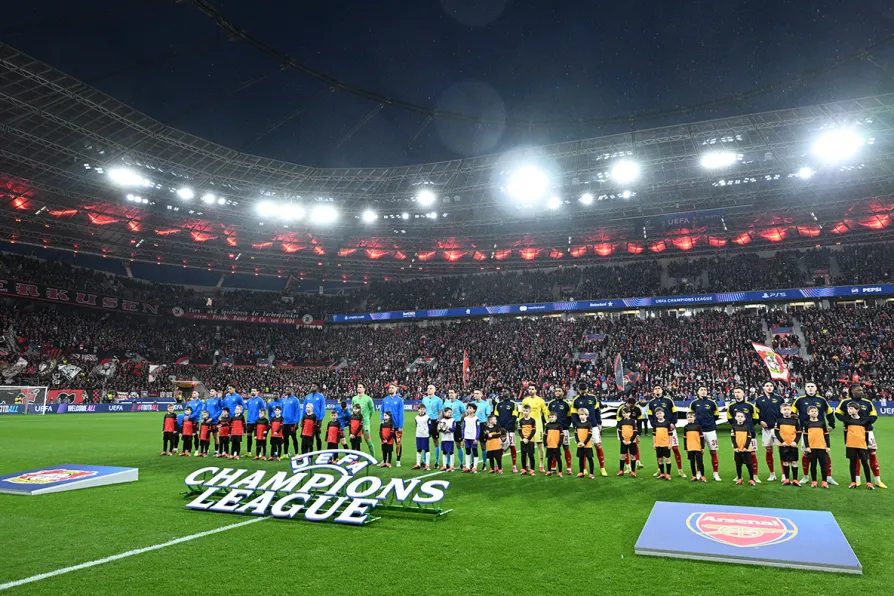
 Bayer Leverkusen and Arsenal players line up ahead of the Uefa Champions League round of sixteen, first leg match at the BayArena, Leverkusen, March 11, 2026





EUROPE’S leagues are calling for “substantial, if not radical” change to how money from Uefa club competitions is split to prevent the continent’s biggest clubs from becoming ever more dominant.
Currently, 74 per cent of the revenue from Uefa competitions which is set aside to participating clubs – amounting to €2.437 billion or £2.1bn – goes to the 36 Champions League teams.
Clubs not participating in Europe receive just €308 million (£265.8m) between them – 7 per cent of the total revenue.
Claudius Schafer, the president of the European Leagues group, said the polarisation between clubs in and outside of European competitions, driven by this distribution model, was an “urgent situation” affecting domestic leagues which Uefa had a statutory duty to address.
He said if it was not tackled, the problem would become “insurmountable” in some leagues and admitted that in some cases, it probably already was insurmountable. As a potential case in point, the European Leagues General Assembly was hosted by the Bulgarian First League, which has been won for the last 14 seasons by Ludogorets, though they could miss out on a 15th.
The leagues say they intend to raise the issue with Uefa, but it appears to be a forlorn hope when Europe’s top clubs, through the European Football Clubs (EFC) group, wield such power.
The current model appears to bake in the wealth of the biggest clubs, with 35 per cent of the revenue to participating Champions League teams put in something called the “value pillar” which awards money based on a team’s historical performance and the size of that team’s Uefa television deal.
European Leagues general secretary Alberto Colombo said tweaking around the edges on the solidarity percentage would not be sufficient to address the issue.
“We are asking that there is a substantial change, if not a radical change, in the way that the revenue distribution is applied to international competition, because this is the sole way to safeguard the ecosystem,” he said.
Schafer was asked how he would convince big clubs to go along with this, as it was put to him that accepting lower prize money would be like turkeys voting for Christmas.
“If you see the outcome, you have to recognise that if we are moving again in this direction that we did now in the past, and in the present, that will lead to big, big problems in different countries.”
Discussions on revenue distribution for the 2027 to 2031 cycle are live, and Schafer reminded Uefa of its role in ensuring the overall health of European football.
“When you read the statutes of Uefa, solidarity is one of the main objectives, to see that we have an ecosystem that is working for everybody and not only for a handful of clubs. So it’s on us now to show in those working groups that we [need to] have these changes, but it will be a challenge, I agree.”
