
Tackling climate change is not just an urgent environmental necessity but provides an opportunity for economic restructuring in the interests of the Welsh people


Labour Together, dark money and the long campaign against Corbyn
Paul Holden’s The Fraud reveals how a network of donors, MPs and opaque organisations quietly organised to destroy Corbyn’s leadership and manufacture a new centre of power inside Labour, writes JOHN ELLISON
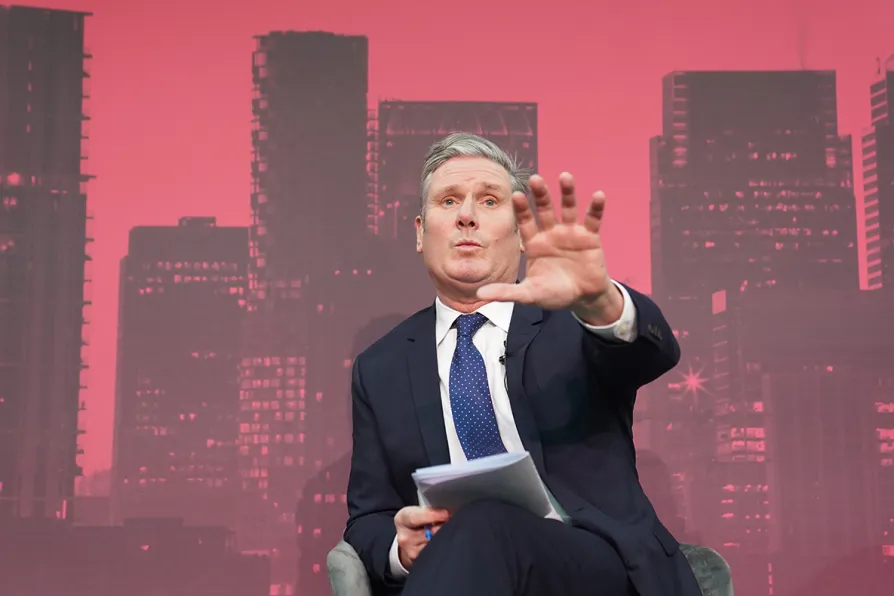
 Labour leader Sir Keir Starmer during the Labour business conference at Canary Wharf, London, December 8, 2022

A spate of bomb recoveries across Dhaka raise questions whether extremism is making a comeback, says SIAM SAROWER JAMIL
Poverty, refugee displacement, child labour and militia violence are exacerbating the challenge of health workers to limit this deadly contagious disease. CONSTANT SAME BAGALWA and MARK BANCHEREAU report
CLAUDIA WEBBE speaks out against the lethal mechanics of Britain’s culture-war press
Powerful agribusiness interests are trying to overturn efforts by the Lula government to protect the environment and indigenous peoples of the Amazon region, writes GABRIELA SA PESSOA
Trade unions and community groups are mobilising to push back against Trump’s racist raids after new revelations of spying on legal protesters. MARK GRUENBERG reports from the US state of Minnesota
The best wildfire service may begin with the community, argues KOMAL RAJ ARYAL





IF THE full message of Paul Holden’s recently published The Fraud is not getting out and changing how Sir Keir Starmer’s world is perceived, it should be.
This attempt to precis some of its strands, interrupted by scene-setting insertions, is intended to be an encouraging nudge that way.
For a while before Jeremy Corbyn entered Labour’s leadership election contest apparently without prospects in mid-June 2015, an influential funding donor, wealthy entrepreneur Sir Trevor Chinn (who was in November 2024 to be awarded the Israeli presidential medal of honour), had been in lockstep with an informal party group whose shared interests led that same month to the creation of a company whose start-up name was soon replaced by “Labour Together.”
Inquiry into its original objectives stops here, as Corbyn’s election as Labour’s leader in September 2015 (with 49.6 per cent of the membership vote) reconstituted the Labour Together objectives into the simple one of kicking out Corbynism for good.
But initially Labour Together, involving MPs Jon Cruddas, Jonathan Rutherford, Steve Reed and Lisa Nandy, was softer-booted and, when ex-Local Government Association apparatchik Morgan McSweeney was taken on board, was given a temporary focus on “localism.”
The result of the Brexit referendum (51.9 per cent for exit), declared on June 23 2016, must for some Labour MPs have looked like a perfect moment to ditch Corbyn as leader.
Shadow foreign secretary Hillary Benn, publicly expressing no confidence in Corbyn, was, in response, dismissed, prompting resignations by other shadow ministers.
Richard Seymour’s book — Corbyn — tells us that its subject was expected to capitulate obediently when under such pressure. But he stood firm as incumbent in the leadership contest which speedily ensued.
The first rival candidate (with an Iraq war-supporting record), Angela Eagle, was to dazzle mainstream media, though not for long, before withdrawing. She was followed by obscure challenger from the right number two, Owen Smith, who stayed the course.
The result on September 21 was 61.85 per cent for Corbyn and the rest for Smith.
After that, the “taking out Corbyn” mission by insiders became more carefully orchestrated and conducted further away from spotlights.
By June 2017, £121,000 in donations had been poured into the Labour Together pot by number two funding donor Martin Taylor, a hedge fund manager with interests in private healthcare.
Until 2018, Labour Together’s proclamation that its aim was to facilitate constructive inter-party discussion about the party’s future implied that there could be nothing secretive or sinister about it
Meanwhile, Corbyn’s leadership had been buttressed by startling electoral advances which Labour (while remaining in opposition) obtained from the June 8 2017 general election. Thirty more seats.
But Labour Together was up to no good. It was operating within conspiratorial covers, confirmed that June by McSweeney’s private presentation to the Labour Together group of an analysis which promised elimination of Corbynist control of the party.
He could have added, for good measure: “However low we have to sink, we will get there.” It was a goal carrying future general election implications, and therefore tolerance of five more years of Tory rule.
Labour Together’s mission called for funding aplenty as well as secrecy. Between June 2017 and September 2020 (six months after Starmer had become leader), no less than £760,992 had been transferred from the pockets of Taylor and Chinn into the company’s pockets, together with more than £100,000 from lesser donors, making £862,492 in all. Almost all of this, £849,429 had been received by March 18 2020, two weeks before the leadership vote.
But although each donation in excess of £7,500 should by law have been reported within 30 days to the Electoral Commission, and although this regulation had been complied with in the case of Taylor’s pre-2017 donations, the big money now requiring an outsize Labour Together cash box went unreported.
A freedom of information disclosure much later, however, was to bring to light a call between McSweeney and a Commission staff member on November 14 2017. McSweeney was then advised that qualifying-amount donations should be reported, albeit late, with an explanation for the lateness.
A Commission letter of December 6 2017 confirmed what McSweeney had been told over the phone. Further correspondence with the Commission in line with this followed in February 2018.
Yet no donations to Labour Together were reported during the whole of 2019. It was a flagrant breach of electoral law, with McSweeney’s figurative fingerprints on display for forensic examination.
The big money poured in could only sustain Labour Together’s undeserved respectability level, help to oust Corbyn as leader, and slot the knight without armour or principles into his place.
One upshot of the silence about donations was to be an almost token fine of Labour Together in September 2021 of £14,250. Another was the withholding of the Commission’s investigative report responding to late filing, despite the strong case for disclosure.
Reinvestigation of the full circumstances was also to be declined. Hm!
Meanwhile, the debate over renewed EU membership or not had run on. It continued to offer a platform for party division. Although shadow chancellor John McDonnell had, just before Labour’s annual conference in late September 2018, confirmed that another referendum, if there was one, would exclude a return to membership, Starmer at the conference deviated sharply from this, offering Remain as an option.
In this environment of increasing menace for Labour at the general election to come (underlined already by Labour’s 13.6 per cent vote share in the May 2019 EU parliamentary elections), Labour Together, in Holden’s words: “had set up a parallel policy-making group of MPs,” while claiming to be non-factional.
Supplementing this from mid-2019 was activity from a looser network linked to Jenny Chapman MP.
All this helped to fertilise the soil for Starmer’s future leadership bid.
Secrecy abounded in respect of Labour Together’s parenting of the Centre for Countering Digital Hate, born in late 2018, and baptised in September 2019 at Labour Together’s address. McSweeney was initially sole director.
In March 2019, Labour Together’s second infant — Stop Funding Fake News (SSFN) — had appeared, and the following month McSweeney disguised his intentions by assuring Corbyn directly that Labour Together’s objective was “renewal,” not rivalry.
More than six months later McSweeney was quietly appointed director of the party’s Labour List information-disseminating website.
SSFN kept a deathly silence about those who had created and were conducting it, and about its funders, while claiming to be a warrior against fake news. Holden describes the SFFN agency as “astroturfing” — falsely claiming a grassroots base. Its campaign messages swept across social media.
More realistic names could be given to these shady set-ups. Labour Together could be entitled “Together Against Corbynism,” the Centre Against Digital Hate could be called “Countering Corbynism Clandestinely” and Stop Funding Fake News could be renamed “Twisting the Truth for Starmer.”
Labour Together and its secret offspring also had angry allies within Labour’s bureaucracy, headed until March 2018 by general secretary Iain McNicol (to be knighted in due course), as was to be disclosed in the anonymously leaked party report in April 2020.
The disastrous December 2019 general election result for Labour (32.1 per cent vote share) ended Corbyn’s tenure as leader and paved the way for Starmer’s candidacy as his successor — supposedly as a three-quarters Corbynist.
It was during Starmer’s campaign (with Rebecca Long Bailey as his left-wing rival), that on February 12 2020 Shabana Mahmood wrote in Labour List to educate its readers. She stated: “Labour Together is not a membership body or faction, so we are funded by donations small and large from activists, trade unions and members.”
Holden states that this was demonstrably false, that it was indeed “a membership body.” Mahmood went on, he states, to assert that the organisation’s funding was registered on the Electoral Commission’s website, when most of it was not. Donations were far from being fully reported. Another distortion. (Today, of course, Mahmood is home secretary, having previously been lord chancellor and justice secretary.)
Holden’s The Fraud tells us more, much more. It needs to be read.
