


Labour urged to close energy tax loopholes as Shell reports ‘obscene’ £5bn profits thanks to Iran war
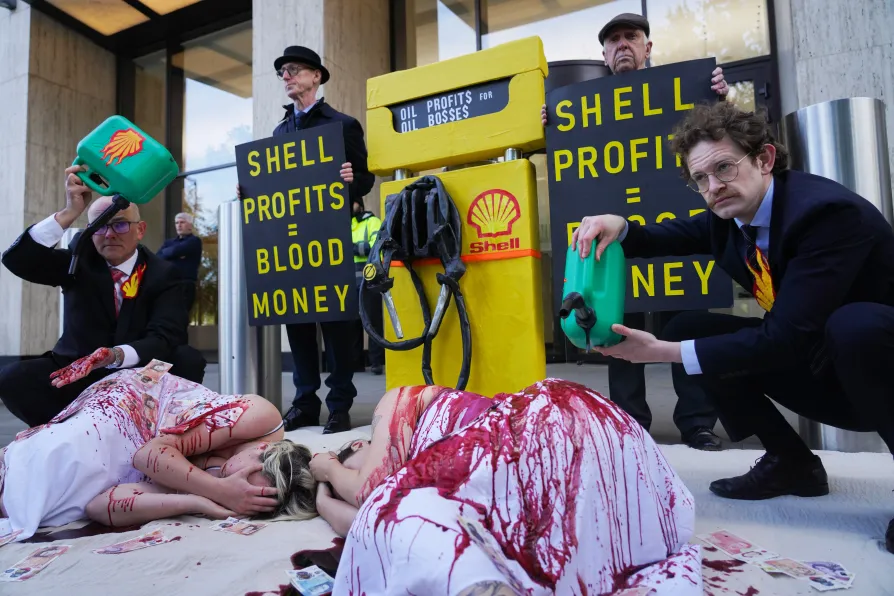
 Protesters gather outside Shell’s London headquarters [Pic: Fossil Free London]





LABOUR was urged to back hard-up Britons by closing energy tax loopholes after Shell reported “obscene” £5 billion profits thanks to the Iran war today.
Europe’s biggest oil and gas producer sparked fury as it reported better-than-expected quarterly takings after the Middle East conflict sent energy prices soaring.
New analysis today showed energy giants have raked in more than £26.2bn in the first three months of the year, including around £3bn from Britain alone.
The End Fuel Poverty Coalition said this equates to £102 in profit for every household in the country, as it led calls for energy profits to be taxed properly amid anger over a four-year-old tax loophole on up to 91 per cent of energy firms’ spoils of war profits.
Coalition co-ordinator Simon Francis told the Morning Star: “While the energy profits levy (EPL) is in place, it seems to appear that firms like Shell will always look to find ways around paying the full whack, such as creating firms like Adura.”
A loophole in the EPL — a 35 per cent tax on top of the standard 40 per cent rate applied to profits from British oil and gas extraction — allows companies that invest in new projects to pump fossil fuels out of the North Sea to see their tax relief rise to 91 per cent, according to the New Economics Foundation.
“Around a quarter of every energy bill is taken in profit by a range of firms involved in the industry and that figure could well grow thanks to the war profits still being generated by the energy industry,” he added.
“It can’t be right that while the public see their energy bills increase, energy firms make billions and employ rafts of accountants to maximise their profits and lobbyists to campaign against the windfall tax.”
In December, it emerged that Shell failed to tell the government about the huge implications for the public purse from its new merger with Equinor during high-level meetings.
Meeting records obtained through Freedom of Information requests by Global Witness revealed the merger’s potential for a £1.3bn tax dodge, sparking calls for a government investigation as the Shell and Equinor joint venture Adura was launched.
Today Global Witness head of news investigations Patrick Galey said: “It’s time to break free from the fossil fuel doom loop — we need robust taxes on big polluters to insulate households from price shocks and to fund a cheaper, cleaner, more stable energy future for all.”
Green Party leader Zack Polanski said it was “obscene” that fossil fuel companies are “making windfall profits from war when energy prices are rising and people are increasingly uncertain over how they are going to pay their bills.
“We need a real, loophole-free windfall tax with no exemptions for reinvesting in fossil fuels,” he added. “A robust tax that claws back every single pound of reckless profiteering from this crisis and repurposes it immediately to protect every home in the country.”
A Momentum spokesperson said: “This is the result of a system that prioritises profit over the living standards of ordinary people. The government could go further by bringing energy companies into public ownership.”
Danny Gross, a climate campaigner at Friends of the Earth, said: “Fossil fuel giants are pocketing monstrous profits while drivers are being squeezed at the petrol pump and households are set to pay higher energy bills.
“The answer is clear: strengthen the windfall tax on these indefensible profits and break our dependence on fossil fuels by powering our economy with homegrown renewables.”
Anne Jellema, the executive director of the climate campaign group 350.org, added: “Governments must act now to tax these excess profits and use the money to protect vulnerable households and expand affordable, homegrown renewable energy.”
Tessa Khan, founder and executive director of Uplift, said: “These are unearned windfall profits handed to them by Trump’s war with Iran.
“At the same time, Shell is lobbying the UK government to scrap the windfall tax, which would amount to an enormous tax break for the industry, all while households brace for higher bills. It’s not just tone-deaf, it’s indefensible.”
The increase in oil prices helped BP to last week report better than expected profits of £2.35bn for the first quarter, more than double the £1bn it made in the same period last year.
Shell was contacted for comment.
