


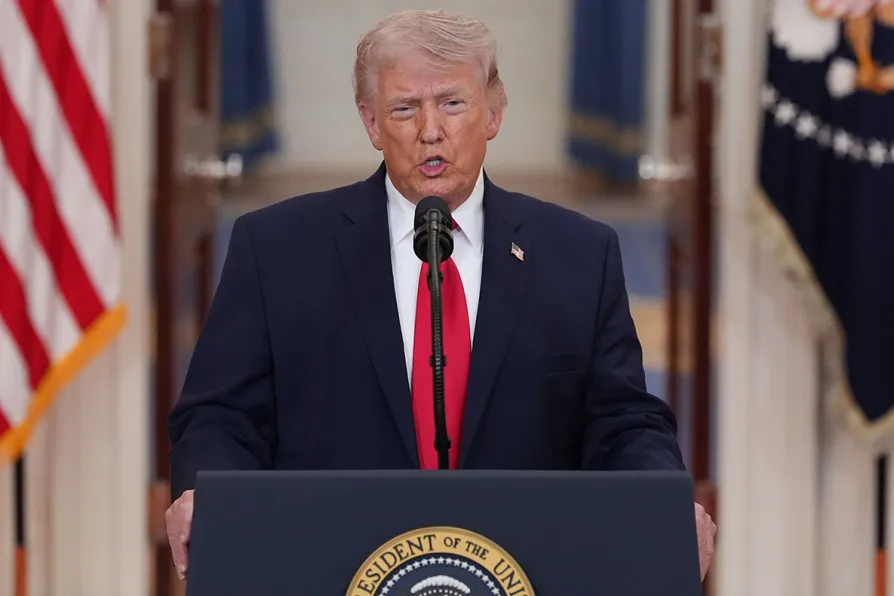
 President Donald Trump speaks about the Iran war from the Cross Hall of the White House, April 1, 2026, in Washington





IRAN kept up attacks today in retaliation for the illegal and unprovoked war launched against it by the United States and Israel.
Tehran’s forces fired more missiles at targets in Israel and Gulf Arab states, demonstrating their continued ability to strike across the region even as US President Donald Trump claimed the threat from the country had been almost eliminated.
Iran’s attacks on Gulf states and its chokehold on the Strait of Hormuz have disrupted the world’s energy supplies and plunged the global economy into crisis.
In in a television address on Wednesday night Mr Trump claimed to believe the strait can be taken by force — but said it was not up to the US to do that.
He encouraged countries that depend on the passage of oil through the strait to “build some delayed courage” and go “take it.”
Before the US and Israel started the war on February 28 with strikes on Iran, the waterway was open to traffic and 20 per cent of all traded oil passed through it.
Iranian officials have insisted the strait is open to all, except the US, Israel and their allies.
Tehran responded defiantly to Mr Trump’s speech, in which he asserted that US military action had been so decisive that “one of the most powerful countries” is “really no longer a threat.”
Iranian military spokesman Lieutenant Colonel Ebrahim Zolfaghari insisted today that his country retains hidden stockpiles of arms, munitions and production facilities.
Facilities targeted so far by US strikes are “insignificant,” he added.
During his speech, Mr Trump claimed the US “core strategic objectives are nearing completion,” without clarifying what they were.
Just before he began his address, explosions were heard in Dubai as air defences worked to intercept Iranian missiles.
Less than half an hour after the US president’s TV address, Israel said its military was also working to intercept Iranian missiles. Sirens sounded in Bahrain, where the US Navy’s 5th Fleet is based, immediately after the speech.
Attacks continued across Iran today, with strikes reported in multiple cities.
In London, talks took place between 35 countries, with the notable exception of the US, focused on political and diplomatic measures to reopen the strait.
No country appears willing to try to force open the strait while the war is raging.
French President Emmanuel Macron, on a visit to South Korea, dismissed talk of a military operation to secure the waterway as “unrealistic.”
