ANGUS REID urges us to understand the persecution of Jason Arday from a political and historical perspective, and to see the victim in human terms



Icons of the working class, or patronising exploitation?
JOHN GREEN explores the controversial and popular images of the late Martin Parr, made in the heyday of Thatcherism
 [Pic: © Martin Parr / MAGNUM PHOTOS]
Re-releases of the classics Gypsy Rhumba and Buena Vista Social Club, and a stunning album by Palestinian artist Faris Ishaq
Nothing, says ANDY HEDGECOCK, can rescue this undistinguished amalgam of ponderous melodrama and shallow philosophical speculation
JAMIE BRITTON invites readers to visit 3,500 locals as part of a marathon artistic pub crawl
JOHN GREEN welcomes a valuable and incisive analysis of a world become hyperpolitical but without the mass movement institutions to represent it





The Last Resort: 40 years on
Martin Parr, Dewi Lewis, £30
The photos in “The Last Resort – Forty Years On” still have that elusive iconic quality.
Shot around the seaside town of New Brighton between 1983 and 1985, The Last Resort was one of the pioneering bodies of work driving British colour documentary photography, and established Martin Parr as one of Britain’s most influential photographers. “When I get to the Pearly Gates, those are the ones I’d probably get out first!” Parr noted.
This book is being published in association with the Martin Parr Foundation to coincide with an exhibition being shown at the Foundation’s Bristol-based gallery to honour the photographer following his death in December. The book includes images from the Last Resort series, as well as extensive archive material, contact sheets and items of ephemera from his personal collection.
Parr was born in Epsom, Surrey, and educated at Surbiton grammar school, before he moved to Wallasey as his wife found a job there. “The advantage of coming from Surrey is that everywhere else looks more interesting,” he would say. “There was a sense of community [in the north] that didn’t exist in the south.”
Being middle class and a southerner were not the best credentials to endear yourself to northerners, and predictably, he has been accused of patronising the working classes, looking down on them or lampooning them.
Image
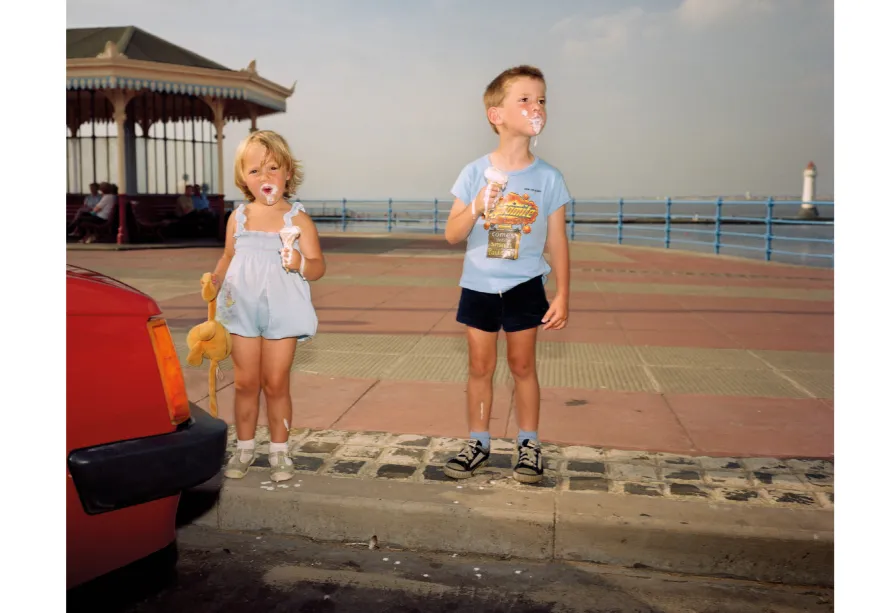
Undoubtedly his images, with their often garish colours and invariably unflattering poses, do reveal a working class at leisure that is not exactly inspiring or heroic. They are more reminiscent of those old picture postcards of bosomy women and paunchy men, and with suggestive captions. Although he does often capture intimate and tender moments of human interaction, he does remain an outside observer; he is not part of them and their culture. His upbringing stayed with him. Tall and laconic, Parr dressed like an insurance salesman or junior accountant.
Isaac Blease, Archivist at the Foundation, explores the background and the influences that led Parr to move from black and white photography to colour. Peter Brawne, the designer of the original 1986 book discusses how the design process was developed as well as the experience of working with Parr. Finally, there is a short text by Parr’s wife, Susie, in which she describes her perspective on New Brighton and her view of the first exhibition of the work at Liverpool’s Open Eye Gallery in 1985.
His work has been controversial and has provoked extreme commentaries, such as that of Henri Cartier-Bresson, who said Parr was a fascist and an exploiter, although he subsequently apologised for this remark.
He became famous for his highly saturated, ring-flash close-ups of garish and grotesque beach scenes and social occasions from across the class divide, a style that brings together the methods of photojournalism, conceptual and art photography, advertising and commercial photography. “I’m attracted like a jackdaw to colour and sweets,” Parr said.
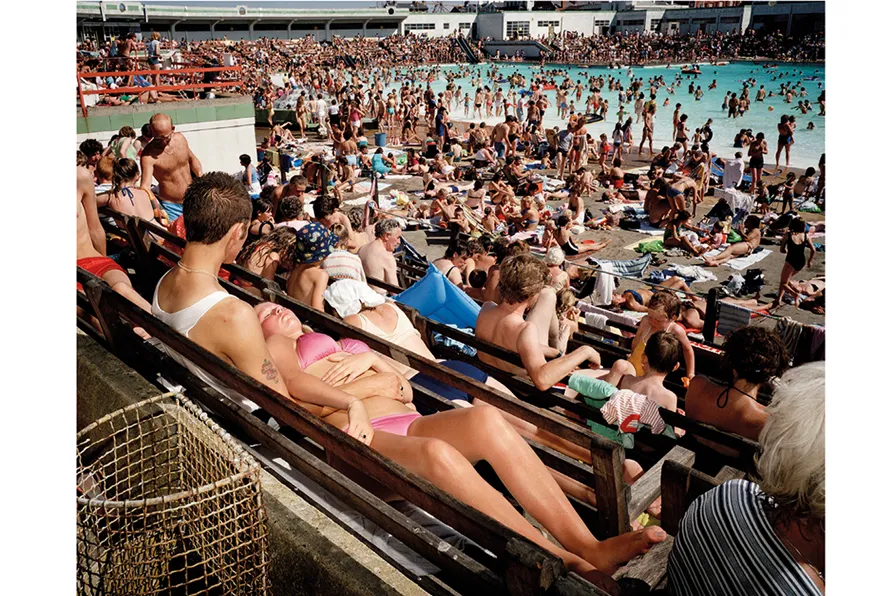
From the New Brighton series, one image shows a packed lido foregrounded by a rusting wire litter basket. In another, a causeway near the beach has a baby crying in its stroller, while its mother lies indifferently sunbathing on the concrete, surrounded by scattered shoes and clothing, a crisp wrapper and a discarded biscuit among other carelessly cast-off items. Yet another shows a mother changing her baby, while sitting on a concrete walkway alongside a stretch of debris-polluted water.
Image
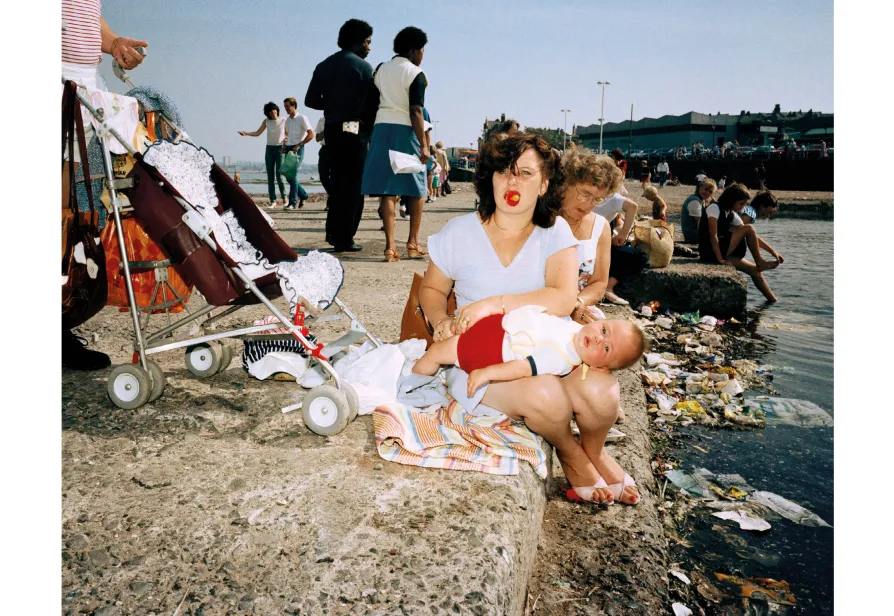
Such images typify his approach: turning the mundane into something exotic. He captures the tackiness of cheap and shoddy entertainment, greasy spoon cafes and rusting street furniture, but not condescendingly.
His way of working was certainly innovative and pushed photojournalism in a new direction, reflecting the tenor of those Thatcherite times. Others felt it flew in the face of the “humane photo-documentary” tradition.
A need to break with the conventions of his black and white imagery of the 1970s was building against a rising frustration with the humanist tradition in photography. New Brighton was an area symbolic of northern neglect. When, in 1983, Martin began photographing what would become The Last Resort, Thatcher was entering her second term, and the effects of cuts to industry and social services were being felt particularly in the North. Originally a place to relax for the wealthy merchants of Liverpool, New Brighton hit the peak of its popularity during the first two decades of the 20th century.
As Isaac Blease says in his introductory remarks: “On this hallowed ground, heritage and culture collided with the stark economic downturn of the period, as the project subtly repositioned the seemingly untouchable institution of the British seaside resort as a frontier for the wider changes unfolding across the country.”
Through their architecture, amusements, and collective memories, English holiday resorts occupied a treasured place in the national imagination. Their status had steadily diminished with the rise of affordable package holidays abroad, often becoming under-resourced and marginal places, where fun and decay existed side by side.
With his move to colour, he began using 120 medium-format film and fill-in flash, working with the newly released Plaubel Makina W67 — a lightweight camera combining Japanese and German engineering — and started by photographing urban areas of Liverpool and Merseyside.
Parr was effectively photographing what was on his doorstep, and that which he would often describe as “ordinary.” He spoke about being more concerned with images of everyday events that happen to all of us: waiting in a queue, carrying shopping home from the supermarket, a crying baby; as opposed to focusing on the extreme events in society, although the political was always looming in the background.
As an artist he never wavered in his quest for that elusive image: the one where everything comes together. The Last Resort contains a number of such unique images.
He would remain, by his own estimation, politically of the soft left. In his eyes, the photographs in The Last Resort were not patronising but “lyrical,” a poetic version of the social research project, Mass Observation. However, this was not how they were often seen by many of his profession.
The Martin Parr Foundation in Bristol, which he set up in 2017, supports emerging or overlooked British artists through bursaries and buying their work, as well as holding his own vast archive.
He also published a photographic autobiography, Utterly Lazy and Inattentive (Particular Books, 2025), the title coming from a school report on the 14-year-old Parr.
Although renowned largely for his iconic images of the northern working class, his oeuvre was much wider and encompassing but perhaps not so memorable. I feel he was, in many ways, the photographic equivalent of LS Lowry or Phillip Larkin.
The Last Resort: 40 years on runs at the Martin Parr Foundation Gallery, Bristol February 20-May 24. For more information see: martinparrfoundation.org
