


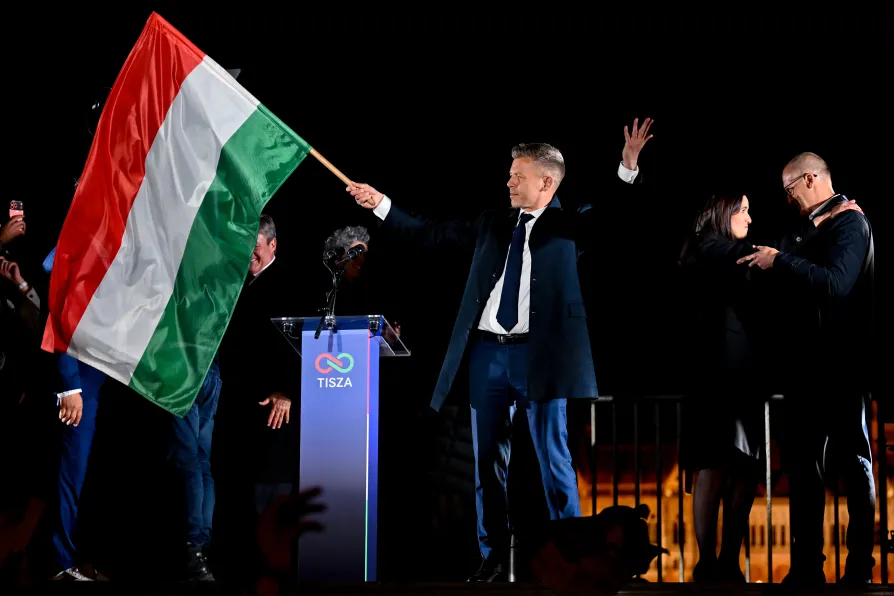
 Peter Magyar, leader of the opposition Tisza party, waves the Hungarian flag following the announcement of the partial results of the parliamentary election in Budapest, Hungary, April 12, 2026






FEW Hungarian elections have received as much global attention as last weekend’s, which ended the 16-year rule of premier Viktor Orban.
The reason is not hard to find – national political dramas are today played out in a context of mounting great power rivalry.
Thus Orban’s defeat was welcomed by the European Union as removing an obstacle to its federalising ambition.
It was conversely a setback for Trump’s USA and Putin’s Russia. Trump had dispatched his Vice-President JD Vance to back Orban in the last days of the campaign – the result is a further sign of the US president’s political toxicity in Europe.
For Putin, Orban was helpful in disrupting the EU’s drive to keep the war in Ukraine going by all possible means.
The result is unwelcome to Israel too – Orban combined staunch support for Israel’s genocidal aggression while deploying antisemitism for domestic political purposes.
For the left, the outcome is therefore ambiguous. It is entirely welcome that a far-right leader who squeezed media freedom and judicial independence while demonising migrants and wallowing in corruption has been repudiated.
But if the victory of Peter Magyar in an election where the left was entirely absent empowers EU neoliberalism and the forces of war, nothing has been gained. Neither far-right populism nor centrism answer today’s social crisis.
