The 25th anniversary meeting of the Shanghai Co-operation Organisation in the Kyrgyz capital may offer a glimmer of hope that international relations do not need to be defined by endless confrontation, writes KENNY COYLE


 Latest editorial

How British artists rallied to the defence of Republican Spain
JIM JUMP describes how artists in Britain rallied to the anti-fascist cause
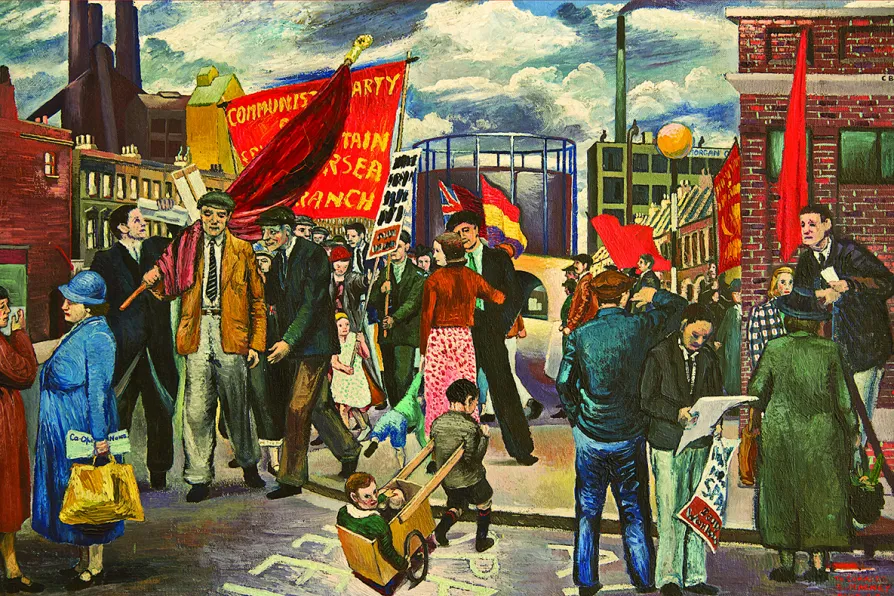 “Demonstration in Battersea, 1939” by Clive Branson who had served in the International Brigades in Spain
The artist, who has just died, is embedded in the subconscious of the Palestinian people
The five young men killed in the A66 crash were responsible for a devastating tragedy — but the crash should force us to ask difficult questions about wider society, argues RENATA MEDEIROS MIRRA
Britain funds the policing of black culture 16 times better than the culture itself. The Diamond Jubilee is the moment to end that, argues CLAUDIA WEBBE
Despite Andy Burnham’s declaration defending the continued partition of the island, all major international and internal trends are converging to make Irish reunification inevitable
Humans are part of the ‘animal kingdom’ – and of nature in general – but also distinct from it and labour (work) is part of what makes us unique, declared Engels. His insights 150 years ago into how our species came to be and how we differ from the rest of nature, are as important today as they were then, says the MARX MEMORIAL LIBRARY
Committee for the Defence of the Iranian People’s Rights general secretary GAWAIN LITTLE discusses the impact of the US-Israeli war on the Iranian people and economy





FOR an insight into how the rise of fascism and the Spanish civil war affected the British art scene, a visit to the Towner gallery in Eastbourne will prove an eye-opener.
Running until October 18, the Comrades in Art: Artists Against Fascism exhibition showcase the work of painters, sculptors and illustrators associated with the Artists International Association (AIA).
The AIA was founded in 1933 explicitly to counter the rising threat of fascism. The artists were responding to a world in crisis, reeling from the economic crash of 1929, mass poverty and unemployment and the drumbeat of war.
The death of artist Felicia Browne fighting as a militiawoman in Spain in August 1936, had a profound impact on AIA artists. Julian Trevelyan, for example, said their “thoughts and consciences” were turned to Spain as a result.
The painter wrote: “Until the Spanish civil war started in 1936, there was an air of gentle frivolity about our life in London. True, the Hitler terror had begun, and refugees were pouring into England. Moreover, it was clear from Abyssinia and Japan that war and violence were to be the order of the day.”
Even artists who didn’t do overtly “political” work became involved in the AIA’s fundraising activities for Spain. The Portraits for Spain scheme saw more than 100 members offer their usual fees to go towards food and medicine for Spain and to help refugees. Among those who took part were Eric Ravilious and Augustus John.
Speaking after the end of the war in Spain, art historian Kenneth Clark, then director of the National Gallery in London, praised the AIA for making artists “more conscious of the world of political ideas.” He went on to recall the banners painted to “show sympathy with the Spanish government during the Spanish civil war.” Six outstanding examples are held by the Marx Memorial Library in London.
The AIA brought together artists of varying styles, from Royal Academy stalwarts to younger modernists and surrealists, and differing political persuasions on the left.
AIA founder members Pearl Binder, James Boswell, James Holland, Betty Rea, Cliff Rowe and Nan Youngman feature in the Eastbourne exhibition — and in the book with the same name as the exhibition written by curator Any Friend. Their works are shown alongside ones by established artists who supported the association, including Laura Knight, Paul Nash and Lucien Pissaro.
Another AIA artist, Reg Turner, recalled: “The factor that kept us together was the anti-fascist business and the civil war in Spain… however varied we were in work or outlook.”
It was the AIA that created the British Battalion’s now iconic banner. Its central image of a clenched surrounded by the words FREEDOM DEMOCRACY PEACE on a red background now features on countless T-shirts, badges and tea towels — and has been replicated by the International Brigade Memorial Trust (IBMT) for its own banner.
It was originally designed by James Lucas and embroidered by Phylis Ladyman. Betty Rea sculpted a clenched-fist pole for it.
Several exhibitions and events were organised by the AIA to raise money for Spain. In London, Artists Help Spain, with contributions from John, Nash, Pissaro and Ravilious as well as Vanessa Bell, Jacob Epstein, Eric Gill and Ben Nicholson, raised enough money to pay for an ambulance and £500 worth of supplies.
Many of these artists, along with Henri Matisse, Virginia Woolf and others, signed a letter to the Manchester Guardian in June 1937 in which they proclaimed: “Our friends in fascist countries have been silenced, imprisoned, or exiled. Now in a country [Spain] which has contributed in no small part to our culture, a struggle is going on before our eyes… Whether we wish it or not, we cannot remain unmoved.”
Woolf, whose nephew Julian Bell was killed in Spain while driving an ambulance, had already penned an article for the Daily Worker in December 1936 in which she praised the work of the AIA.
“How can an artist remain at peace in his studio?” she asked, given the news from Germany, Spain and elsewhere. “He is forced to take part in politics: he must form himself into societies like the Artists International Association.”
Jim Jump is the chair of the IBMT.

Similar stories
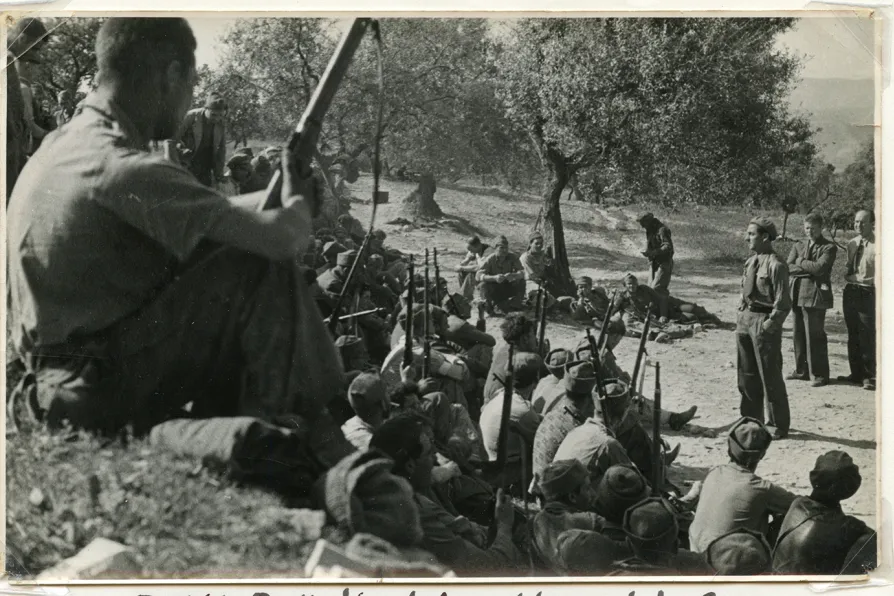
Thousands of remarkable Britons left ordinary lives behind to join the struggle against Franco. Here is a snapshot of those who answered the call
![Exhumation of a mass grave of 26 Spanish Republicans killed by the fascists at Estépar, near Burgos. They were among an estimated 2,500 executions carried out in the area [Pic: Mario Modesto Mata /Creative Commons]](https://msd11.gn.apc.org/sites/default/files/styles/desktop/public/2026-07/1280px-Spanish_Civil_War_-_Mass_grave_-_Este%CC%81par%2C_Burgos.jpg.webp?itok=CRZDhTXK)
Historical shame prevents the International Brigades and those Spaniards who supported the Republic from being properly recognised and honoured, writes NOELIA SANCHEZ
![Harry Pollitt (right) with International Brigade volunteer David Guest, who was killed at the Ebro in July 1938 [Pic: Marx Memorial Library]](https://msd11.gn.apc.org/sites/default/files/styles/desktop/public/2026-07/a-2_a_50b_Harry%20Pollitt_David_Guest.jpg.webp?itok=Ag0u-8n5)
ALEX GORDON applauds the leading role played by Harry Pollitt and the Communist Party in the fight against fascism in Spain and salutes the memory of the International Brigades
![Meirian Jump with MML archivist Matt Dunne [Pic: Marx Memorial Library]](https://msd11.gn.apc.org/sites/default/files/styles/desktop/public/2026-07/image.png.webp?itok=EO4HHX_7)
The Marx Memorial Library’s Spanish Collection remains a powerful tool for the working-class movement today, writes MML director MEIRIAN JUMP