

 Latest editorial
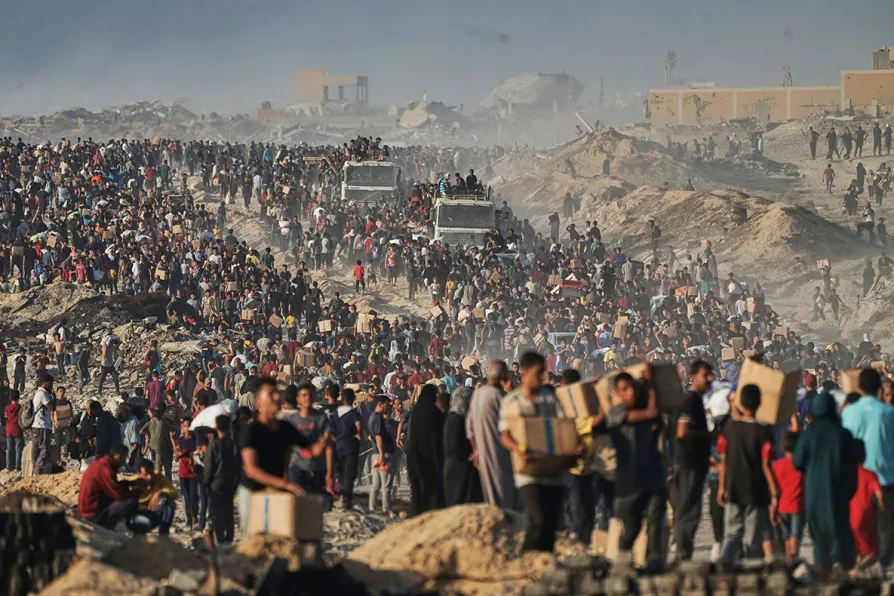 Hamas militants and Egyptian workers accompanied by members of the International Committee of the Red Cross (ICRC) head to Zeitoun neighbourhood of Gaza City to search for the remains of deceased hostages, December 8, 2025





A SENIOR Hamas figure warned today that the Palestinian resistance group would not move forward into the next phase of the Gaza ceasefire agreement until more pressure was placed on Israel.
Husam Badran, a member of Hamas’s political wing, said pressure needed to be applied on the Israeli authorities to open a key border crossing, stop deadly strikes and allow more aid into the Palestinian territory.
Israel’s government says it’s ready to move into the next, more complicated, phase of the ceasefire deal — even as it has called on Hamas to return the remains of the last Israeli hostage held in Gaza.
Mr Badran called for the “full implementation of all the terms of the first phase” before the next stage is begun, including an end to the continuing demolition of Palestinian homes in the part of the territory still controlled by Israel.
Israeli military operations in Gaza have resulted in the deaths of at least 376 Palestinians since the ceasefire officially began on October 10, according to Palestinian health officials.
It has also accused Hamas of violating the ceasefire and defended its strikes as responses to attacks on its soldiers or to people coming too close to an ill-defined line established by the ceasefire agreement.
However, most of those killed have been women and children and some strikes have occurred in the “safe zone,” according to Palestinian health officials.
With a humanitarian crisis continuing in Gaza, the United Nations and other aid organisations said that not nearly enough aid was entering the territory.
Hamas’s comments come as the US-led plan outlining the future of the devastated territory has gained momentum in recent weeks.
Israeli Prime Minister Benjamin Netanyahu said on Sunday that Israel and Hamas were “very shortly expected to move into the second phase of the ceasefire” after Hamas returns the remains of the last hostage held in Gaza.
But it appears that the group has struggled to find the remains amid the destruction caused by Israeli strikes.
Elsewhere, Israel launched a new wave of air attacks on southern Lebanon on Monday.
Having largely ignored the ceasefire agreed with Hezbollah last November, Israeli forces attacked Mount Safi, the town of Jbaa, the Zefta valley and the area between Azza and Rumin Arki, said the Lebanese National News Agency.
The Israeli military said it had struck several sites linked to Hezbollah, including what it claimed was a special operations training compound.
There was no immediate report of casualties.
