

 Latest editorial
TURLOUGH KELLY explains why the coalition government is so eager for the home match against Israel to go ahead despite widespread opposition
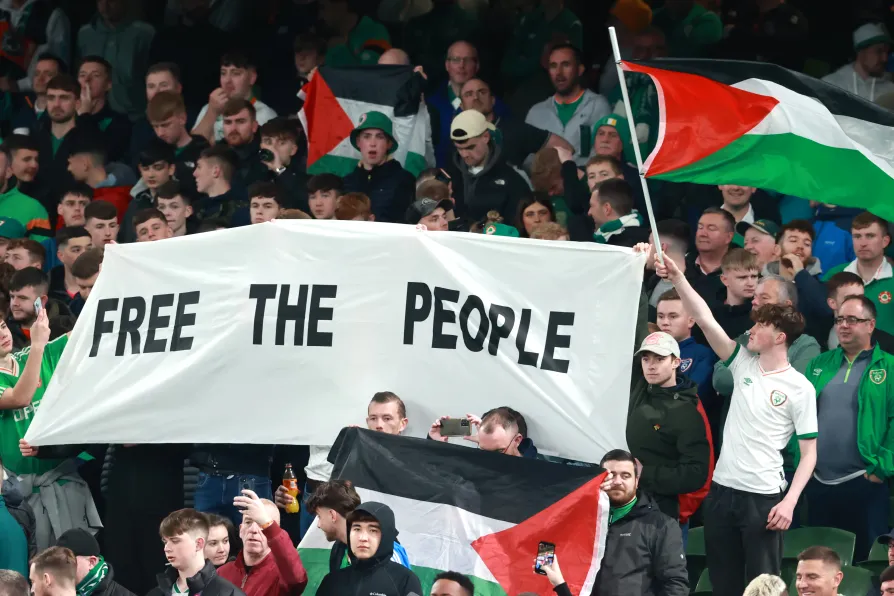 Palestine flags in the stands prior to the UEFA Euro 2024 Qualifying Group B match at the Aviva Stadium, Dublin, October 13, 2023






THE DRAW for League B of the Uefa Nations League is generally as low-stakes as international football gets in Europe. But when Patrick Vieira plucked the name of Israel to play in the Republic of Ireland’s qualifying group in February, Irish football was swiftly plunged into crisis.
With its own history of resistance to occupation and empire, Ireland has long been a hotbed of pro-Palestinian sentiment. This is as true of Irish football as of Irish society, with Palestinian flags almost ubiquitous at League of Ireland grounds.
The 2024 re-election of the grand coalition of Fianna Fail and Fine Gael – historically, rival parties on the Irish right – has placed that solidarity under strain.
Led by an increasingly hardline pro-US Taoiseach in Fianna Fáil’s Micheál Martin, the coalition has made it clear that sympathy with Palestine will not be allowed to jeopardise the state’s relationship with US capital.
Under the stewardship of Fianna Fail and Fine Gael, Ireland’s economy remains heavily reliant on foreign direct investment, much of it from the US.
It is in this context that both Martin’s government and the Football Association of Ireland have insisted that the fixtures go ahead as scheduled, with Dublin set to host the Israeli team in October, despite suggestions that the home game might be switched to a neutral venue.
The footballing public remains firmly against fulfilling the fixtures; last November, Football Association of Ireland delegates voted overwhelmingly to submit a motion to Uefa demanding that Israel be expelled from European football.
That motion, flatly dismissed by Uefa, reflected a broader mood in Irish society. In December, Ireland’s state-funded broadcaster RTE declared that it would not participate alongside Israel at this year’s Eurovision Song Contest, a decision prompted by trade unionists at the broadcaster in response to the widespread killing of journalists in Gaza.
Leading figures within the Irish game, including former national team manager Brian Kerr, have lent their voices to the boycott call, and a survey by the Professional Footballers’ Association of Ireland found a hefty majority of Irish-based pros opposed to the game going ahead.
Football Association of Ireland CEO David Courell remains unmoved, insisting the fixture must be fulfilled in the interests of Irish football, while admitting that Uefa have threatened no consequences beyond the forfeiture of six points in the relatively unimportant Nations League.
Martin’s government has been even more insistent on the matter, with the Taoiseach smartly out of the traps to demand that the fixture take place.
That demand was swiftly echoed by the sports minister, Patrick O’Donovan, a pugnacious character whose past antics have included instigating a culture war over the use of live animals in a civic Christmas crib (he was in favour of it).
There is an undoubted sense that Martin’s government, perpetually seeking to signal its openness to US business, has been spoiling for a fight with the Palestine solidarity movement for some time.
Last December, the Taoiseach flew two-footed into attempts to rename Dublin’s Herzog Park, which currently bears the name of Chaim Herzog, an Irish-born president of Israel (and father of its current president).
The proposal was scrapped after government intervention, ostensibly prompted by concerns for the impact on Dublin’s small Jewish community, although subsequent Freedom of Information requests revealed a flurry of diplomatic activity between Dublin, Washington and Tel Aviv on the day of the Taoiseach’s edict.
The contrived controversy over Herzog Park reflects a broader rowing-back on official solidarity with Palestine, and a more general repudiation of Ireland’s anti-imperialist past.
Unburdened by the need to assuage public opinion after his re-election, Martin has instead pursued long-cherished but unpopular goals of the Irish political class, most notably the normalisation of relations with Israel, and the undermining of Ireland’s military neutrality.
A successful showdown over the Israel game in October, which is sure to be fiercely opposed even if it goes ahead as planned, will allow the coalition to signal Ireland’s return to the European mainstream on the issue.
Like Martin, FAI chief Courell, whose my-way-or-the-highway approach mirrors the Taoiseach’s own, will be hoping that World Cup qualification takes the heat out of the debate. A remarkable victory over Hungary last November left the Republic in with a shout of a first World Cup appearance since 2002.
But even if manager Heimir Hallgrimsson — who has himself softened previous opposition to playing Israel since the draw — guides Ireland to the World Cup (and who knows what controversies await in Donald Trump’s host nation?), the Israel fixtures will continue to loom darkly on the horizon.
If the home game goes ahead without controversy, Martin’s government will feel a little more secure in its mission to radically re-shape Ireland’s foreign policy alignments.
It is still possible, however, that public revulsion towards the government’s stance may turn that victory to ashes in his mouth.
Turlough Kelly is a freelance journalist based in Dublin.
