
Washington’s inability to subjugate Iran is an example of how it is trying to preserve a regional order that no longer exists, argues RAMZY BAROUD


Fictitious capital and the rootless ruling class
The social base of the old Tory Party has disappeared as surely as that of Labour, argues ANDREW MURRAY – today’s right are the debased offspring of a capitalism that speculates without investing and profits without producing

 The London Stock Exchange. The City facilitates the 'prolonged hegemony of speculation, trading without investing, profiting without producing within British capitalism'

US financial instability is exposing the limits of a dollar-dominated global economy — and giving the Global South a historic chance to build an alternative, says MURAD QURESHI
DOUG NICHOLLS says the parasitic finance markets must be challenged or another British government could be toppled
The late country singer’s Imagination Library has put hundreds of millions of books into children’s hands. We should build on that legacy by defending the libraries at the heart of our communities, says BRENDA AITCHISON
Deprivation is a fundamental factor in criminal behaviour that must be addressed but, KENNY MacASKILL argues, there needs to a major rethink in sentencing to tackle overcrowding
MML director MEIRIAN JUMP outlines the recently refreshed library’s busy autumn schedule that ranges from book sales, archival exploration, community work with online education and the ever popular site tours
TONY BURKE surveys the shifting political landscape and the challenges Labour needs to address if it is to prevail in the 2028 federal elections





IN A capitalist system we are unavoidably cursed with a capitalist class.
What happens then when fictitious capital and those who benefit from it rule the roost? Is a fictional capitalist class now in charge?
Addressing that question may help us get to an understanding as to what has happened to the Tory Party over the last generation, and the last five years in particular.
All that is solid melts into air, the celebrated insight of Marx and Engels, hardly does justice to it.
Few things seemed more solid than the Conservative Party, which liked to style itself the most successful political party in world history, a title only the Communist Party of China could dispute, albeit in a very different social environment.
It was the main political expression of a powerful, confident, cohesive and adaptable ruling class, which by the 20th century had successfully fused a landed aristocracy — from which the country’s traditional governing elite was drawn — with finance capital in a bloc able to mobilise sufficient mass sentiment against the rising menace of working class power.
Now look at it. The Tories are proof of Ernest Hemingway’s so-called Law of Motion expressed in the words of a character in The Sun Also Rises who, when asked how he went bankrupt, replied “gradually, then suddenly.”
Evicted from office with their lowest-ever share of the vote, the Tories presently poll around 20 per cent, a lesser figure still. They have trailed Reform on the right for 18 months and are now just one of a jostle of parties elbowing each other on that side of the political spectrum.
Few anticipate a Badenoch premiership as the outcome of the next general election.
Labour faces similar travails. No-one seriously evaluates Labour’s prospects without acknowledging that they are, at least in significant part, conditioned by the erosion — or perhaps evisceration — of its social base over the last 50 years.
It should be obvious that a radical change in the circumstances of one class in society can only be reflected in major modifications in all others, too. Class expresses an inter-relationship, and cannot easily be isolated for laboratory inspection.
The Tories have been manifesting pathologies for some time. They are caused by the same processes which have undone the strongholds of organised labour in Britain — to whit, the nexus of globalisation, financialisation and neoliberalism which have reshaped world capitalism from the 1970s onwards.
The last column sketched the impact of all that on social democracy. But it has also undone the prized stability of the British bourgeoisie, uprooting it from the soil of the society it led.
Those setting the pace for British capitalism — the modernised worshippers of the Golden Calf in the City — have scant interest in British society, beyond the continued malleability of its legal system, liquidity of its markets and stability of its currency.
They face outwards to the world, not inwards to the country. They are in Britain but scarcely of it. For the props of the bourgeois order, great — the army, religion, monarchy, social hierarchy — and small — community leadership, charitable association, the discharge of obligation — they care little.
It was an unintended consequence of Margaret Thatcher that she turned the Conservative Party from a pillar of the social order into an authoritarian clique in the service only of global money-making, incapable any longer of articulating a plausible national project.
That is by no means to idealise the Tories of old. The flint-faced men of money were always heard the loudest in its counsels. But they never discarded that crucial element of noblesse oblige, of the benevolent hegemon which allowed them to pass off, plausibly for millions, their own interests as those of society as a whole.
Their leaders were as varied as you might expect from a great, once all-conquering, class. But two things they were not — the Conservatives abstained from electing the disreputable or the fanatical as their chief, for fear of what conclusions the other orders might draw.
Even Thatcher herself, certainly the prisoner of a deeply held and severely circumscribed collection of attitudes and prejudices, made some effort at pragmatic adaptation when needs must.
Only in her last days in office — and still more thereafter — did she become captive to her own self-mythologising as freedom’s intransigent spear-carrier, scorning any softening counsel. As these symptoms grew more lurid, her own party did not hesitate to kick her to the kerb.
Today, we are in the age of Boris Johnson and Liz Truss, the brazenly disreputable and the frankly unhinged, chosen to re-enact the fantasies of reactionary cliques rather than offer good governance on behalf of the ruling class.
We are also in the age of Nigel Farage, Robert Jenrick and Rupert Lowe, the ascendant right.
Here we come back to fictitious capital, that is capital which does not seek accumulation through the production of value, but accumulates through staking claims to value already in circulation, or value anticipated but not yet produced and which perhaps never will be.
As we saw in 2008, those claims come to represent many multiples of the actual underpinning value, turning capitalism into a vast ponzi scheme. Its expressions — state debt, stocks, shares, securities and credit, and speculation in all of the above — constitute a radical fetishisation of unsustainable accumulation.
And it remakes capitalists in its own image, dispersing the solid in favour of comic book phantasmagoria.
Thus Nigel Farage is, we learn through a daily drip of revelations, funded very largely and lavishly by those most fictitious of capitalists, the crypto-entrepreneurs, some of them literal gamblers with criminal convictions. Nigel Harborne is a very rich man but, ensconced in his Thai refuge, is he a part of a cohesive ruling class?
Or consider the brazen attempts to game the British political system by Elon Musk, Peter Thiel and the other mewling man-childs of big tech. Do they have the slightest interest in the wellbeing of the British people?
They do not. Their interests go no further than maintaining and extending the enormous valuation of their enterprises, which are again speculative bubbles vulnerable to puncturing by decisive democratic intervention.
Rather than seeking to maintain the coherence of society — albeit on the basis of private property and social hierarchy — they pursue its maximal atomisation, its disaggregation into a primal state where it cannot conceivably come together to propose any interference with the realisation of their speculative ambitions.
Thus the political right becomes a rabble of provocateurs competing for the favours of their moneyed masters through the ever-more aggressive promotion of social divisions.
Enoch Powell, let us recall, was immediately evicted from the Tory front bench after his “rivers of blood” speech in 1968, not because contemporary Tories were innocent of racial prejudice but because they saw no interest in recklessly stimulating social conflict.
Today, Powell’s fulminations would pass unremarked. Badenoch’s Tories, Farage and Jenrick’s Reform and Lowe’s Restore are engaged in a Dutch auction of authoritarianism and racism with, sad to say, Starmer’s Labour not exactly absent from the bidding either.
The Tory Party remains a site of struggle, not yet fully absorbed into the new dispensation, nor detached from its traditions. Badenoch is a strident and unpleasant culture warrior, without being a social media-sponsored grifter.
However, she licences the likes of Nick Timothy, shadow justice secretary and once a somewhat interesting conservative thinker, now an Islamophobic demagogue who promised last week to ban pro-Palestinian marches altogether.
Farage is typical of the new right. He may yet quit the field, unwilling to sustain the scrutiny of his personal finances, most likely leaving Reform in the hands of former Tory Robert Jenrick.
Personal spite rather than political substance will likely keep Jenrick and Badenoch apart, as it separates Farage from his erstwhile collaborator Lowe, whose standard now attracts the explicit racists and fascists, not to mention the approval of Musk.
This is not a confident class project. It is the product of the prolonged hegemony of speculation, trading without investing, profiting without producing within British capitalism — a deracinated right wing with no future to offer, only the leavings of an imagined past warmed up in social media vitriol.
If the Conservative Party once exuded the right to rule, this mob have no claim whatsoever on the respect of the populace. Despair is their only recruiting sergeant.
It is not true yet to say the class power in Britain is in the gutter, waiting for someone bold enough to pick it up. But the establishment rests on rotten foundations.

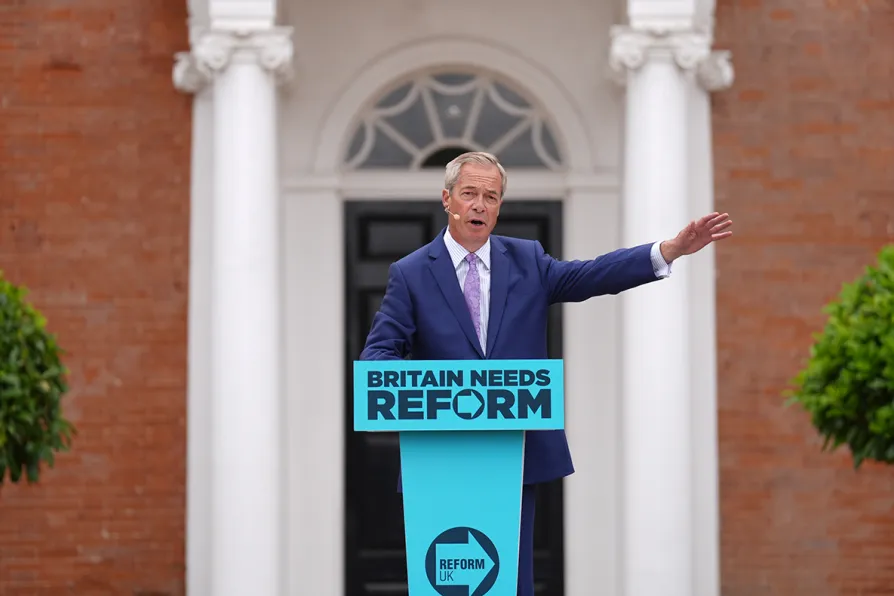
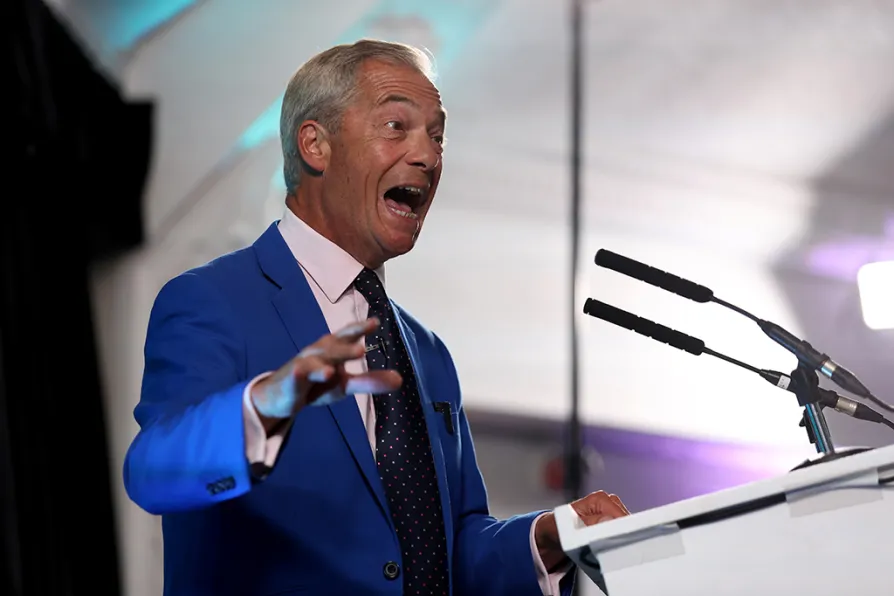
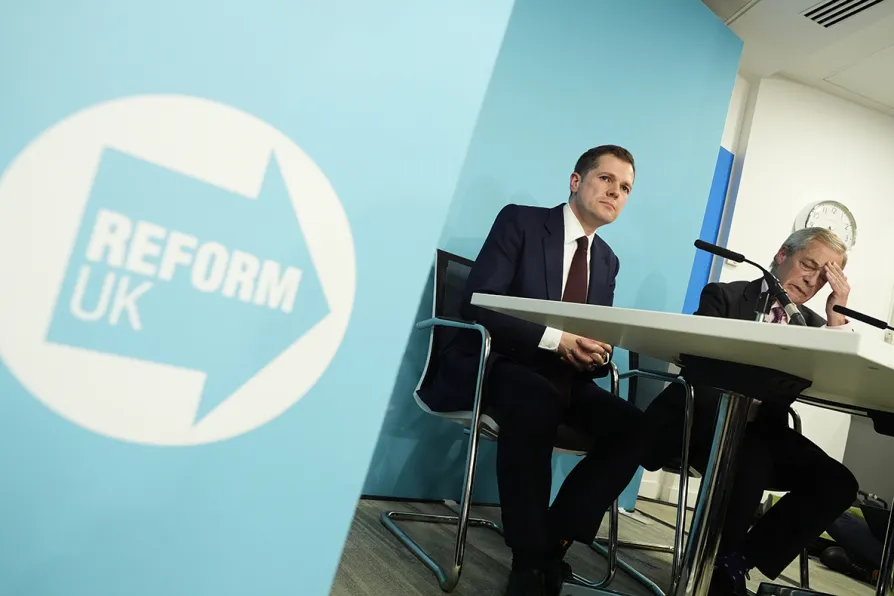
Once derided by Farage as a ‘fraud,’ Jenrick has defected to Reform, bringing experience and political ruthlessness to the populist right — and raising the unsettling prospect of a Farage-led movement with a seasoned operative pulling the strings, says ANDREW MURRAY

The Tory conference was a pseudo-sacred affair, with devotees paying homage in front of Thatcher’s old shrouds — and your reporter, initially barred, only need mention he’d once met her to gain access. But would she consider what was on offer a worthy legacy, asks ANDREW MURRAY