APURBA CHATTERJEE explains how British artists in India used the “picturesque” to reshape colonial landscapes and celebrate imperial power


 Latest editorial

Estonian spirituality
SIMON DUFF recommends a recording of Arvo Part that takes the listener on a pilgrimage through seemingly distant times and events of the Bible
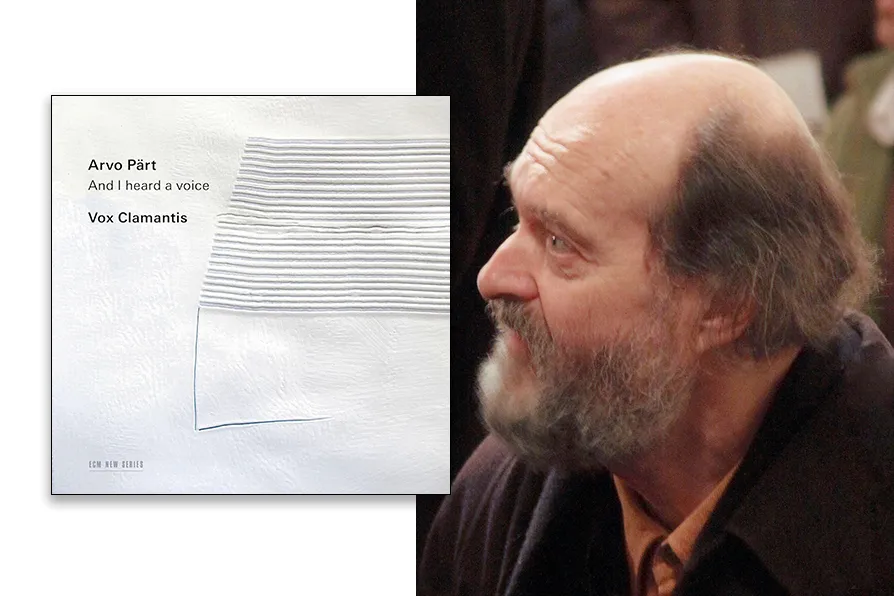 Arvo Part [Pic: Woesinger/CC]

PAUL DONOVAN welcomes a revival of Reginald Rose’s classic play that reminds us of the fundamental need for trials with juries
SIMON PARSONS applauds an exceptional performance of Wesker’s little-known play, by the same actor for whom it was written 45 years ago
ANDY HEDGECOCK and MARIA DUARTE review Late Fame, The Death of Robin Hood, Leviticus, and Gail Daughtry and the Celebrity Sex Pass
ANGUS REID recommends a uniquely accomplished documentary collage that contemplates our relation to the natural world
GORDON PARSONS enjoys Kant’s ‘mind-boggling’ theory of human reality: that we create the reality we experience





Arvo Part
And I heard a voice
Vox Clamantis
(ECM)
★★★★★
ARVO PART turned 90 in September and his importance continues to grow. A sound engineer turned composer, his sonic background fired up his compositional ambitions. There is a religious zeal that is central to his work, not a framework for an elitist approach to making music, or a career in banal soundtrack film work.
A great deal of his inspiration is the music of the Western Middle Ages and the Renaissance. He also uses a formula called the tintinnabuli technique, referencing a slow tempo sparse minimal approach emphasising a tonic triad or cluster set of three notes.
Part explains: “This orderly system penetrates us and our subconscious. One does not realise it, but one accepts it. And it creates a kind of new state, a new order within us.”
His approach is also resolutely text-centred. For many years he has had close ties with the label Edition of Contemporary Music (ECM) that began life in 1969, the life work of founder and producer Manfred Eicher. Its roots remain in the European avant-garde and notions of impressionism and spirituality.
Formed in 1996, Estonian vocal ensemble Vox Clamantis, under their director, conductor Jaan-Eik Tulve and 15 core singers, have established themselves as a leading interpreter of Part’s music. They have collaborated with the composer, and formed a strong rapport with Eicher who produced this new album. All share a deep sense of feeling for both ancient plainchant and contemporary music.
And I Heard A Voice takes the listener on a pilgrimage through seemingly distant times and events of the Bible. Opening with Nunc dimittis, written in 2001, a song of thanksgiving sung to the Lord by the aged Simeon before his death. “For mine eyes have seen the salvation” the ensemble sings.
Haunting throughout, as vocal pitches rise and fall, touching the boundary between this world and the next, the work features an unusually dissonant harmony within the context of Part’s tintinnabuli.
Next up is O Holy Father Nicholas, written in 2021 and taken from the Orthodox Prayer Book, slowing the tempo to allow for a probing, searching, questioning mood. The atmospheres become deeper and more rhythmic.
Recorded in the Haapsalu Cathedral, Estonia, in 2021 and 2022, the album’s engineering by Margo Kolar captures a stunning vocal clarity and full frequency detail that is also apparent in the organ played by Ene Salumae. The overall emotional impact of the album is overwhelming.
