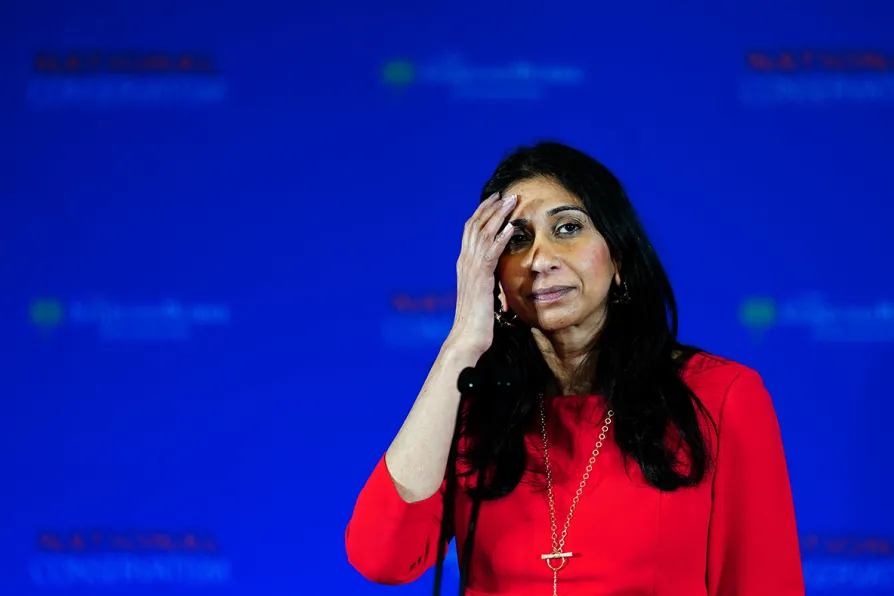
 Home Secretary Suella Braverman speaking during the National Conservatism Conference at the Emmanuel Centre, central London, May 15, 2023





A BATTLE is going on for the soul of the Conservative Party. For the what, it may be asked? We have it on the authority of Matt Hancock, he of the dodgy Covid contracts last seen consuming kangaroo genitals on television: “The Conservative Party is finished if it succumbs to a Trumpian-style takeover … The liberal-conservative majority needs to now stand up for the centre ground to ensure this right-wing takeover doesn’t succeed.
“We moderates can’t let these extreme voices and divisive arguments win the debate or claim the soul of the party,” he said at the weekend.
We shall not pause to enquire into the soul of Hancock. It is doubtful that Mephistopheles would find it worth haggling over. There are larger issues at stake, highlighted by last week’s National Conservative conference in London.
This underlined that there are two Tory right wings at present disputing over the future of the Conservative Party. One majors on undiluted neoliberalism, the other on waging war on “the woke.”
For one the enemy is state intervention in the economy — for the other, it’s migrants, black people generally, critical historians, students, transgender people, and so on.
The two elements are in a frictional relationship. Many of the strident national populists at Natcon were at least somewhat sceptical about the benefits of free market economics, some going so far as to say “Thatcherism is over.”
In a purely electoral sense, the positions are unevenly matched. There is undoubtedly a basis for “culture war” conservatism as a political project, particularly allied to “levelling-up” economics.
It plays to established assumptions, widespread among the middle class and even elements of the working class.
The “culture wars” are of course a misdirection, trying to channel popular anger at declining living standards and degraded public services — perhaps best represented by the water industry fat cats gorging on their dividends as they poison our rivers and beaches — away from the bourgeoisie to minorities, or a phantom “liberal elite” dwelling in academia and the Civil Service.
It does not speak for a majority by any means, but for a minority large enough to make it viable. The US Republican Party grasped this some years ago, and the spread of right-wing populism in Europe also underlines its relative potency.
Its challenge is to convince enough voters that their atavistic prejudices are the most important question, outweighing economic considerations. Natcon partisans thus present civilisation as collapsing thanks to “woke” hegemony, 13 years of Conservative government notwithstanding.
By contrast, pure Friedrich Hayek-style free-market economics enjoy a negligible following — a percentage in the low single digits, according to surveys.
Thus there is a vocal lobby calling for Boris Johnson’s return as Tory leader in order to avert election disaster, but there is no “bring back Liz Truss” campaign: those 47 days were enough.
So the Singapore-by-the-Thames low-wage deregulators need the populist tub-thumpers to construct a workable electoral offer. It does not require much mutual sacrifice — the “culture war” is not necessarily disagreeable to hardcore neoliberals, and is at worst mildly distracting.
And populism’s economic interventionism has seldom passed beyond rhetoric — the Donald Trump presidency and Johnson’s premiership established that. If neoliberalism is a weak hand to play electorally, it holds many of the class power aces nevertheless.
Rishi Sunak seeks to ride both horses for now. The left should do more than merely spectate.
The issues raised, concerning the nation and globalisation and the attempt to generate a refreshed mass basis for ruling-class politics demand a response that roots both the economic crisis and cultural dislocation in the misrule of a decaying capitalist class with no genuine answers to the challenges of our times.


Deep disillusionment with the Westminster cross-party consensus means rupture with the status quo is on the cards – bringing not only opportunities but also dangers, says NICK WRIGHT
The Tories’ trouble is rooted in the British capitalist Establishment now being more disoriented and uncertain of its social mission than before, argues ANDREW MURRAY

Reform’s rise speaks to a deep crisis in Establishment parties – but relies on appealing to social and economic grievances the left should make its own, argues NICK WRIGHT