
PETER MASON applauds the revival, 39 years later with the same team and cast, of Manfred Karge’s version of Brecht’s 100-year-old play, Mann Ist Mann

Dancing on the Tory grave
PAUL DONOVAN is tickled by the excruciating take-downs of one of the funniest, wittiest, political writers around.
 WRONG ANSWER: Nigel Farage and Reform UK's Treasury spokesman Robert Jenrick, March 2, 2026

New releases from Biita Houdei, The Mary Wallopers, and The Tubs
New releases from Biita Houdei, The Mary Wallopers, and The Tubs
MAYER WAKEFIELD applauds a fearless attempt to bring to the stage the 1984 toxic gas disaster in Bhopal, India
ALEX HALL applauds the account of a dogged, traumatic and punishing campaign for justice that has lasted from 1998 to the present day
NICK WRIGHT laments the political bias of an epic attempt to tell the history of the liberation of France from the Nazis, that excludes both the decisive contribution of the Soviet Red Army, and of the French communist party itself





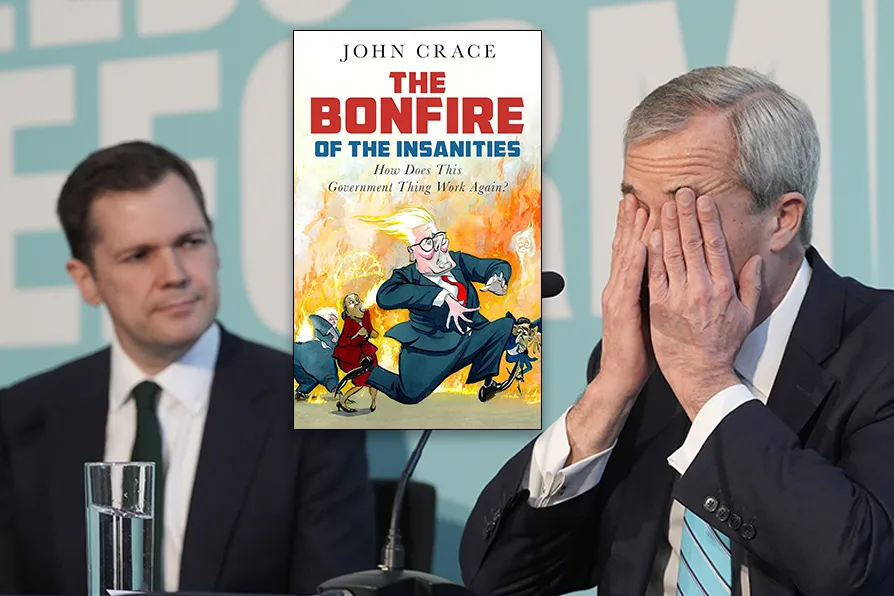
The Bonfire of the Insanities: How Does This Government Thing Work Again?
John Crace, Guardian Faber, £16.99
THIS latest hilarious collection of Guardian political sketch writer John Crace’s columns covers the dying days of Rishi Sunak’s Tory government through the first year of Keir Starmer’s Labour.
Crace really has to be one of the best satirical sketch writers around, shooting down the pomposity and incompetence of the political class in equal measure. The day to day terrain of the political sphere is laid bare, as the politicians stumble from crisis to mishap. He takes no prisoners, especially when it comes to the ineptitude of Sunak and his assorted ministers.
The nicknames given to different ministers seem particularly apt. So, James Cleverly becomes Jimmy Dimly. When assessing Cleverly’s credentials as a contender in the Tory Party leadership contest, following the election defeat, Crace asks “What has Jimmy D ever done in government?” Answer: “Very little, apart from turning left into first class, when boarding aeroplanes on government business.”
In the same contest, there is “Honest Bob” (Robert Jenrick). “If the answer is Robert Jenrick then odds are you’ve been asking the wrong question,” observes Crace; he heralds the return of “Lord Big Dave” (David Cameron) to government as foreign secretary as: “Sunak searches the gene puddle of Tory talent … and finds David Cameron.”
Crace scythes through one calamity after another, from the flights to Rwanda to the “we’ll leave them on the beaches” episode that saw the hapless Sunak depart the D-day commemoration early.
Crace has much fun at the expense of Tory convert and later Reform defector Lee Anderson, asserting that he’d said: “Sadiq Khan had been taken over by Islamists and London was now being run by terrorists.” Then as Anderson doubles down on his claims, Tory MPs get queasy. “And while there are plenty of Tories willing to attest that they had personally seen the London mayor take part in the October 7 terrorist attack, there were still a few who thought that maybe — just maybe — Anderson had gone too far this time.”
And so the Tory trauma goes on, with chancellor Jeremy Hunt described as “someone unthreatening, if a bit useless… [There is] literally nothing to him”; Priti Patel “not just dim but dangerous with it”; and, finally, Kemikazi (Kemi Badenoch), “the most divisive woman in politics” and someone “who hates the electorate almost as much as she hates her colleagues. And herself. She could start a fight with her reflection.”
There is a longing to see the back of Sunak and co. The election becomes a formality.
Crace does betray a hope in the new Labour government. He does seem to have swallowed some of the propaganda about the return of adults to government etc. One wonders if he was not something of a Keir Starmer fan in the run up to the election and early days of government. He probably, together with most at the Guardian, was not a Jeremy Corbyn fan.
The first year of the Starmer government is chronicled with some hope and sympathy but this eventually reaches the same level of derision as was deployed against the Tories. So, the Labour leading lights come under scrutiny. Starmer’s boring demeanour and Angel of Death, Rachel Reeves, come in for increasing ridicule. Health secretary Wes Streeting is described as: “One of those who always knows he’s loved by everyone. By himself more than anyone.”
On the subject of Reform, Crace is beginning to turn his critical fire on the party as they become a looming political threat. Nigel Farage (Nige) is regularly described in charlatan terms, while no opportunity is wasted to link deputy Richard Tice to sun beds and fake tans: “a man you might find on the shopping channel, trying to flog you an air fryer, that would fall apart within a week.”
This book provides a highly entertaining romp through the period from October 2023 to last July. The problem, of course, is that these things rapidly date. So reading the accounts of the dying days of Rishi Sunak in 2026 does seem a bit distant. And many of the calamities of Starmer are yet to come.
To read the column each week in it’s first manifestation does not suffer such an ageing process, but it begins to make itself felt when a number are brought together later in a chronology.
All that said, this is a great read from one of the funniest, wittiest, political writers around. The take downs can be excruciating, leaving the reader in fits, but also wondering how Crace got away with saying that. Great read, especially in these dark days.
