


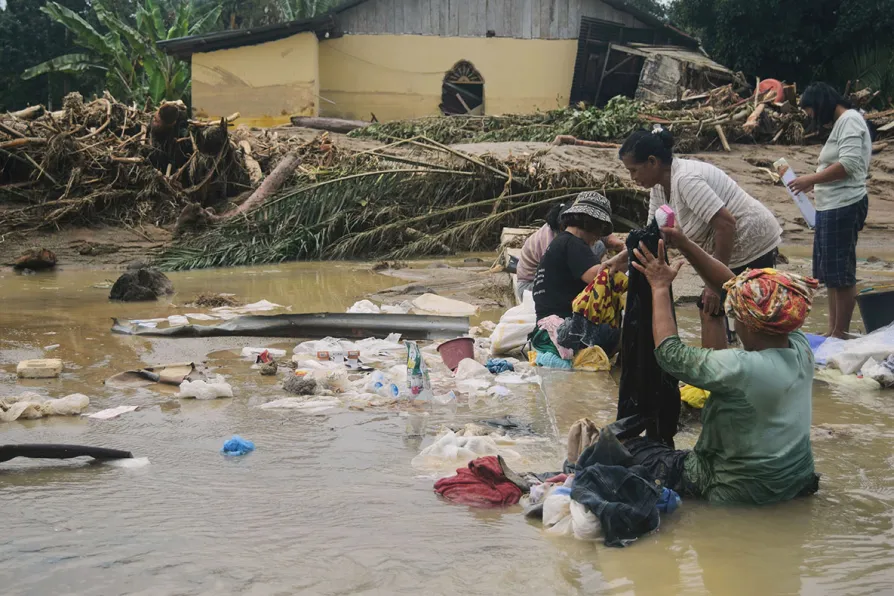
 People use flood water to remove mud from clothing at a village hit by a flash flood in Batang Toru, North Sumatra, Indonesia, November 29, 2025
‘Ah the irony:’ Aamer Anwar says he doubts Reform has handed over the names of the far-right thugs who went on the rampage in Glasgow last weekend to the Police





EXTREME weather events driven by human-induced climate change continued to disproportionately hit poorer communities in 2025, a group of international scientists has found.
The last year saw devastating conditions across the world, including worsening heatwaves, droughts, storms and wildfires.
Global temperatures were so high that they made 2025 one of the hottest three years ever recorded, according to scientists behind the World Weather Attribution’s (WWA) annual report.
This came despite “La Nina” conditions — a weather phenomenon usually associated with cooler global temperatures.
The three-year global temperature average will cross the key warming threshold of 1.5°C for the first time, the scientists found.
Passing 1.5°C over the long term means the world could see increased climate risks, faster sea-level rise and growing chances of passing irreversible “tipping points.”
And for every extreme event, vulnerable populations are systematically the hardest hit, according to its analyses.
The group of scientists ultimately highlighted that reducing planet-warming fossil fuel emissions remains the key policy to avoid the deadliest impacts of climate change.
Friederike Otto, professor in climate science at Imperial College London and WWA co-founder, said: “Each year, the risks of climate change become less hypothetical and more brutal reality.
“Our report shows that despite efforts to cut carbon emissions, they have fallen short in preventing global temperature rise and the worst impacts.
“Decision-makers must face the reality that their continued reliance on fossil fuels is costing lives, billions in economic losses, and causing irreversible damage to communities worldwide.”
For the study, the WWA identified 157 extreme weather events that met a set of criteria of humanitarian impact in 2025.
Floods and heatwaves were found to be the most frequent occurrences — at 49 events each — followed by storms (38), wildfires (11), droughts (seven) and cold spells (three).
Of the 22 that the team studied in depth, they concluded that 17 were made more severe or more likely due to climate change.
These extreme weather events have affected vulnerable groups of people and marginalised communities the most in the last year, according to the report.
Theodore Keeping, researcher at Imperial College London, said: “This year we have also seen a slide into climate inaction, and the defunding of important climate information initiatives.
“In 2026, every country needs to do more to prepare for the escalating threat of extreme weather and to commit to the swift replacement of fossil fuels and avoid further devastation.”
