DOUG NICHOLLS says the parasitic finance markets must be challenged or another British government could be toppled


 Latest editorial

Climate action can also serve the cause of economic justice
Tackling climate change is not just an urgent environmental necessity but provides an opportunity for economic restructuring in the interests of the Welsh people
 Smoke from a fire on the side of Bangor Mountain

The late country singer’s Imagination Library has put hundreds of millions of books into children’s hands. We should build on that legacy by defending the libraries at the heart of our communities, says BRENDA AITCHISON
Deprivation is a fundamental factor in criminal behaviour that must be addressed but, KENNY MacASKILL argues, there needs to a major rethink in sentencing to tackle overcrowding
MML director MEIRIAN JUMP outlines the recently refreshed library’s busy autumn schedule that ranges from book sales, archival exploration, community work with online education and the ever popular site tours
Some thinkers and authors on the right are openly discussing the possibility that the historically successful party of the British ruling class may be exhausted
Class struggle is the motor of history but the direction and detail of change at any time and place is the outcome of many factors, suggests the Marx Memorial Library and Workers’ School
TONY BURKE surveys the shifting political landscape and the challenges Labour needs to address if it is to prevail in the 2028 federal elections





“Climate change will manifest as a series of disasters viewed through phones with footage that gets closer and closer to where you live until you’re the one filming it.”
At the time of writing, the new Welsh government has issued at least seven announcements on extreme heat, drought, and wildfires since June. Emergency services are currently tackling 20 wildfires across Wales.
There are various causes of the wildfires, but the underlying issue is simple: dry land is much more susceptible to burning. We know that human-driven climate change is leading to rising global temperatures.
In Wales, we are seeing the direct consequence of that before our eyes, on social media and in the news. We have reached a point where a system built on fossil-fuel extraction and endless growth is leading to climate destabilisation.
If we want to stop climate disaster, we must move toward an economy that is not only sustainable in terms of the environment and our resources, but equitable. Because, while Wales burns, a select few are continuing to make inconceivable profits from the destruction of our planet.
According to Oxfam International, six of the biggest fossil-fuel companies are projected to earn nearly $3,000 (£2,200) a second in profits in 2026. This marks an increase of almost $37 million (£27 million) a day compared with their combined 2025 profits.
Meanwhile, the burden of these wildfires and heatwaves in Wales falls disproportionately on low-income households – those without air conditioning, in unfit housing, in unsafe working environments, or whose homes are at risk.
On June 23, the Welsh government announced that a Red Extreme Heat warning had been issued in Wales. Yet, there is currently no maximum temperature set in health and safety legislation for employees, and the Welsh government does not have the power to change this.
Climate justice can be economic justice. In the Plaid Cymru manifesto, we committed to reach net-zero 2040. This target doesn’t just present an opportunity to change the trajectory of our climate; it presents an opportunity to change the nature of our economy.
In Plaid Cymru’s first 100 days, work has already started on a climate and nature action plan, to reach net-zero by 2040 and substantive natural recovery by 2050. Farmers need land that is productive and resilient, not land that is repeatedly under floodwater or struggling because of drought.
Children and families should be able to enjoy clean beaches and seas. Businesses need access to resilient supply chains. Future generations should inherit a Wales where nature is recovering, not one where species are disappearing.
The plan will embed action on climate as cabinet-level responsibilities across all portfolios, so that it is built into decisions on housing, transport, energy, health, the economy, and public services.
Crucially, it will tackle climate change while supporting opportunities for well-paid jobs, community energy, better infrastructure and a fair transition for all. On August 7, the Welsh government announced that consent had been granted for the Llyr Wind Farm, off the cost of Pembrokeshire.
This is a step in the right direction, but we must push ourselves further. This project has been developed by Cierco Energy, whose offices are in London, and a lease was signed with The Crown Estate.
While we move towards a greener Wales, we must also move towards a fairer Wales, where profits are kept and reinvested in the communities that create them – not sent off to London.
We can see here how Welsh profits are siphoned off to London, the Treasury, and the Crown. Crown Estate profits from Welsh assets have soared more than 2,300 per cent in five years – £210 million profit in 2025/26.
Similarly, in my constituency of Caerdydd Penarth there is an application for a 20,000 square-metre data centre in Pontyclun made by a company in England.
The expected number of new jobs may not even reach double digits, while it will guzzle water 24/7. South Wales has been designated as an AI Growth Zone by the UK Labour government, which has led to applications for data centres popping up everywhere.
At the same time, a drought was recently declared across the whole of Wales. While residents are being told to treat their water as a scarce resource, outside companies are trying to extract profit from significant local water access.
Planning and ownership Plaid Cymru’s Economic Plan, Making Wales Work, written by the previous Plaid Cymru spokesperson on the economy, Luke Fletcher, stated clearly and correctly: “In simple terms, we do not currently own enough in Wales – enough of our own resources, intuitions, or businesses – to begin to turn the economic tide.”
I believe this statement is inextricably linked to the climate emergency. I recently watched the People’s Emergency Briefing film. I’d recommend it, but it was a difficult watch. A lot of the information was information that I had been aware of since I left school a decade ago.
But when I was learning about climate change in school, I naively assumed that because we knew about it, people were doing something about it. But here I was, years later, elected, hearing the same information, but the situation had only gotten worse.
I’m glad to be part of a party with an ambitious and much-needed net-zero target, and I’m looking forward to pushing the government to ensure that economic justice and the ownership gap are at the forefront of this work.
Kiera Marshall is Welsh Senedd Member (MS) for Caerdydd Penarth.

Similar stories


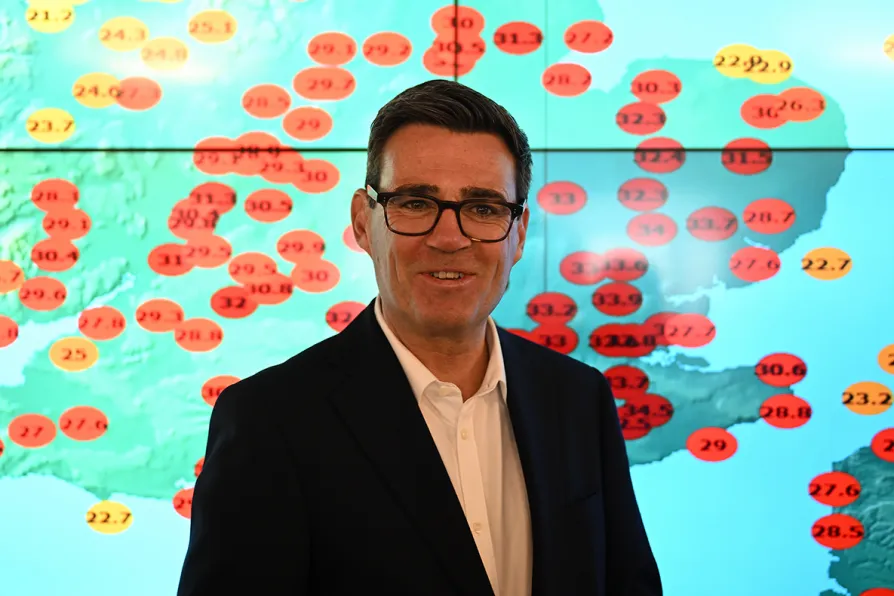
Burnham urged to stand up to the fossil fuel giants and reject plans to drill Britain’s largest untapped oil fields

Climate extremes are becoming our new normal, says CHLOE BRIMICOMBE