

 Latest editorial
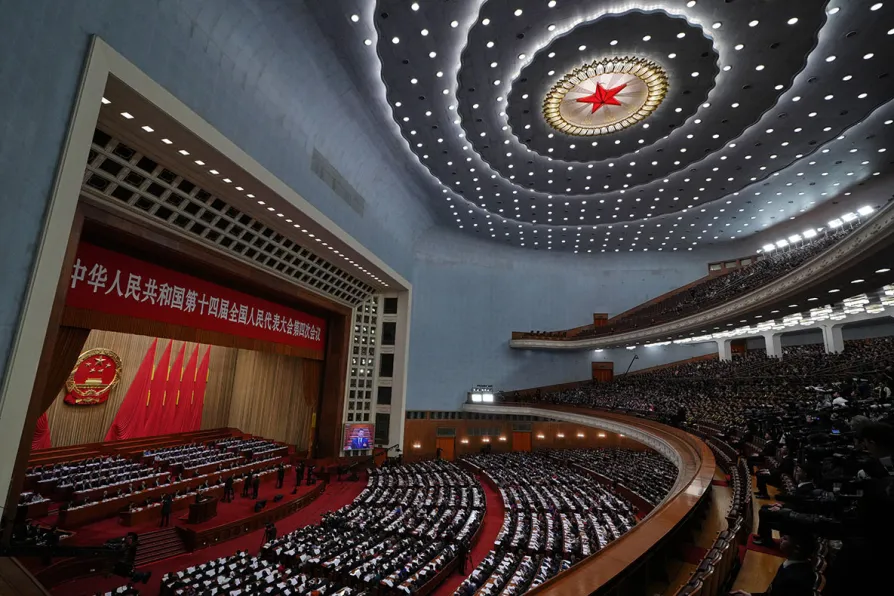 A screen showing Chinese President Xi Jinping as Premier Li Qiang delivers his work reports during the opening session of the National People's Congress (NPC) at the Great Hall of the People, in Beijing, March 5, 2026





CHINA is aiming for a growth target of between 4.5 and 5 per cent for 2026, it was revealed today.
Delivering the opening report at the opening of the fourth session of the 14th National People’s Congress in Beijing, Prime Minister Li Qiang said the target is well aligned with the country’s long-range objectives through the year 2035 and is broadly in line with the long-term growth potential of China’s economy.
Mr Li said the government believed the conditions were favourable to achieve the target, but authorities at a local level should take into account their own conditions to deliver positive outcomes.
The premier said this year’s targets took into account the need to leave some room for structural adjustments, risk prevention and reform in what is the opening year of the 15th Five-Year Plan (2026-30), in order to lay a solid foundation for delivering better performance in the coming years.
China managed to achieve a healthy 5 per cent growth last year, but the premier said: “While recognising our achievements, we are also clear-eyed about the difficulties and challenges we face.”
China is grappling with tariff wars and the impact of actual wars.
Like much of Asia, it depends heavily on oil and natural gas from the Middle East, and the war in the Middle East has driven up prices and threatened supplies even though Iran has said Chinese tankers will be the only ones permitted to pass the Strait of Hormuz without interference.
The report said that free trade is under severe threat, noting rising geopolitical risks. At home, it highlighted an “acute” imbalance between strong manufacturing supply and weak demand and the challenge of shifting to new drivers of growth.
“Rarely have we encountered such a grave and complex landscape, where external shocks and challenges were intertwined with numerous domestic difficulties,” Mr Li said in his report.
The premier pledged to improve living standards and boost consumer spending.
The report said the government would issue 250 billion yuan (£27 billion) in bonds for rebates to consumers who trade in cars, appliances and other products for new ones. City-specific policies to control new housing supply and reduce unsold properties will be used to stabilise the market, Mr Li said.
Sun Xuegong, director-general of the department of policy study and consultation at the Chinese Academy of Macroeconomic Research, said: “If China is to double its per capita GDP from its 2020 level by 2035 to achieve socialist modernisation, the economy would need to grow by around 4.2 per cent annually in the coming years, making this year’s target necessary and achievable.”
