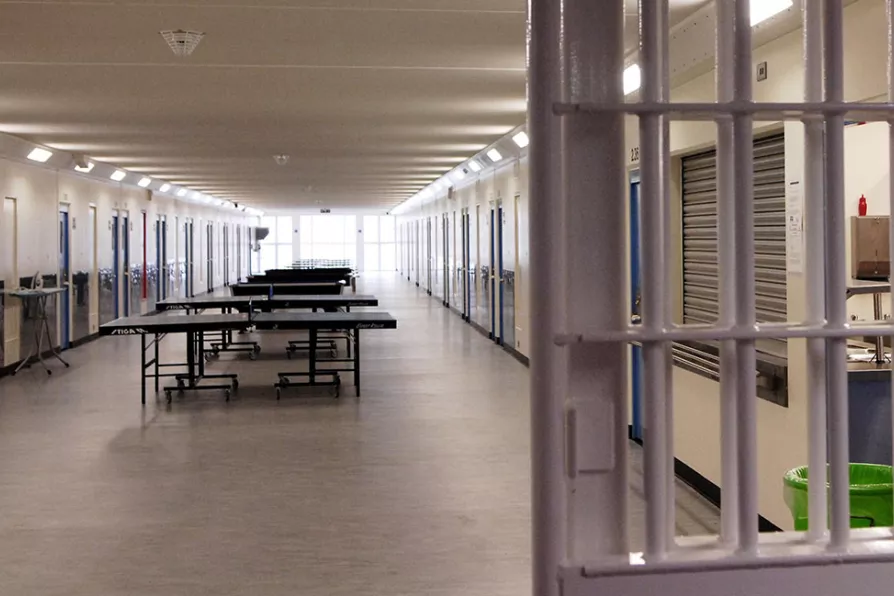
 HMP Millsike in East Yorkshire is Britain's newest prison






ANDY BURNHAM’S interview on BBC News yesterday showed a Prime Minister who appears to be grappling sincerely with the dilemmas of Britain’s criminal justice system.
He announced that the emergency release scheme will not allow prisoners guilty of unlawful killing or sexual assault to end their incarceration earlier and thereby ease the overcrowding in Britain’s prisons.
Understandably, this has been welcomed by the families of those killed in a number of recent cases headlined in the media, although gratuitous references to killers from overseas are unhelpful when the culprits were actually born here.
It should also be remembered that British homicide rates are now at their lowest level for two decades. Furthermore, in some cases those guilty of reckless and criminal acts were convicted of manslaughter rather than murder precisely because they had no intention of taking a life and little or no understanding that this could be a consequence of their actions.
Others found guilty of unlawful killing have committed their crime while the balance of their mind was so deeply disturbed as to not meet the criteria for committing murder.
Nevertheless, after weeks of agonising the Prime Minister has taken into account the deeply held concerns of bereaved relatives and friends. This is to be welcomed, not mocked by Tory and Reform UK spokespersons who supported the austerity and privatisation policies that have brought Britain’s prison, probation and youth services to the brink.
For decades, successive governments have failed to invest in modern, spacious prison facilities with fully trained, well paid and properly supported staff. Privately run prisons and associated security services have produced many scandalous breaches of management and safety standards. Rehabilitation is rightly regarded by most of those inside the system as a bad joke.
The probation service has been plunged into chaos not only by underinvestment but also by Tory on-off partial privatisations. Youth services have been slashed to the bone, instead of being expanded to provide attractive, life-enhancing alternatives to crime and anti-social behaviour.
Then there has been the perceived need of governments to look “tough,” banging up more criminals for longer periods in response to public opinion whipped up by the gutter press lynch mob (some of whose owners and journalists should be experiencing the very porridge they wish for others).
At any one time, one-fifth of the prison population consists of unconvicted defendants waiting in long queues for their court date. Of the remainder, two-thirds of convicted prisoners are doing time for violence, sexual assault, robbery or possession of weapons; the remaining one-third are in for non-violent theft, drugs and public order offences that could best be dealt with outside the prison system.
However, when British governments seek to learn “best practice” from other countries in matters of crime and punishment, they rarely look at sentencing, custody, rehabilitation and anti-recidivism policies in low-crime, low-incarceration developed countries in Europe and further afield. No, they turn instead to the US, where the record of failure is worse than Britain’s in almost every respect and where the motto, to parody Tony Blair, is “tough on crime, oblivious to the causes of crime.”
Fixing the prison system will not be possible without a whole barrage of economic and social policies that prioritise the needs of working-class communities above the interests of big business profiteering.


TUC president and POA leader STEVE GILLAN speaks to Ben Chacko on the eve of Congress 2026