The Labour government must deliver on its commitment to bring back privatised services into the public sector. This not only saves money but also creates accountability and generates wider social benefits, argues ANDY MCDONALD MP


 Latest editorial
The awkward half-way house status of the ICC
The US is hell-bent on dismantling the International Criminal Court as part of its assault on global legal systems, but others also have valid reasons to seek its demise. BEN CHACKO provides the analysis
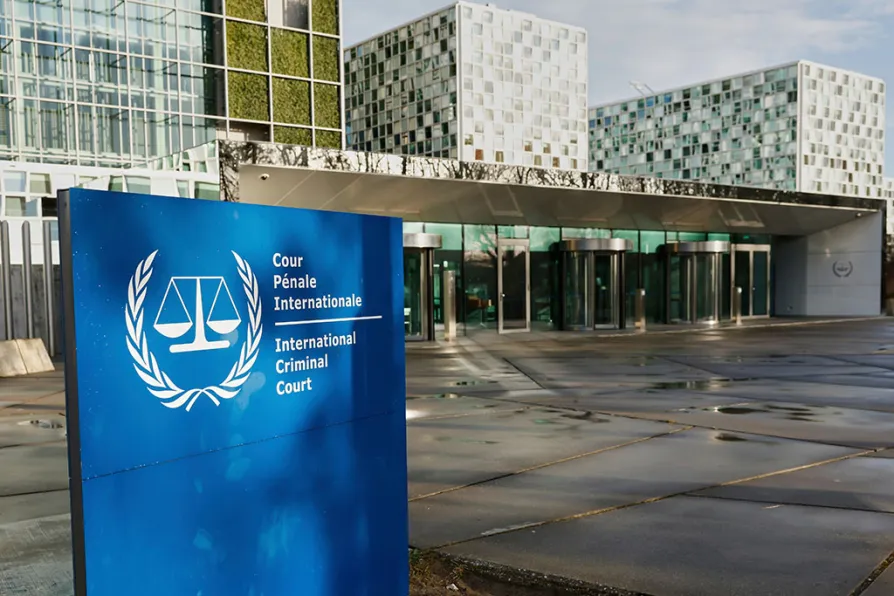
 OFF THE MAIN ROAD: International Criminal Court, The Hague, Netherlands [Pic: Hypergio/CC]
PCS is demanding the long-overdue return of essential services to public ownership, explains FRAN HEATHCOTE
Despite promises of a new era of insourcing, billions of pounds of public contracts continue to flow to private firms. Unions are now calling for urgent action to bring services back in-house, says EDDIE DEMPSEY
Public ownership of Great British Railways has enormous potential to improve our railway network, but that can’t happen unless jobs, employee rights and union recognition is at the heart of the transition, argues MARYAM ESLAMDOUST
If Labour is genuinely committed to supporting working-class students it must act urgently to reverse the funding crisis affecting universities and colleges, JO GRADY tells Christophe Domec
Challenges from the unscrupulous misuse of AI to steal actors’ voice and physical likenesses is being met with a firm union response, writes LYNDA ROOKE





THE International Criminal Court (ICC) is in dire straits. The United States has declared war on it, furious at its decision to prosecute Israeli ministers.
But the US’s main rivals don’t recognise the court either — and those leaving the court to date are mainly vocal opponents of the West.
The ICC is still defended by the countries that have always been its main advocates and funders — the western European powers, Japan, Canada. But this gives less security than might be imagined.
The ICC has been a feature of the “unipolar” moment in international relations — ironically, since the the pole that order revolved around, the United States, has never recognised it — and its problems today stem from a new world of contested hegemony and great power conflict. For anti-imperialists, the question is therefore double edged.
We see its dual character in the rationales of the states attacking it. The three Sahel states — Burkina Faso, Mali and Niger — tie their withdrawal to the wider anti-colonial revolutions they are pursuing, which have involved the expulsion of French and US troops and the nationalisation of foreign-dominated mining assets.
The ICC, the three declared in their joint statement, is “an instrument of neocolonial repression in the hands of imperialism.” And this is not a new accusation.
When Burundi — the first state to withdraw from the court — announced its intention to do so in 2016, a wave of African countries expressed interest in following suit, and a special summit of the African Union even backed a collective withdrawal strategy, though it was never implemented.
The criticisms voiced then were that the court had only ever indicted Africans, and the specific failure to hold US or British troops accountable for war crimes committed in Iraq was raised as evidence of the double standard.
On one level that was because (unlike the International Court of Justice, which considers accusations against states, not people, and is a branch of the UN) the ICC has never been a global court. It has an awkward half-way house status.
Its jurisdiction extends to states which have signed up to it, and Iraq never has: the arrest warrants it has issued more recently for politicians from Israel and Russia, which are also not party to it, depend legally on the charges against them referring to crimes committed on territories which have accepted its jurisdiction (Palestine and Ukraine).
But on another level it was, of course, because there was a double standard. The ICC was a court for the ruled, not the rulers in the global pecking order.
That was always exemplified by the curious attitude of the United States itself: it never ratified the Rome Statute establishing it, but did sign it (under Bill Clinton).
The court grew out of proposals for a permanent international court dating from the end of the first world war, and the UN general assembly asked the International Law Commission to look into establishing one in the 1950s, following the bespoke courts set up to try Nazis at Nuremberg and Japanese imperialists at Tokyo.
But the cold war ensured no international court could ever be agreed by the UN. The statutes establishing the ICC as it was eventually endorsed by the UN general assembly (in 1998) were drawn up between 1989-94, the period of the collapse of European and Soviet socialism.
Though it was never viewed with enthusiasm from Washington, which never forgot that the “Washington Consensus” rested ultimately on power rather than principles, its adoption was part of the wave of liberal optimism that accompanied the so-called “end of history” — when some imagined ideological conflict was over, “liberal democracy” would soon be the global norm and there was enough common ground on legal and political principles for a world court to be feasible.
That optimism was shared by a big majority of states at the time, and the general assembly vote to endorse the ICC was opposed by just seven states (of which one was the US, and another, significantly given today’s international picture, was China). Real hope existed that such a court would be even-handed and hold all parties to account equally.
This lent itself to the court’s ambiguous relationship to the UN: it’s not a UN court, but its own statutes give authority to UN institutions (the security council, for example, is given the power to refer situations to it if they take place on territory where it lacks jurisdiction, as happened with Darfur). It is not quite a world court, but it wants to be.
And it could affect to be one, when the overwhelming majority of countries accepted a US-dominated world order.
The US didn’t accept that it could have any authority over US personnel, though it was happy to refer others to it (as with Libya in 2011) or to welcome prosecutions of its adversaries (as with the arrest warrant issued for Vladimir Putin in 2023).
Those who accepted US world leadership acknowledged the court, unless they had a specific reason not to (Israel objected to clauses making the transfer of populations to occupied territory a prosecutable offence).
Those who rejected the court’s authority were largely those who rejected Washington’s (at the start of the millennium, China, Russia, Iraq and Libya, for example) as well as India, which shared suspicions that this was an effectively neocolonial project, subjecting former colonies to a court dominated by Europeans.
That history makes the current US hostility to the court potentially existential.
Secretary of State Marco Rubio has pledged to “dismantle” the court, “brick by brick if necessary.”
US sanctions are unilateral, but are no joke given an international financial architecture controlled by the US: court judges and prosecutors have had their bank accounts frozen and their emails cut off, even when they are citizens of states which support the ICC.
More seriously still, the Donald Trump administration is quite prepared to punish US allies which defy it and has, unlike any previous administration, declared its intention to press allies into withdrawing from it.
War Secretary Pete Hegseth has urged it on the US’s partners in the new Americas Counter-Cartel Coalition, an alliance designed to facilitate US military interventions across Latin America; while Rubio threatens punitive measures against any country which assists investigations into US personnel or the citizens of its allies.
This escalation is prompted by the arrest warrants issued for Israeli Prime Minister Benjamin Netanyahu and former defence minister Yoav Gallant, which provoked a presidential decree declaring the ICC’s act “an extraordinary threat to the national security of the United States;” but they fit perfectly with the wider Trump administration aim of dismantling international law.
The ICC’s main funders already have a mixed record on upholding its impartiality; as foreign secretary in the Rishi Sunak government, David Cameron threatened withdrawal of funding and other consequences should it proceed with arrest warrants for Israeli leaders, while German Chancellor Friedrich Merz has vowed to invite Netanyahu to Berlin in defiance of Germany’s obligation as a state party to arrest him.
The craven attitude of European and Japanese leaders to Trump’s outrages of international law — their total passivity with regard to his kidnap of Venezuela’s president in January, for example, or their effective facilitation of his war on Iran — suggests any attempt to defend the court on their part will involve active deterrence of any prosecutions that might anger the White House.
But that double standard — expressed by late senator Lindsey Graham who snarled, in response to the Netanyahu warrant, that the ICC “is for Africans and thugs like Putin” — can only accelerate the alienation of Global South countries inclined to follow the Sahel trio out the door. These currently include Chad and Venezuela, the latter a special case since its withdrawal can be explained from opposite angles — as a longstanding opponent of US hegemony or as a country whose government now acts with a US gun to its head at all times.
Denounced by a United States which now sees any and all international law as an affront, and rejected by alternative or rising powers like China, India and Russia as a Western imposition, the ICC’s long-term future looks bleak, even if most states worldwide are still party to it.
Attempting a one-size-fits-all response risks repeating the delusion that it could ever have operated as a truly impartial world court given the reality of the imperialist system. Burkina Faso, Mali and Niger can be respected for quitting, even as Rubio and Hegseth’s campaign for a world without law is opposed: the contexts are totally different.
In a British context, that means opposing Trump’s attacks on the ICC, and insisting our government defend its independence, both as regards its right to prosecute US allies and in retaliating when British citizens are targeted by Washington for their work for the court, as former chief prosecutor Karim Khan was.
Like the UN itself, the ICC is neither one thing nor another. The UN preserves a hierarchy established in 1945, most obviously in its undemocratic veto powers.
But it also represents the democratic aspirations of the victors of World War II — the hopes of anti-fascists that an era of violent state-to-state conflict would be superseded by one of peace and co-operation.
Imperialism — the determination of the US-led bloc to suppress or subvert decolonisation and to break the socialist bloc — dashed those hopes then, and imperialism is not something that can be defeated in court. Justice at Nuremberg depended on victory at Stalingrad.
For all their contradictions, though, the war being waged against these institutions now is not aimed at furthering decolonisation, democratising world institutions or delivering real equality among states.
Its motivation is the precise opposite: the reversal of the verdict of 1945 and the untrammelled right of the strongest to do whatever they want.
Ben Chacko is the editor of Morning Star.

Similar stories
Trump’s ‘Peace Council’ is not a peace project, but a war and colonial council that renews Western colonialism, writes SEVIM DAGDELEN
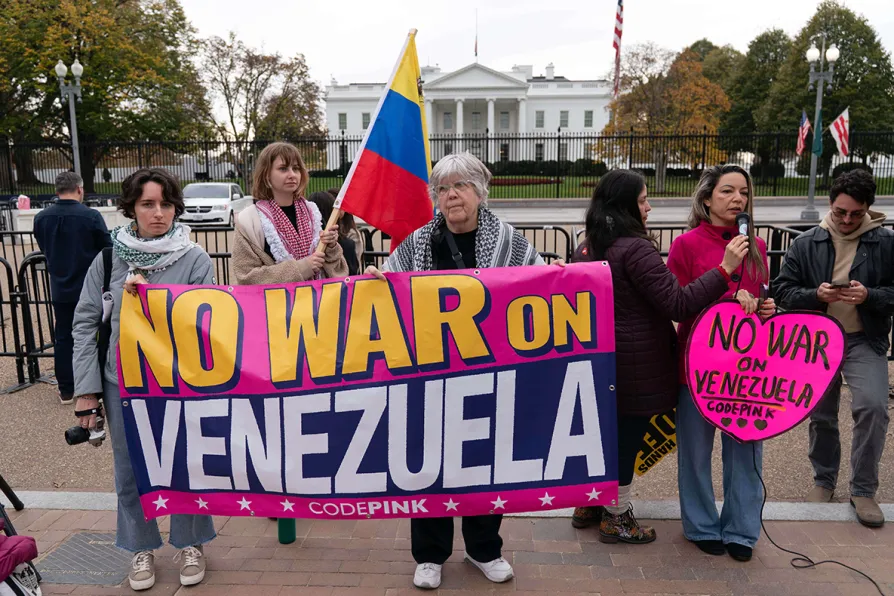
The global left must be unwavering in it is support for Venezuela as Washington increases its aggression, and clear-eyed about the West’s cynical motives for targeting it, says CLAUDIA WEBBE