Even the oligarchs of the artificial intelligence industries are warning that their creations have the capacity for the ultimate destruction of the planet and its population. ANDREW MURRAY suggests that there might just be other solutions


 Latest editorial
Against immigration controls: refugees and migrants are welcome here
ROY WILKES takes issue with those on the left who argue immigration lowers wages — dividing resident and migrant workers only strengthens capitalist exploitation
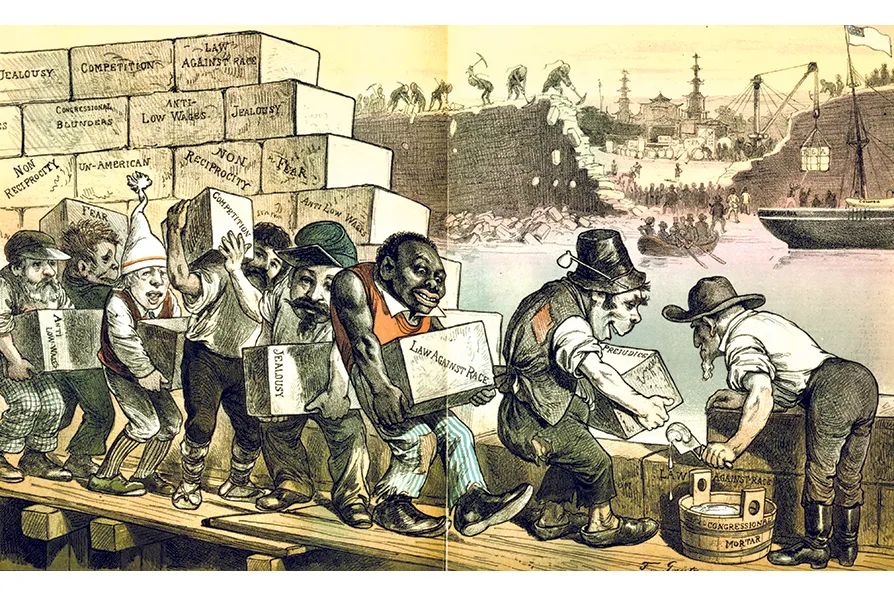 AS OLD AS THE HILLS: The anti-Chinese wall: The American wall goes up as the Chinese original goes down, a 1882 cartoon by Friedrich Gratz published in Puck / Public domain

The Labour government must deliver on its commitment to bring back privatised services into the public sector. This not only saves money but also creates accountability and generates wider social benefits, argues ANDY MCDONALD MP
PCS is demanding the long-overdue return of essential services to public ownership, explains FRAN HEATHCOTE
Despite promises of a new era of insourcing, billions of pounds of public contracts continue to flow to private firms. Unions are now calling for urgent action to bring services back in-house, says EDDIE DEMPSEY
Public ownership of Great British Railways has enormous potential to improve our railway network, but that can’t happen unless jobs, employee rights and union recognition is at the heart of the transition, argues MARYAM ESLAMDOUST
If Labour is genuinely committed to supporting working-class students it must act urgently to reverse the funding crisis affecting universities and colleges, JO GRADY tells Christophe Domec
Challenges from the unscrupulous misuse of AI to steal actors’ voice and physical likenesses is being met with a firm union response, writes LYNDA ROOKE





ANDY BURNHAM has promised to be “relentless” in stopping small boat crossings, acknowledging this as a concern that was raised repeatedly on the doorsteps of Makerfield.
It is not surprising that voters are concerned about this issue. Almost every day we are told that Britain is facing a “migration crisis,” with television bulletins dwelling on small boats crossing the Channel, and newspapers competing to demand harsher border controls.
This manufactured obsession serves a purpose. Workers are facing an ever worsening cost of living crisis, growing economic insecurity, widening inequality, endless wars, and an increasingly catastrophic climate emergency. To distract us from the systemic causes of these crises, our rulers encourage us to scapegoat those with the least power: asylum-seekers and migrants in particular.
Unfortunately there are some on the left who swallow this propaganda. Paul Knaggs, for example, suggests in his Labour Heartlands website that “open borders” is a neoliberal policy, and that unrestricted immigration benefits corporate capital by undermining the wages and conditions of British workers. He cites Marx’s analysis of the “reserve army of labour” to justify his position. In a similar vein, Bernie Sanders describes open borders as a “Koch brothers proposal”.
It is true that the capitalist class benefits from the immigration of skilled workers who pay taxes here, but for whom the costs of education and training have been borne elsewhere.
It is also true that some bosses — particularly those in agriculture and hospitality — profit from the super-exploitation of undocumented migrants. But that does not mean that the capitalist class as a whole favours open borders, as Knaggs and Sanders claim. Employers only want those limited numbers of migrants who meet their precise needs. And they can only super-exploit migrantworkers who are first rendered vulnerable by a hostile environment.
More importantly, the draconian immigration controls imposed by Britain and the other imperial powers play a crucial role in the global strategy of finance capital. Since the 1980s transnational corporations have been fragmenting the production process and shifting manufacturing into the ultra-low-wage economies of the global South. It is this profitable outsourcing that is responsible for the deindustrialisation and economic decline of so many communities in Britain, not the “mass immigration” that we are all meant to be concerned about.
It is in the newly industrialised countries of the global South that capital needs its reserve army of labour, far more than in the imperial heartlands of Europe and North America. Hundreds of millions of impoverished and marginalised people languish in the slums and shanty towns of the southern megacities, desperate for any opportunity to sell their labour power in order to survive. They remain trapped in those megacities, at the beck and call of corporate capital, because they have nowhere else to go. And they have nowhere else to go precisely because of draconian immigration controls.
It was very different for Europeans in the late 19th and early 20th centuries, when emigration acted as a safety valve that reduced the pressures of industrialisation. Around 70 million Europeans (17 per cent of the turn-of-the-century population) emigrated to the colonies between 1850 and 1920, alleviating the downward pressure on wages for those who stayed behind. By contrast, only a negligible 0.8 per cent of the workforce of developing countries have migrated to the global North since the second world war.
The earliest substantive measures to restrict immigration were enacted not in Britain or mainland Europe, but in California. Exactly the same arguments marshalled now to justify action to “stop the boats” and “defend our borders” were being deployed in the 1870s by Denis Kearney, an entrepreneurial grifter and self-styled leader of the Workingmen’s Party of California, to advocate measures to restrict the immigration of Chinese workers.
Kearney’s campaign, which provided a “socialist” gloss to a wave of anti-Chinese racist pogroms, achieved its aims. The California Constitution of 1879 authorised the legislature to regulate or prohibit the employment of Chinese workers, and even, where necessary, to expel them. A short time later Kearney’s core demands became national policy, with the passing of the Chinese Exclusion Act of 1882.
American socialist Henry George demolished Kearney’s arguments in The Kearney Agitation in California, which explained how deploying the repressive apparatus of the state against Chinese workers would ultimately benefit the capitalist class and not the American workers. Karl Marx warmly welcomed George’s article, and agreed wholeheartedly with the position he took.
In the end it was George who proved to be correct, not Kearney. In 1870 the average wage in California was $2 per day. In 1884, after the forcible exclusion of Chinese workers, it rose modestly and briefly to $2.42 per day. But by 1898 wages had fallen back to $1.59 per day, well below the pre-exclusion rate. Why? Because wages are not determined solely by supply and demand, but by the class struggle. Bolstering the repressive apparatus of the state in order to restrict Chinese immigration helped to strengthen the employers and weaken the workers, just as George had predicted.
Marx took exactly the same stance as George when he condemned the hostility of English workers towards Irish migrants, explaining that this antagonism was deliberately fostered by the capitalists as a means of dividing and weakening the working class. The key to undermining the employers’ offensive, he explained, is proletarian organisation at an international level.
Lenin agreed with Marx but went even further, emphasising the progressive significance of migration and its role in helping to break down national barriers. In 1922 the Fourth Congress of the Communist International declared unequivocally that communist parties must campaign against laws restricting immigration, because such laws “deepen antagonism between coloured and white workers” and weaken unity.
An uncomfortable truth that George, Marx and Lenin understood is that there is only one way to “defend our borders,” and that is to unleash the repressive apparatus of the state against our fellow workers. And which groups of workers will it be wielded against? To ask the question is to answer it.
All immigration controls are by their nature anti-working-class and racist. None of them have ever been used against rich white people. It is always working-class people, blacks and Asians in particular, who bear the brunt. Immigration detention centres and a British Ice won’t save the NHS or improve education, for exactly the same reason that they won’t raise wages or reduce unemployment.
The media exaggerate the “small boat crisis” out of all proportion to persuade us that we are being overrun by refugees and asylum-seekers. But the suggestion that we are taking “more than our fair share” of refugees simply isn’t true. Britain has taken a measly 0.3 per cent of the world’s 120 million forcibly displaced people, despite being responsible for many of the wars and famines that people are forced to escape from in the first place. Over 90 per cent of refugees remain in the poor countries of the global South.
A particularly hateful offshoot of the “small boat” propaganda is the far-right assertion that asylum-seekers are a danger to women and girls. This is a racist distortion, a variant of the old white supremacist trope about the uncontrollable sexual urges of black men. It is also grossly insulting to the victims of sexual violence, the vast majority of whom are abused by white British men.
We should of course do everything we can to stop our rulers from causing the problems that force people to flee their own homelands in the first place. But even that would not be enough. As climate change intensifies, conditions for the world’s poorest people will get horrifically worse, as many parts of the global South become literally uninhabitable.
Where will all those hundreds of millions (perhaps billions) of displaced people be expected to go? The rich countries, the ones who actually caused the climate crisis, will either have to find a way to accommodate them, or else keep them out with barbed wire and machine guns. Which of those futures do we want for our children?
The right-wing insistence that “our country is already full” and that there is no space for migrants and refugees is nonsense. Take any train journey across Britain and you will see vast swathes of open countryside, much of it depopulated by half a millennium of enclosures and land clearances. Less visible, but no less real, are the private grouse moors and the vast gardened mansions of the ultra-rich. We need to bring all of that land back into common ownership, so that we can repopulate and sustainably manage it. We could then comfortably increase our population by an order of magnitude.
But in order to do so we must first overcome the ignorance and prejudice that lie behind the so-called “legitimate concerns about immigration,” and in particular the hateful labelling of undocumented migrants as “illegals.” No human being should be declared “illegal” simply for wanting to survive, or for wanting a decent quality of life for themselves and their families. We need to abolish the status of illegality, so that everyone can enjoy full civil and employment rights, irrespective of their country of origin or of how they arrived here.
The lessons of the past are perfectly clear. We prevent the ruling class from using migration to divide us and drive down wages by welcoming migrant workers into our unions and socialist parties, encouraging them to join us as brothers, sisters and comrades in our shared struggle to build a brighter future for all.

Similar stories

CARLOS MARTINEZ responds to liberal hawk Simon Tisdall’s evidence-free China-bashing and asks whose agenda it really serves


Nature as well as society works dialectically, asserts the Marx Memorial Library and Workers’ School

ROGER D HARRIS and SARA FLOUNDERS challenge propaganda against the blockaded socialist island