
PETER MASON applauds the revival, 39 years later with the same team and cast, of Manfred Karge’s version of Brecht’s 100-year-old play, Mann Ist Mann

Who liberated France?
NICK WRIGHT laments the political bias of an epic attempt to tell the history of the liberation of France from the Nazis, that excludes both the decisive contribution of the Soviet Red Army, and of the French communist party itself
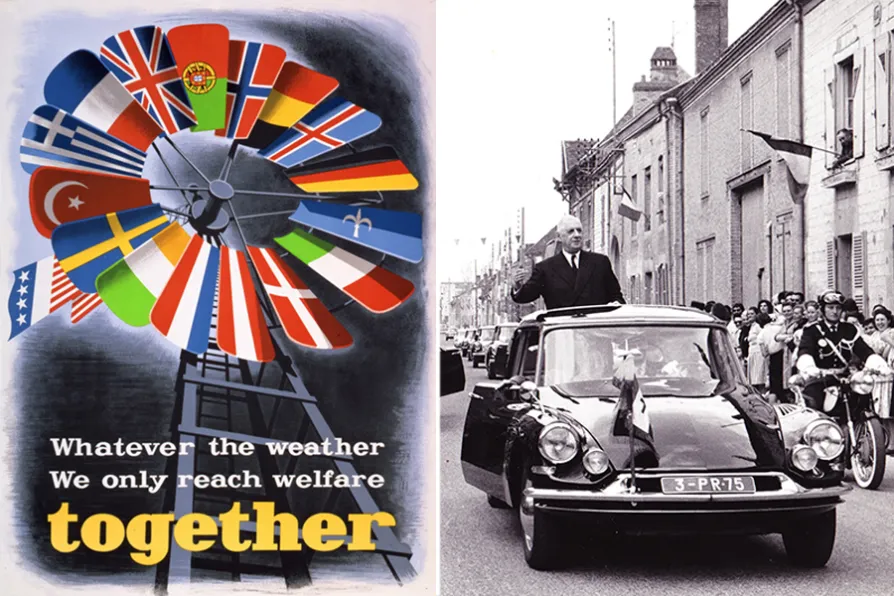
 (R) Having outmanoeuvred the left, De Gaulle in his comfort zone: a black Citroen and a provincial town, 1963 (L) US Marshall Plan propaganda poster 1950: the fantail, directing the energy of Europe is a US flag [Pics: Gnotype/CC; E Spreckmeester/CC]
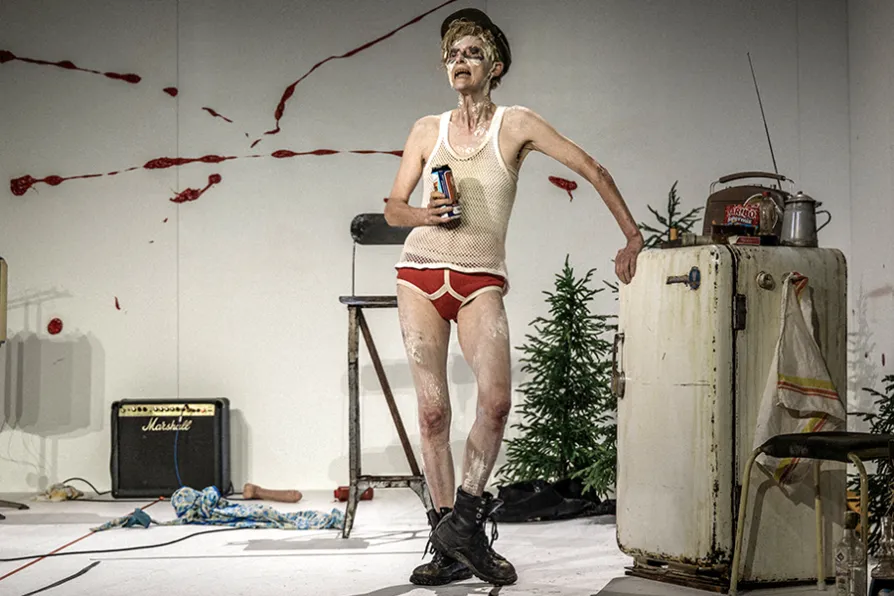
MAYER WAKEFIELD applauds a fearless attempt to bring to the stage the 1984 toxic gas disaster in Bhopal, India
ALEX HALL applauds the account of a dogged, traumatic and punishing campaign for justice that has lasted from 1998 to the present day
JOE GILL traces the ideology and method of contemporary imperialism back to the greed, hubris and violence of the late 15th century Portuguese





DE GAULLE, this year’s major French film release, is a two-part biographical account of the French leader’s role in rallying the French after the shameful collapse of its bourgeois institutions before the Nazi advance.
Director Antonin Baudry, with co-writer Berenice Vila, drew on A Certain Idea of France: The Life of Charles de Gaulle by British historian Julian Jackson, a leading academic authority on modern France.
Where De Gaulle, in later British narratives, is portrayed as an obdurate obstacle to Britain’s entry to the Common Market, these films present its main protagonist as both a defender of French sovereignty and as a champion of France as embodied in its Empire. Churchill no less.
De Gaulle is also presented as an opponent of US transgressions on the sovereignty of France and by extension of Europe as a whole.
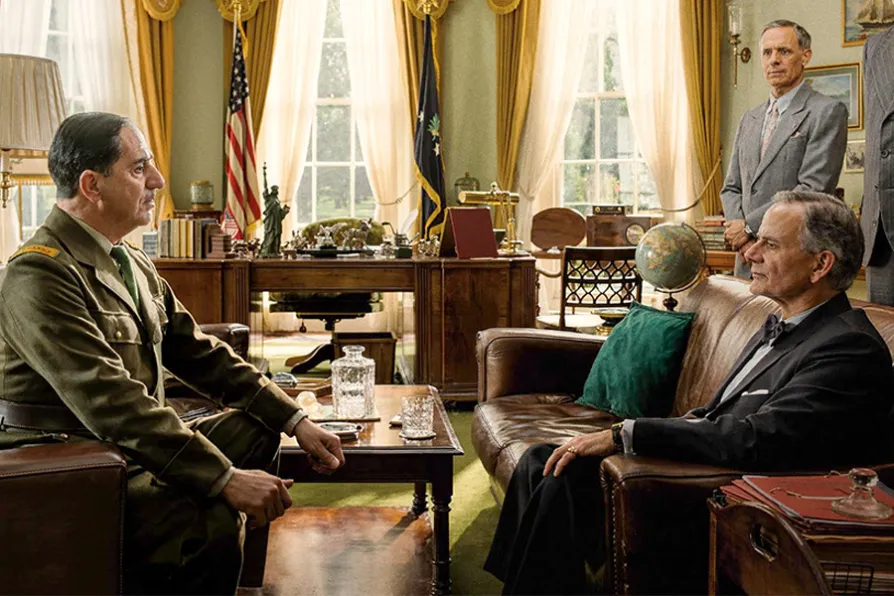
The three-cornered depiction of the relationships between Churchill, de Gaulle and US president Roosevelt sets out, in embryo, the real-life post-war political scenario in which De Gaulle asserted the distinct interests of France in opposition to US hegemony, while Churchill represents the partnership, unequal and dependent, of British capital with the new hegemon.
In this sense the films function to reinforce contemporary French concerns about the role of US imperial power in European statecraft and politics in which the UK is seen as a proxy for US influence, and no less now than when de Gaulle vetoed Britain’s entry to the Common market.
Image
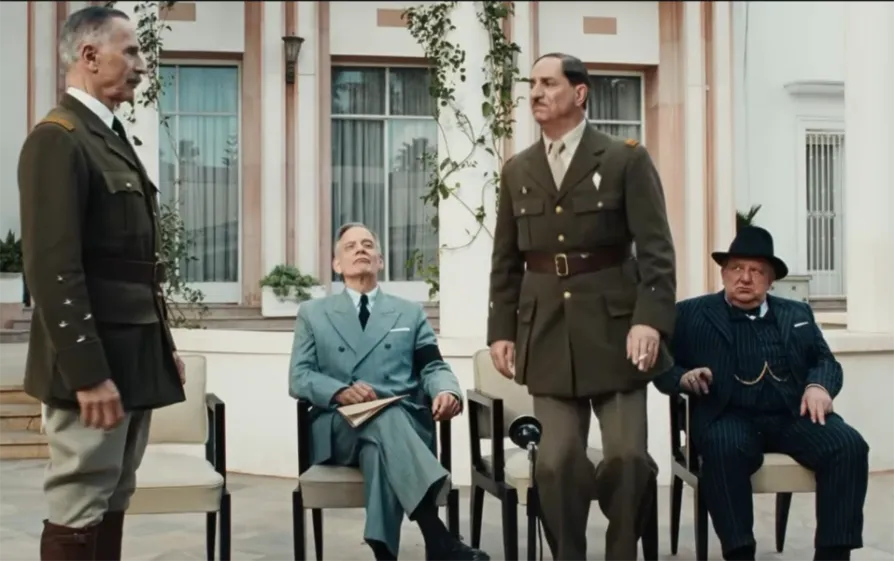
Woven into the narrative are two themes. The formation of a Free French state apparatus and military force — in France’s colonies and in North Africa — is a vital element in compelling Churchill to more fully accept that the Free French were not just his instruments, but possessed an autonomy and esprit that made them a useful force.
There is a much simplified, if very dramatic account of the Battle of Beir Hakim, in which Free French forces resist an Axis (German and Italian) attack and thus cover the withdrawal of British troops. This battle, in which the vastly outnumbered and out-gunned Free French engaged the enemy with enormous courage, became an important symbol of French national honour.
Interwoven into these rather old-fashioned films is a fictionalised romance between Fernand Bonnier de la Chapelle — a real-life right-wing royalist and anti-Vichy resistant — and a semi-fictional Livia. He is shot after assassinating Admiral Darlan, Vichy’s collaborationist boss in Algeria. She goes on to work in the underground, to aid Jean Moulin (De Gaulle’s representative inside France) and, in the second film, participate in the Paris insurrection against the German occupation.
This sets the scene for an account of the development of the Gaullist element in the French Resistance where Jean Moulin works to unify the disparate resistance groups.
While remaining truthful in what it depicts, the film misses out on the broader picture and this is what makes both films a compelling but incomplete drama, and there are two missing elements which weaken any claim to historical accuracy.
Firstly, the depiction of the Western theatre as decisive in the European war when it was the Soviet Red Army which engaged the majority of Axis troops, inflicted the most casualties on Hitler’s army and bore the brunt of the fighting. The Normandy landings were an important, if deliberately delayed, element in the Allied victory but the eventual outcome was decided on the Eastern Front at the battles of Stalingrad, Kursk and Bagration.
And, secondly, the role of the French communists in the Resistance.
From 1939 to June 1941 anti-fascist impulses remained secondary to inter-imperialist intrigues, and the essential character of the war remained unclear. French communists followed the Comintern analysis which characterised the war as, principally, an inter-imperialist conflict.
When the tendency in Anglo-French circles to compromise with Hitler were sidelined, alongside Churchill’s accession the premiership, Hitler attacked a Soviet Union now better prepared to draw the Wehrmacht into an attritional war.
The PCF, already organised underground and illegal since 1939, immediately went onto the armed offensive inside France.
A US Library of Congress document records that in 1942 the PCF created the Francs-Tireurs et Partisans: “Commonly known as the FTP, they were a merger of three communist militant groups: the Organisation Speciale, formed in 1940 to protect communist leaders; a group of young communists, the first to attack German soldiers; and the fighters of the Main-d’Oeuvre Immigree.
“The FTP was effective and energetic and they gained a huge wave of new recruits after the unpopular Service du Travail Obligatoire was instituted by the Germans, which required Frenchmen to go to Germany and serve forced labour in factories.”
In 1941, on the initiative of the PCF, the Front National de l’Independance de la France was formed, which united catholic, socialist, Radical and non-party and religious elements.
The Front National was the political arm of the FTP. It was this resistance network which, in 1943, federated with Jean Moulin’s Conseil National de la Résistance, a process only briefly depicted in the film.
The film ends with General Leclerc’s Free French armoured units reaching Paris when the city was already in the grip of an armed uprising that was, in fact, led by the communist commander of the French Forces of the Interior, Colonel Rol-Tanguy.
Leclerc’s tanks carried many Spanish anti-fascist fighters enrolled in the Free French forces. In a small and telling vignette a soldier greets the cheering Parisians with the distinctive salute of the International Brigades, pressing his clenched fist to his forehead in a clear reference to Robert Capra’s famous photograph.
If we set aside these symptomatic absences, these films provide an emotional and necessary experience for a British audience to understand how a positive patriotism can unite disparate political elements when confronted by fascism and occupation, and how complex the battle to achieve a popular unity really is.
Nevertheless, it remains necessary to challenge a wider historical revisionism which, as these films do, marginalises equally the Holocaust and the fate of French Jews, the role of the Soviet Union and that of the French communists.
In France its reception has been mixed. There was general approval of the theme, the direction and the players but l’Humanite described it as a Gaullist film bordering on caricature: “Ultimately it serves as a hagiography for the future father of the Fifth Republic.”
Out of around 100,000 casualties between 20 and 30,000 resistants were executed by the Nazis. 100,000 died from torture — as did Jean Moulin — in combat or in prison. The PCF is still known as “le parti des 75,000 fusilles” — the party of 75,000 martyrs.
Because of their popularity, the PCF participated in the first post-war French government, occupying ministerial posts, but that participation did not survive submission to the diktat of the USA entailed in the French acceptance of the US Marshall Plan and the onset of the cold war. These films, wittingly or not, continue to reflect that censure of the historic role played by communists in liberating France.

Similar stories
NICK WRIGHT laments the one-sided telling of French history in an otherwise entertaining spectacle
While Italy’s communist tradition remains fragmented and politically marginal, France’s party is attempting to re-establish itself as an independent force rooted in working-class organisation, says NICK WRIGHT
While millions face poverty and public services are squeezed, France is committing billions to defence spending and weapons production, in a dangerous shift towards permanent preparation for war, says CONOR BOLLINS
WILL PODMORE admires an account of the liberation of Berlin that overthrows the conventional US army-inspired account