Even the oligarchs of the artificial intelligence industries are warning that their creations have the capacity for the ultimate destruction of the planet and its population. ANDREW MURRAY suggests that there might just be other solutions


 Latest editorial
Who opened the border at Ceuta?
CARLOS MARTINEZ shows how EU, Israel and US shenanigans were used in an attempt to destabilise Spain’s mildly socialist government
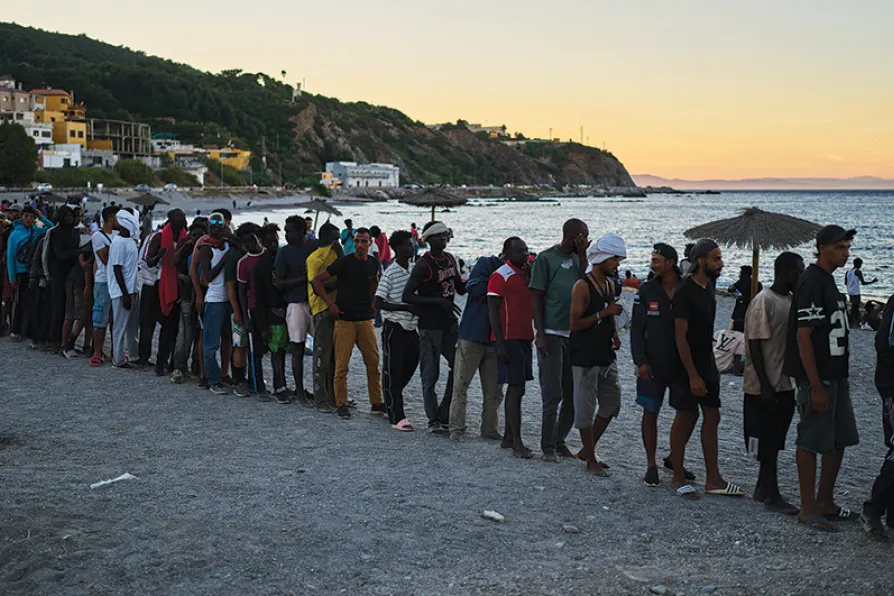
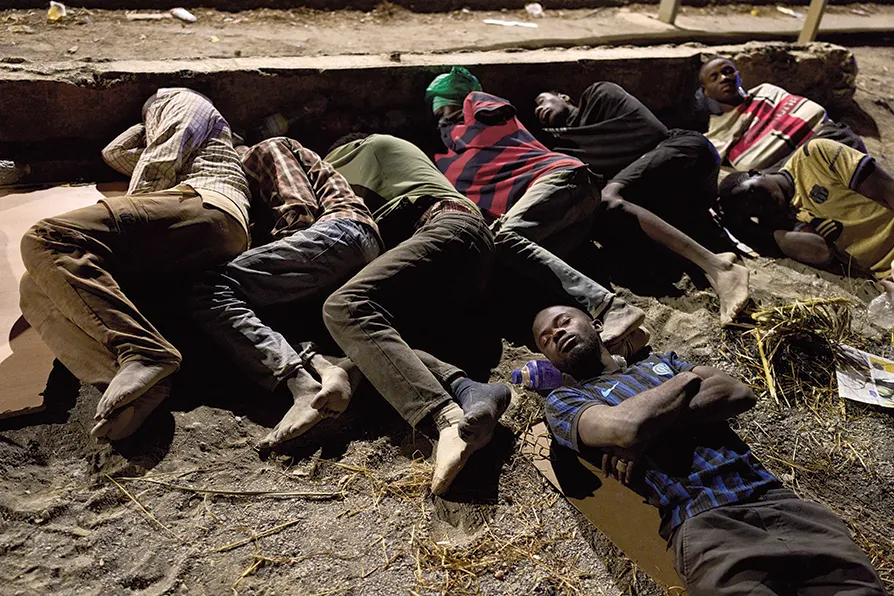 PAWNS IN A POLITICAL GAME: Migrants who crossed into Spain from Morocco sleep on a Ceuta beach, August 3 2026
The Labour government must deliver on its commitment to bring back privatised services into the public sector. This not only saves money but also creates accountability and generates wider social benefits, argues ANDY MCDONALD MP
PCS is demanding the long-overdue return of essential services to public ownership, explains FRAN HEATHCOTE
Despite promises of a new era of insourcing, billions of pounds of public contracts continue to flow to private firms. Unions are now calling for urgent action to bring services back in-house, says EDDIE DEMPSEY
Public ownership of Great British Railways has enormous potential to improve our railway network, but that can’t happen unless jobs, employee rights and union recognition is at the heart of the transition, argues MARYAM ESLAMDOUST
If Labour is genuinely committed to supporting working-class students it must act urgently to reverse the funding crisis affecting universities and colleges, JO GRADY tells Christophe Domec
Challenges from the unscrupulous misuse of AI to steal actors’ voice and physical likenesses is being met with a firm union response, writes LYNDA ROOKE





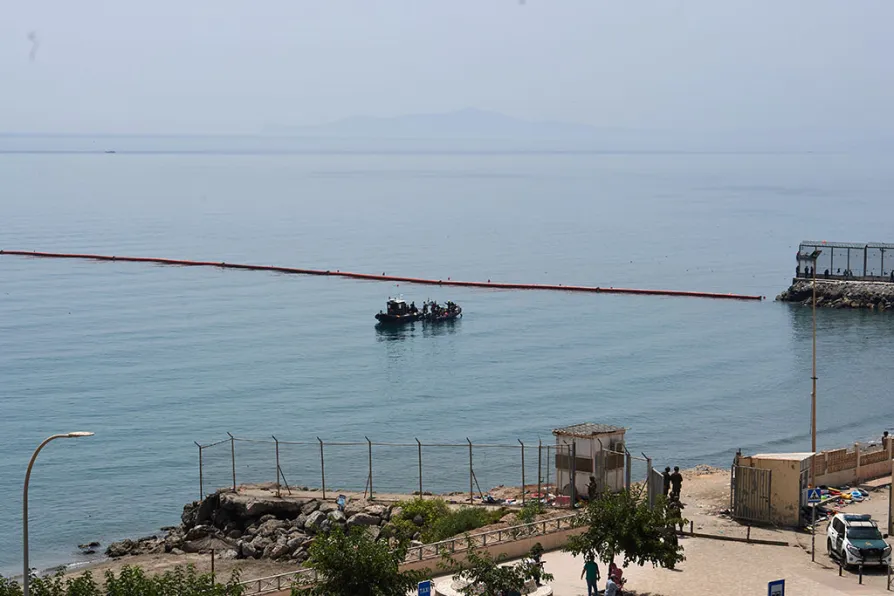
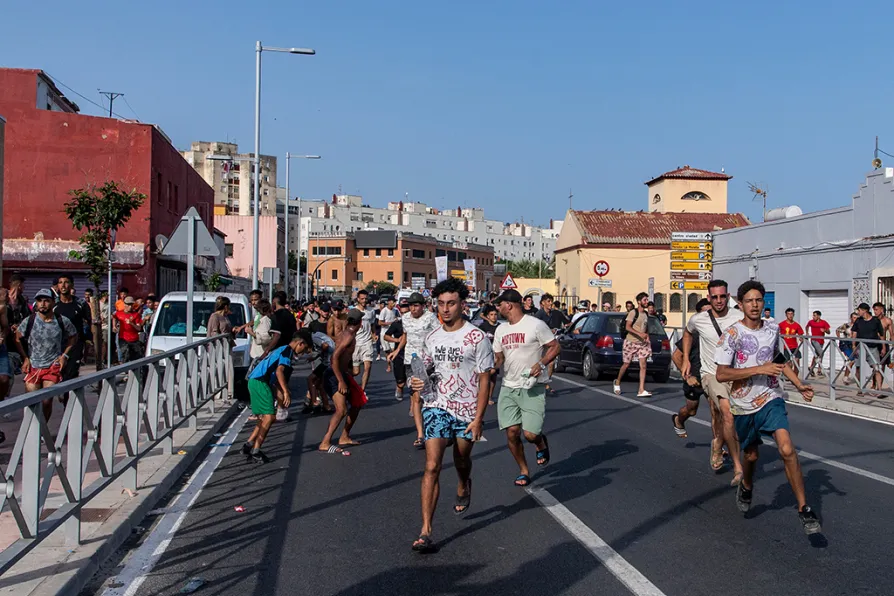
ON JULY 30-31, something in the region of 60,000 Moroccans crossed into the Spanish enclave of Ceuta. At least 72 died on the Spanish side of the border, drowned in the Mediterranean or crushed in the attempt. Within days, the great majority had returned to Morocco, many of them voluntarily, on account of Ceuta having no work, food or shelter to offer them.
They were overwhelmingly young, poor and unemployed. “Everyone came because there is no work in Morocco,” one 24-year-old told the New York Times.
They were not “invaders;” they were workers looking for work, and dozens of them died for it. They deserve our sympathy and our solidarity.
But this was no ordinary movement of people. Tens of thousands do not converge on one of the world’s most heavily fortified borders in a matter of hours by coincidence.
The immediate spark was a flood of online messages falsely claiming that a Spanish Supreme Court ruling meant anyone reaching Ceuta by sea would receive papers and employment. The ruling said no such thing.
Besides, rumours alone do not open a militarised border. The decisive factor was the conduct of the Moroccan state. Its normally formidable border apparatus stopped functioning; the authorities failed to warn Madrid about the online mobilisation; and numerous accounts suggest that Moroccan officers actively encouraged people to cross.
Indeed, Spanish intelligence has reportedly concluded that Rabat permitted and exploited the crossing.
There is a precedent. In 2021, Morocco relaxed its border controls and thousands entered Ceuta after Spain admitted Brahim Ghali, leader of the Polisario Front (Western Sahara’s liberation movement), for medical treatment. Rabat was using desperate people to punish Madrid over Western Sahara.
The provocation this time was very similar. On July 20, just 10 days before the crossing, Pedro Sanchez travelled to Algiers to announce a “new phase” in relations with Algeria, Morocco’s principal regional rival and the main supporter of the Sahrawi struggle for self-determination.
Algeria is also Spain’s largest supplier of natural gas this year, giving the rapprochement considerable economic and strategic weight.
Rabat, then, had reasons of its own to open the border. But the resulting crisis fitted seamlessly into a wider campaign against Spain’s increasingly independent foreign policy.
Madrid recognised the Palestinian state in May 2024 and intervened in support of South Africa’s genocide case against Israel.
It has described the destruction of Gaza as genocide, imposed an arms embargo, banned imports from illegal settlements and repeatedly called for European sanctions against Israel.
Spain also refused Washington the use of the jointly operated Rota and Moron bases for attacks on Iran, subsequently closing its airspace to US aircraft involved in a war it described as illegal.
It was alone within Nato in rejecting Donald Trump’s demand for military spending to rise to 5 per cent of GDP.
And on China it has been almost alone in Europe in resisting the tariff war, opposing the EU’s duties on Chinese electric vehicles and treating Beijing as a partner rather than a threat.
For a medium-sized member state, this is a remarkable degree of insubordination – and it has not gone unpunished.
Washington’s response has been explicit. Trump threatened to cut off trade with Spain over its refusal to facilitate the attack on Iran. After the Ceuta crossing, he and JD Vance immediately presented the episode as an “invasion” caused by “weak and very liberal laws,” instructing the US right to turn the deaths into a domestic political weapon.
Italy’s quasi-fascist prime minister Giorgia Meloni suspended Schengen arrangements with Spain and demanded its expulsion, regardless of the fact that Ceuta and Melilla are not part of the Schengen zone.
The Israeli response was also revealing. Israel’s UN ambassador, Danny Danon, used the crisis to taunt Spain over its “colonial enclaves.”
Pro-Israel commentators had already advocated a new Moroccan “Green March” into Ceuta and Melilla as a means of punishing Sanchez and strengthening an ally controlling the entrance to the Mediterranean.
Such interventions demonstrate how neatly the resulting crisis aligned with the strategic interests of Israel and the US.
Morocco has been drawn ever more deeply into that system of strategic interests. In December 2020, it normalised relations with Israel under the Abraham Accords.
The price was US recognition of Moroccan sovereignty over occupied Western Sahara, overturning decades of international consensus. Israel followed with its own recognition in 2023, while Israeli drones, air-defence systems and surveillance technology have become pillars of Morocco’s armed forces.
Washington has now begun applying pressure directly to the status of Ceuta and Melilla. In April, a US House appropriations committee described them as cities “under Spanish administration” but “located in Moroccan territory.”
This was not the adoption of a new US policy, still less an outbreak of anti-colonial principle. The same administration recognises Morocco’s occupation of Western Sahara and maintains its own colonial possession at Guantanamo Bay – not to mention a global empire of military bases, alliances and client states.
It is of course the case that Ceuta and Melilla are colonial enclaves, relics of the Iberian conquest of north Africa. Like the six counties of the north of Ireland, the Malvinas and the Chagos Islands, they are unfinished business that will eventually have to be settled.
But the colonial question must not be reduced to an instrument for disciplining a government that has broken ranks over Palestine and Iran.
The external pressure, moreover, has a domestic twin. For two years the Spanish right has sought to bring the Sanchez government down by means other than the ballot box.
A judiciary that the country’s transition to democracy left substantially intact – the same courts that pursued Catalonia’s elected leaders into prison and exile – has opened a cascade of investigations into the prime minister’s wife, his brother and his attorney general, on transparently political charges.
The neo-fascist Vox party has made common cause with an international far right movement which cannot tolerate the kind of independent, mildly redistributive government that Sanchez represents.
A “mass immigration crisis” is the perfect tool for presenting the government as weak, incompetent and incapable of protecting Spain’s borders.
Morocco has shamelessly exploited the poverty of its own people for its immediate geopolitical purposes, while the US, Israel and the European right are exploiting the resulting spectacle against Spain.
None of them care about the lives of the young workers who died in the Mediterranean, nor about the thousands that have lost their lives in the wars the Sanchez government has stood up against.

Similar stories
The border spat is a useful turning of the screw against Spain for US interests, says ROGER McKENZIE