
Working people across Britain are fighting back against austerity, war, repression and exploitation. The challenge now is to unite those struggles, says Communist Party of Britain assistant general secretary JOHNNIE HUNTER

Our friends in the north
KEITH FLETT looks at geographical roots of working-class activism in Britain
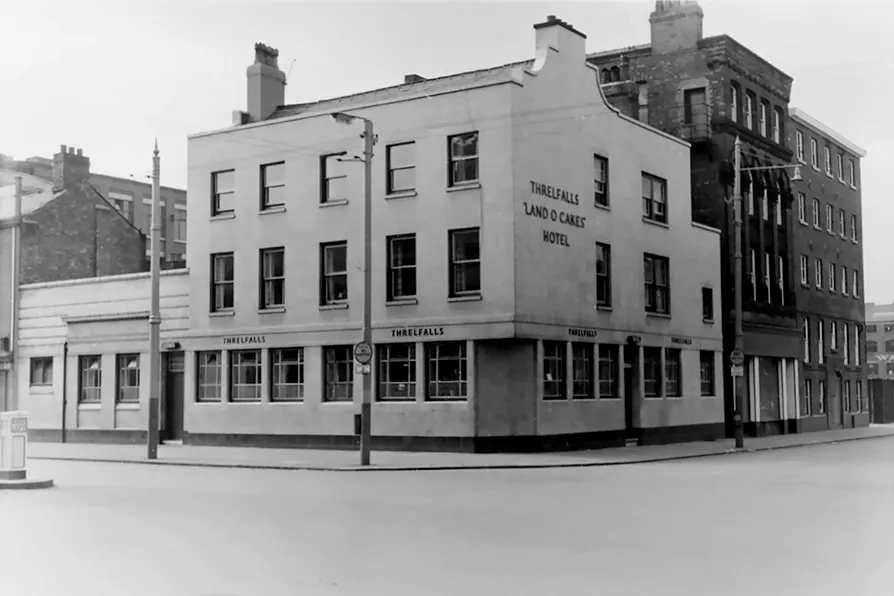
 Land O’Cakes Hotel, Great Ancoats Street, Manchester in July 1962 / pic: Manchester Archives+/CC
Train drivers’ union Aslef general secretary DAVE CALFE speaks to Ben Chacko about his hopes that Burnham’s devolution agenda will include the importance of the railway
DIANE ABBOTT provides an analysis of the reasons for EU and British voters’ dramatic swing to the right
Some of the review’s proposals could make the benefits system less cruel and dehumanising. But its vague plans for services and non-cash support revive the threat that disabled people will lose control over the money we need to survive, writes DYLAN MURPHY
Believe it or not, there was a time when the US government built beautiful homes for working‑class Americans to deal with a housing shortage, writes ERAN BEN-JOSEPH
MAT COWARD has heaps of good advice on recycling garden and household waste over the winter





ANDY BURNHAM has revealed plans to set up a “No 10 Downing Street of the north” in Ancoats in Manchester’s Northern Quarter when he becomes prime minister.
The National Charter Association (NCA) was founded at a delegate meeting which began 186 years ago on July 20 1840.
The NCA provided an organised structure to attempts to win the vote for working men around the Six Points of the People’s Charter.
It had an elected provisional executive and a branch structure with a paid membership. It lasted until 1860.
The party encompassed a wide range of views, from moderate parliamentary reformers to those who supported a socialist revolution such as George Julian Harney.
The meeting took place in the Griffin pub on Great Ancoats Street, Manchester. The pub dated from 1791 and was closed in 2005 by which time it was known as the Land O Cakes, pictured. It is now the Bem Brasil restaurant.
Perhaps typically of how much of Britain’s working-class history is either forgotten or not remembered at all, I don’t believe there is any current plaque on or near the spot to mark the event.
Maybe Burnham’s northern focus will address that issue. After all, he made his first speech after winning the Makerfield by-election at the People’s History Museum, also in Manchester.
The history of the labour movement can provide further backing to Burnham’s north but there are also other stories to tell.
Burnham has long been arguing that Labour policy-making should be less London-centric, laying out the case, for example, in a Guardian article in May 2021.
When EP Thompson wrote about the birth of the Independent Labour Party in Homage to Tom Maguire (1960), a Leeds trade union activist, he argued that the labour movement was born in those “shadowy parts” known as the “provinces,” and saw this as a positive.
He contrasted this, however, not with London as such, but with the thinking that came of London HQs of unions and political organisations.
The Independent Labour Party also grappled with the issue of where it should have its focus. A first attempt at electing a national executive saw people representing the areas of the UK, who hailed from those parts, with the proviso that they must live in London.
This was rejected. The founding conference took place in January 1893 in Bradford and Manchester became an organisational focus.
However, there were limits to the principle of rooting working-class organisation in the north of England and these were underlined by Keir Hardie.
Hardie stood as an Independent Labour candidate in Lanark in April 1888 and in August of the same year he became the first secretary of the new Scottish Labour Party.
A career in Scottish politics surely beckoned. Except that it didn’t because that wasn’t quite how Hardie saw the world.
In 1892 he travelled to the East End of London, another centre of a newly organising working class, to stand, without Liberal opposition, as a Labour candidate for Westminster. Hardie won and in August 1892 took his seat as an MP.
When it came to the 1900 general election Hardie, in era when it was possible to stand in more than one seat, was nominated in Preston and Merthyr in south Wales.
In a two member seat Hardie was elected MP for Merthyr and in the 1906 general election was re-elected with an increased majority.
Socialist politics is rooted in community and workplace, but it’s also national and international. The language of class politics is universal.

Similar stories

Some thinkers and authors on the right are openly discussing the possibility that the historically successful party of the British ruling class may be exhausted
Can Andy Burnham’s programme deliver a productive economy – or merely a softer version of capitalism, asks VINCE MILLS

Labour movement history in Britain shows workers secured reforms through collective pressure and political representation, rather than being gifted from above, writes KEITH FLETT