
PETER MASON applauds the revival, 39 years later with the same team and cast, of Manfred Karge’s version of Brecht’s 100-year-old play, Mann Ist Mann

Frida Kahlo: what’s not there to see
To rescue Kahlo from the clutches of the corporate art market, we need to acknowledge the overt and covert political dimensions of the work, demands GAVIN O’TOOLE
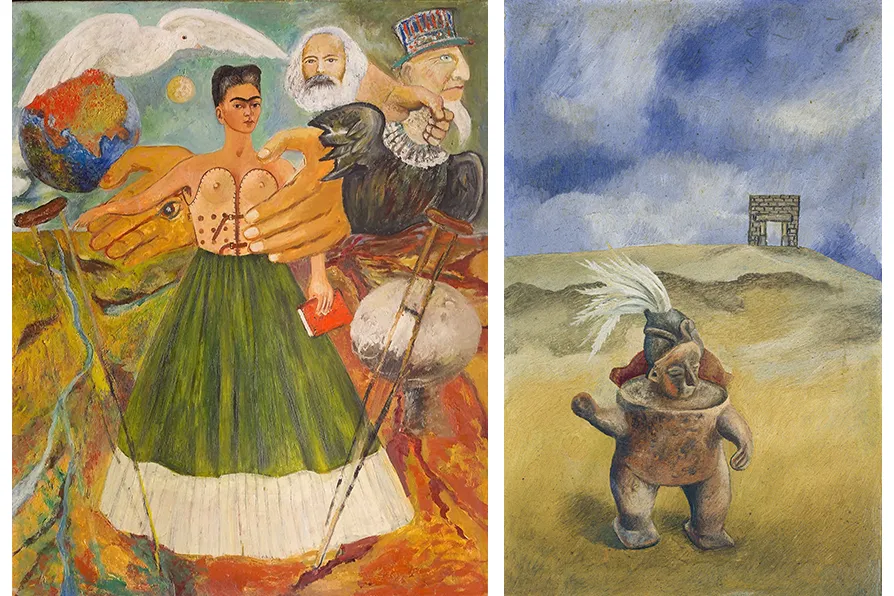
 (L) Frida Kahlo, Marxism Will Give Health To The Sick, 1954; Frida Kahlo, Survivor, 1938. [Pics: Museo Frida Kahlo; Colección Pérez Simón]
New releases from Biita Houdei, The Mary Wallopers, and The Tubs
New releases from Biita Houdei, The Mary Wallopers, and The Tubs
MAYER WAKEFIELD applauds a fearless attempt to bring to the stage the 1984 toxic gas disaster in Bhopal, India
ALEX HALL applauds the account of a dogged, traumatic and punishing campaign for justice that has lasted from 1998 to the present day
NICK WRIGHT laments the political bias of an epic attempt to tell the history of the liberation of France from the Nazis, that excludes both the decisive contribution of the Soviet Red Army, and of the French communist party itself





Frida: The Making of an Icon
Tate Modern, London
⭑⭑☆☆☆
IN ONE of her final paintings completed in 1954 months before her death, Frida Kahlo made an unequivocal statement about her legacy.
Marxism Will Give Health To The Sick, 1954, is yet another self-portrait by a Mexican artist whose work has been raised to unrivalled cultural status through its depiction of female suffering. The canvas depicts Kahlo in characteristic orthopaedic corset, the lifelong result of catastrophic health problems, gently embraced by the saintly hands of Karl Marx, which allow her to cast away her crutches as an imperial US eagle is throttled above her.
It is an emphatic assertion of the two defining aspects of her life — sickness and communism — but you will not find it, or anything similar, in Tate Modern’s latest blockbuster exhibition: “Frida: The Making of an Icon.”
Its absence exemplifies a bizarre void at the heart of this show, which commits itself to exploring how Kahlo constructed her own identity, before then considering how interpretations of this drove the “Fridamania” that turned her into a global icon.
In short, Kahlo was a revolutionary activist before she was an artist, and even if this child of a bourgeois family never scaled the heights of Mexico’s Communist Party, gave it succour through her art and life. This is amply captured in the 1983 biopic “Frida, naturaleza viva” by the Mexican director Paul Leduc, which references the hammer and sickle flag draped upon her coffin for her final journey.
It is also the epicentre of Diego Rivera’s epic mural “The Arsenal” painted in 1928 in which the central figure is a bold, young Frida dressed in red and sporting the Soviet star, distributing weapons to revolutionary insurgents.
Yet if we were to come away from Tate Modern’s extravaganza with even a basic feel for the multiple identities Frida assumed — or that have been attributed to her — we would still know nothing about her politics.
Of the mere 30 works by Kahlo herself on display, just three hint at her Marxist, revolutionary and anti-imperialist sympathies: the hammer and sickle on a plaster corset she wore to support her ruined spine; an image of Pancho Villa in a painting of 1927; and “My Dress Hangs There” from 1933, a collage lambasting US society.
It is a regrettable omission that merely reinforces the apolitical, overblown recognition of Kahlo today as a pained proto-feminist whose face adorns women’s products from T-shirts to sanitary napkins. This is the identity favoured by American liberals that has propelled her work to the stratosphere of the US capitalist art market, not least after it caught the eye of multimillionaire celebrities such as Madonna.
Such is the absence of politics in this show that one could be forgiven for questioning the intentions of those institutions behind it: the Museum of Fine Arts in Houston in partnership with the arch-capitalist Bank of America, and a gleeful Tate Modern counting the proceeds of record ticket pre-sales.
Admittedly, Frida: The Making of an Icon assumes the nominally noble aim of exploring how the ways in which Kahlo “visually articulates her many selves” influenced other artists and communities, and hence the origins of Fridamania. This phenomenon, which has even ensnared Mexico, will be in full flood over the summer across London, with murals in Bankside and installations on Carnaby Street among other highlights.
Tate presents her works in a dialogue with those of contemporaries such as Rivera and Maria Izquierdo; considers their coincidental connections with the surrealists; and explores their impact on the Chicano civil rights movement of the late 1960s. There are nods to feminist interest in Kahlo’s painting and its impact on LGBT+ and disabled artists, and the final display explores her transformation into a ubiquitous global brand.
Yet even here there are no flashbacks to the ideological ferment in which she was formed, whereby in the 1920s artists were imagining a possible future fired by the Mexican and Russian revolutions.
To rescue her corpus from the clutches of the US corporate art market, we need to acknowledge the overt and covert political dimensions of the work of an artist who, although born in 1907, insisted she was born in the year of the Mexican Revolution, 1910.
It was her interest in the political possibilities of art that led her to join the Young Communist League in 1927, and it was at a party of fellow traveller Tina Modotti in 1928 that she reconnected with Rivera just before he visited the Soviet Union.
Rivera’s subsequent expulsion from the party reflected the murderous divisions generated by Stalinism, and the artist and Kahlo would play a starring role in the drama of Trotsky’s exile and assassination in Mexico.
Anti-colonial, revolutionary nationalist, and socialist themes abound in Kahlo’s work, not only to illustrate her subjective experience but also to ask questions about gender, race and class — yet these themes are almost entirely absent from Tate Modern.
The self-image she created with indigenous costume revealed a lifelong commitment to the romantic nationalist search for an authentic Mexico free from imperialism and distinct from US materialistic greed.
The face of the revolutionary Emiliano Zapata made frequent appearances in works that are also not on display here, and in another self-portrait, also from 1954 and absent, Kahlo sits beneath Stalin’s image, finally acknowledging him as the socialist bloc’s “Great Leader.”
Her communist fervour is confirmed in letters and interviews, and in diary entries from 1951 she says of her painting: “Above all I want to transform it into something useful for the communist revolutionary movement, since up to now I have only painted the earnest portrayal of myself, but I’m very far from work that could serve the party.”
Tate Modern has bought into the US’s artistic false consciousness with such acritical zeal in the pursuit of a money-spinning crowd-pleaser that, without a hint of irony, it seems to exemplify the premise of this exhibition itself.
Frida: The making of an icon runs until January 3 2027. For tickets and more information see: tate.org.uk
