Growing instability in the US economy and financial markets could have serious consequences worldwide because of the central role of the US dollar and financial system, argues MICHAEL BURKE


 Latest editorial

Burnham’s challenge is to make social democracy work again. Is it even possible?
The basis for 20th-century social democracy in Britain is gone, argues ANDREW MURRAY – but there are measures a Burnham government could take that would break with neoliberalism
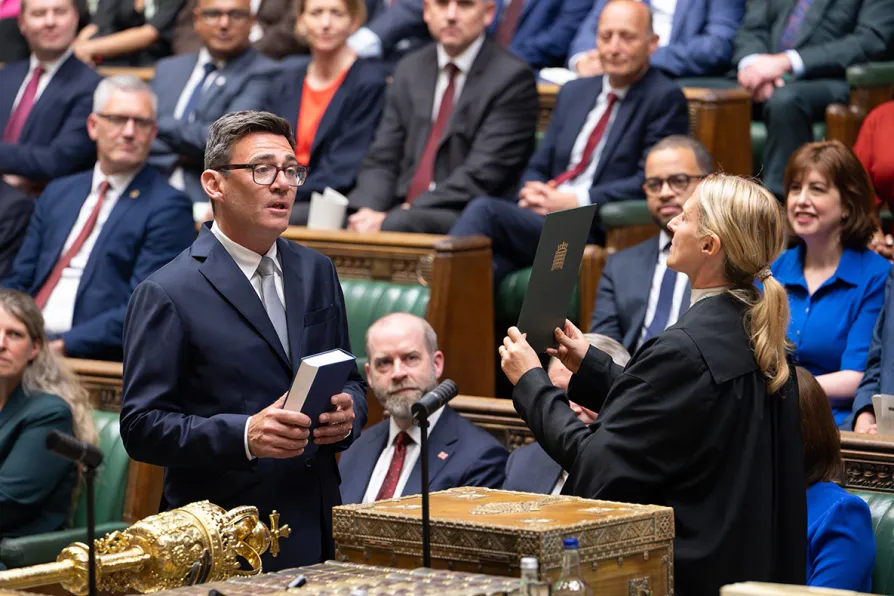 Andy Burnham (front left) is sworn-in as an MP in the House of Common in London, England, June 22, 2026 [Pic:House of Commons via AP]

Despite Andy Burnham’s declaration defending the continued partition of the island, all major international and internal trends are converging to make Irish reunification inevitable
The left needs a bold energy vision – because if it fails to provide one, others will shape the future in their own interests, argues ALAN SIMPSON
From Margate to Deal, mining memories are being kept alive. National co-ordinator for General Strike 100, HENRY FOWLER continued his nationwide tour of partner organisations in the Garden of England
Humans are part of the ‘animal kingdom’ – and of nature in general – but also distinct from it and labour (work) is part of what makes us unique, declared Engels. His insights 150 years ago into how our species came to be and how we differ from the rest of nature, are as important today as they were then, says the MARX MEMORIAL LIBRARY
Boxes of books, family photos and heirlooms, labour movement anniversaries, along with nostalgic memories of glorious childhood days on the Ayrshire coast still leave room for a wistful MATT KERR to hope for a better future





ANDY BURNHAM is going to be the latest to be handed the task of trying to make social democracy work in the 21st century.
Beneath all the froth and the spin that is the actual challenge the new Prime Minister will face.
Labour has seldom changed its leader when in office, meaning the new incumbent automatically takes up residence in Downing Street.
The last time, when Gordon Brown succeeded Tony Blair in 2007, it was a conclusion as foregone as a new Beatles album reaching number one, despite John McDonnell’s best efforts to play party-pooper. Brown and his agenda were very well understood of course, although his performance in the top job disappointed his fans.
The previous occasion, back in 1976, is hailed as the high point of Labour’s political culture, a time when the party could choose between leaders of some considerable distinction.
Indeed, five of the figures competing to take over from an exhausted and paranoid Harold Wilson were outstanding intellectuals. Tony Benn, Michael Foot, Denis Healey, Tony Crossland and Roy Jenkins all were, or would become, famous as thinkers, diarists or biographers, among other accomplishments.
However, it was the sixth candidate who won. Jim Callaghan had never written a book, although indifferent memoirs eventually followed years later.
He conducted his campaign — only Labour MPs got to vote back then — without issuing a single statement or making a single speech.
So much for the testing of ideas in a contest, much advocated today. Callaghan was no unknown quantity having served as chancellor, home secretary and foreign secretary under Wilson and collected piles of IOUs throughout the movement.
Nostalgia for the 1976 contest reflects that we were then — although few fully apprehended it at the time — living in the twilight of the high days of social democracy.
The post-Wilson field reflected the strengths and diversity of that tradition, which had been hegemonic for the preceding 30 years but accumulating strength for 50 or more years before that.
Like most of us, social democracy had two parents — the labour movements of Europe and the imperialist system.
Social democracy as a movement has been preponderantly a European phenomenon, although it gained a certain position, with some admixtures, in Latin America, and various of its ideological precepts attained a more general currency.
It drew its strength from the struggles of the organised working class for the decencies of life on the one hand, and the capacity of the most powerful capitalist countries in the world system to concede reforms.
Both were essential. The dominant financial and colonial position of Britain, above all, made such concessions possible, and the growth of world socialism post-1917 and militant class sentiment at home made them necessary.
The apogee was after the two great imperialist wars of the 20th century, when carrying on in the old way was hardly sustainable. In Britain and elsewhere, the nation-state attained its apogee as a political vehicle, implementing industrial nationalisations and welfare reforms.
Even the City of London was somewhat circumscribed. All this under the aegis of the United States, determined to halt the spread of working-class power and Soviet influence by whatever combination of social amelioration and brute undemocratic force seemed most expedient.
Social democracy never, however, challenged the primacy of capital accumulation as the locomotive of the economy and society, and that was its undoing. When the needs of profit collided with the prevailing reformist social formation, the former prevailed.
The ascent of neoliberalism — powerfully signalled by Jim Callaghan in 1976, his intentions unscrutinised in the leadership race earlier that year, when he announced to the Labour conference that Keynesianism was now dead — is an oft-told tale so this narrative will skip briskly ahead.
Imperialism has endured numerous setbacks but it remains with us today and Britain is a powerful player in the world system, extracting value from across the world and relaundering it with a very substantial rake-off.
So why is it so hard to sustain a reformist, social-democratic project today? Tony Blair did not really try, being content to let the system run its own course unimpeded, and his recent essay shows he has learnt nothing since.
One partial answer is that the working-class movement is not the force it once was, neither organisationally nor ideologically. The social base for reformism is much attenuated — so many of those who enjoy its benefits are no longer organised to defend them effectively.
Another is that the globalisation which Blair lauded has intensified competition between capitalist countries for investment in a world were capital became hyper-mobile.
That imposed a requirement to restrict taxation, nationalisation and regulation, any of which might lead capitalists to turn elsewhere, undercutting the main bases of traditional social democratic policy.
Still, when times were good which they were for capitalism in the 1990s and beyond, with the vast accretion of wage labour in the world economy consequent on the collapse of the socialist system in the USSR and Europe, the opening up of China and the substantial destruction of post-Bandung progressive initiatives in the global South in favour of IMF dictat, some social improvements might yet be allowed.
The 2008 crash put an end to that. But it has not stilled that capitalist competition, instead turning it more feral and zero-sum. It has also, thanks to President Trump, transitioned to inter-state political rivalry too, as the unipolar moment of unchallenged US hegemony has passed, with neo-colonial wars being superseded by great power conflict.
So we have the tyranny of the bond market, pressuring economies to stay in neoliberal line, and we have a drive to war, devouring resources even as it prepares to devour peoples and nations.
This is the basis for the constraints under which Keir Starmer has laboured. They will not be removed as a gesture of goodwill to Andy Burnham.
The former was a singularly poor politician and leader, dishonest, graceless and often gormless, peevish and self-righteous to the very end. Burnham, a better man for sure, we should wish well in his quest.
So to be helpful, let us suggest one way in which he could deliver on his decent social-democratic intentions.
Burnham could perhaps succeed if he engineers a significant degree of disengagement from the world capitalist economy. That is not to say capitalism in Britain can be overthrown here and now. That is not presently on the agenda, and if it were doable it would not be done by him.
It means a willingness to embrace a degree of economic autarky, breaking with the priorities of the City of London and the pressure of the bond market, which is just a fancy term for global capitalist speculation.
It means ending the dependent “special relationship” with the United States, a popular project with Trump in charge in Washington, breaking with Nato’s ever-escalating arms budget demands and winding down all military plans based on worldwide interventionism.
It might be passing painful, but it could be permanently popular. It would be an extension of the “take back control” slogan so ubiquitous, and so abused, at the time of Brexit.
It would have, literally, social and democratic appeal relying for its success on the sort of solidarities which social democracy once valued.
This is the implacable dialectic — a social democracy which for decades relied on embedding Britain in a world economy from which it squeezed the necessary wherewithal for reforms, now depends on an act of self-extraction from an international system based on relentless competition, tending towards war.
Will Andy Burnham be up for it? Almost certainly not, in which case he will almost certainly fail. In which case the movement can draw the appropriate conclusions about social democracy at its leisure — but under, alas, a pitiless hard-right regime.
Cage fight trumpery
Donald Trump gets a lot wrong, but he is sometimes right. What better way to mark the 250th anniversary of the USA than a cage fight?
Mindless unhinged violence? Check. Racist outburst? Check. The stink of corruption? It’s all there. The essence of the decaying society the orange demagogue presides over.
Trump is clearly obsessed with memorialising his rule. Let the cage outside the Whie House be it.
