A California union’s decision to host a meeting about US policy towards Cuba has prompted a congressional probe and renewed attacks on international solidarity, writes CAMERON HARRISON



Nato 3.0 – 85 years after Operation Barbarossa
SEVIM DAGDELEN warns that Germany’s military resurgence and revival of old hostilities towards Russia have dangerous implications for Europe and beyond
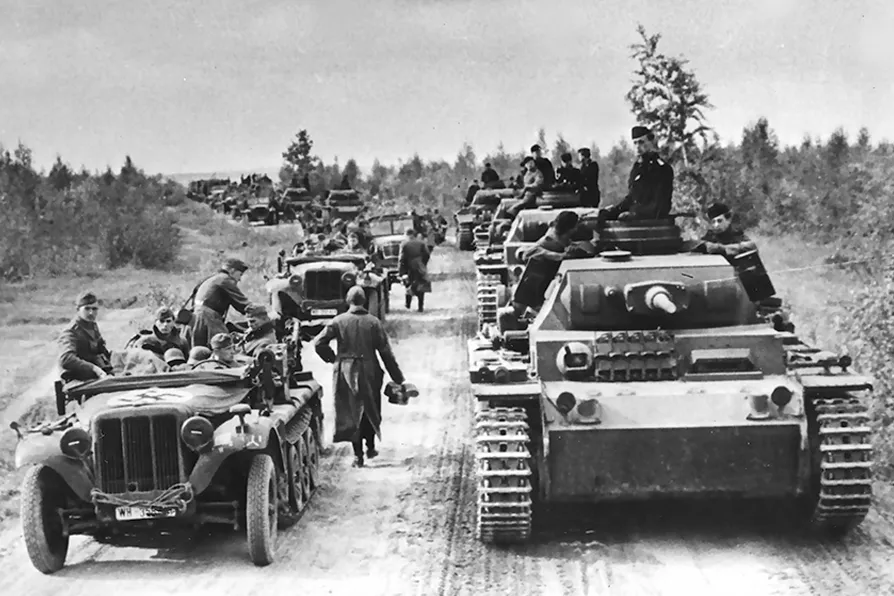
 THE LEBENSRAUM AFFLICTION: ‘Living space’ driven Operation Barbarossa - a column of armoured vehicles, including Panzer III medium tanks, near Moscow in October 1941 / Pic: National Digital Archives/Wydawnictwo Prasowe Krakow-Warszawa/CC
The Baltic state is set to reverse its constitutional prohibition on nuclear weapons and foreign bases as part of accelerated Nato war preparations, warns TOM UNTERRAINER
Long-term underfunding and state neglect, while simultaneously probation services have been undermined, have intensified the prison crises, argues SOLOMON HUGHES
Holyrood incompetence has cost jobs and put the future of Clydeside’s Ferguson Marine shipyard into jeopardy. Its future should have been assured, argues KENNY MACASKILL
With the agitated debate now raging in the media about the early release schemes, Prison Officers Association general secretary STEVE GILLAN gives the view of those who work in the sector
The hounding of the late Jason Arday is an all too familiar experience for many black people. ROGER McKENZIE calls for collective action to combat what can feel like personal isolation





US SECRETARY of War Peter Hegseth has just presented the new US concept for Nato at the meeting of its ministers: Nato 3.0.
The US wants “the Nato to move quickly and irreversibly towards a Europe-led alliance in which Europe takes primary responsibility for the defence of Europe.” This is also the reason for the partial withdrawal of US troops. The US needs all its forces in east and west Asia to challenge China and Iran.
Translated, a Europe-led alliance means above all a Germany-led alliance. Only Berlin has the necessary financial resources — albeit on credit — to build what the Pistorius Plan — named after the federal minister of defence — calls “the largest army in Europe” by 2039.
Lord Ismay, Nato’s first secretary-general from 1952 to 1957, is credited with the statement that the alliance had three central tasks: “to keep the Russians out, the Americans in, and the Germans down.”
Nato 3.0 could be interpreted as follows: “The essence of Nato is to put the Germans in charge so that they fight the Russians in the interest of the Americans.”
One can debate how far this process has already advanced. The fact remains — and this can be seen from numerous statements by German leading politicians and military figures — that Nato 3.0 means nothing other than the unleashing of German revanchism against Russia in the interest of the US.
Revenge for what? Revenge for Germany’s defeat and its unconditional surrender on May 8 1945 in Berlin to the Soviet Union. One can almost feel how Bundeswehr professors such as Carlo Masala are seeking to reactivate Russia as the archetypal enemy image for the Germans.
In criticism of former SPD politician and mayor of Hamburg Klaus von Dohnanyi, who advocates peace with Russia, Masala, one of the key figures driving escalation, tweeted: “You can get the Germans out of Rapallo, but you can’t get Rapallo out of the Germans.”
It was in Rapallo, in 1922, that Soviet Russia and Germany resumed their diplomatic and economic relations. Today, the aim is to destroy these relations — in preparation for a new campaign of hostility and enmity.
In Germany, on the eve of the 85th anniversary of the Nazi Germany invasion of the Soviet Union on June 22 1941, the history of Hitler’s attack still remains largely concealed.
There are detailed studies on the murder of 27 million Soviet citizens by the SS and the Wehrmacht. Yet the character of the war as a colonial war of annihilation of a whole people is still little known in German society.
German governments have refused to recognise the murders as genocide against the peoples of the Soviet Union preferring the term “war crimes.”
The invasion of the Soviet Union was intended to solve the economic problems of the German Reich permanently — in particular, to secure the supply of cheap raw materials for German industry. “Russia is our India” — this vision of a colonial war guided the Nazi leadership.
To establish their rule permanently in the conquered territories, they did not rely on the governance of a few colonial officials as did Britain in India, but on the annihilation of large numbers of the peoples of the Soviet Union.
The space thus “freed” was to be filled with German settlers. The remnants of the population were to be kept as slave labourers.
As the German troops advanced, this murderous colonial plan was immediately put into practice. A particularly gruesome example is the blockade of Leningrad, during which the German Wehrmacht, together with its Finnish allies, deliberately starved around one million Soviet citizens to death.
The hunger plan from Hermann Goering’s four-year plan authority went even further, aiming at causing the death of up to 30 million Soviet citizens in order to secure food supplies for the German population and the Wehrmacht.
It is also little known that the Economic Staff East, with around 20,000 employees, was one of the largest Nazi government agencies and actively promoted the colonisation of the east during the war.
This work is often seen only in the context of the war economy. However, the contours of the colonial penetration of the European part of the Soviet Union are unmistakable.
Formally, the task was the exploitation of the occupied territories: securing food, using raw materials and increasing production — also through the use of the civilian population as forced labourers on site or their deportation as “eastern workers” to Germany.
All seized enterprises were placed under trusteeship with the aim of later privatising them for German companies. Leading figures from German industry were brought in to exploit the raw materials.
We are therefore dealing with a colonial authority that helped implement the genocide against the peoples of the Soviet Union in order to prepare the ground for the colonial takeover of the European territories of the Soviet Union.
Those responsible for the genocide were never held accountable — for example, Lieutenant General Wilhelm Schubert as head of the economic staff or General Otto Stapf, who remained in charge until the end.
Ideologically, colonisation and genocide were disguised as an anti-communist liberation campaign.
The planned ethnic parcelling was the accompanying programme to the genocide against the European Jews and the Slavic peoples of the Soviet Union.
In the Nazi propaganda exhibition Das Sowjetparadies/The Soviet Paradise, in Berlin’s Lustgarten in 1942, which was intended to accompany the campaign, it was stated that “under German leadership and alongside our soldiers, the best forces of the nations of Europe have united” to eliminate the Soviet Union.
It should also be remembered that the exhibition was attacked courageously with Molotov cocktails by the Jewish-communist Herbert Baum Group.
The European context in which the Nazi colonisation plans were placed is not unimportant. It leads us directly back to the present day as in Europe, 85 years later, we are increasingly hearing echos from that invasion.
When we listen today to EU foreign policy chief Kaja Kallas saying: “The dismemberment of Russia — I think if there were more small nations … it is not a bad thing if the great power actually becomes much smaller.”
Similarly the words of CDU politician Roderich Kiesewetter — a former Bundeswehr general staff officer: “Europe must work towards Russia’s capitulation,” make it clear that the history of the attempted colonisation and the disappointment over its failure by 1945 are still resonating today.
This is the great temptation that the Merz federal government risks succumbing to: turning the Nato proxy war in Ukraine into a German war in the dangerous illusion of being able to force Russia’s capitulation also in order to solve the economic problems that paradoxically only arose through this confrontation with Russia.
Be that as it may, the lust for revenge seems to be becoming the driving force of German policy towards Russia.
What is remarkable is that this is not coming from the far right, but from the centre of society and its lust for US investment funds, even if it means to gamble with the lives and wellbeing of its own population.
From now on, every movement for peace in Germany and Europe is a movement for our own survival, for life itself — to stop those whose only goals are maximising profits even at the cost of death.
Sevim Dagdelen is a former member of the German parliament (2005-25) for Die Linke (Left Party).
