ROB WARZYNIAK wades knee deep through a pile of ‘dead canaries’ of Trumpist policies which exacerbated the horrors of US capitalism domestically


 Latest editorial

Banners, brass bands and a 150-year legacy
Fownhope’s Heart of Oak Society traces its roots to the age of friendly societies, when communities provided their own safety net. Its anniversary celebrations reveal a tradition still very much alive, says MARK SEDDON
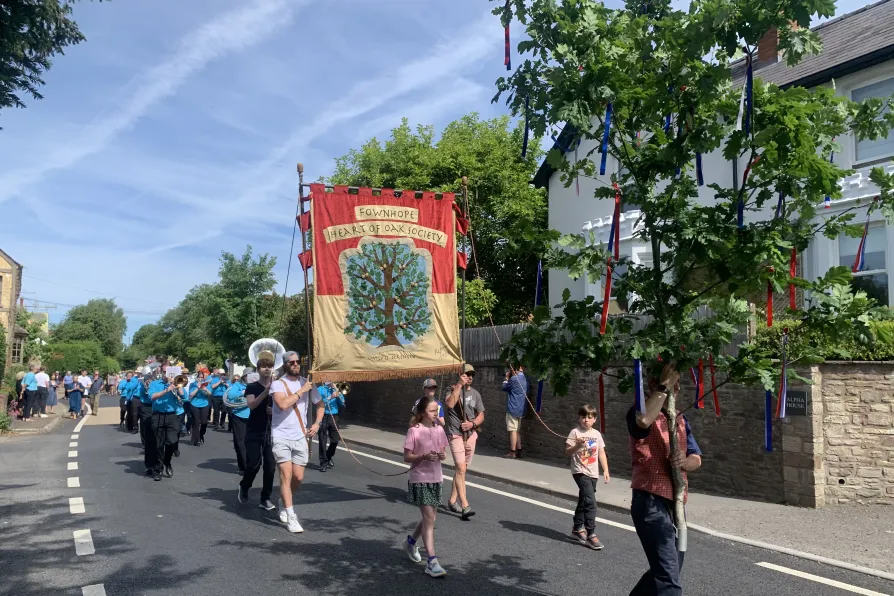 Photo: Author supplied
Without evidence or Nato consultations Berlin’s answer to the Leipzig incident is a rupture of relations. SEVIM DAGDELEN examines why
FRANCISCO DOMINGUEZ introduces the background to a conference on defending Latin America’s sovereignty
The glacier collapse in Nepal is yet another warning that a warming planet is making Himalayan disasters more frequent and destructive – but the countries facing the greatest risks are often those least responsible, says LI YANG
Nick Blair is set to benefit from a hugely lucrative contract to ‘virtually’ train the British army for its next war. Like father, like son, writes SOLOMON HUGHES
Even when tragedy strikes, Western media cannot resist the opportunity to turn it into a sordid propaganda opportunity, as the Nepal-China border tragedy shows, writes CARLOS MARTINEZ
Trade unions should be at the heart of the anti-racist push for reparations for the historic legacy and continuing impact of slavery, writes ROGER McKENZIE





THIS year marks the 150th anniversary of the Fownhope Heart of Oak Society, rooted — excuse the pun — in that very fine tradition of friendly societies, an early collectivism that protected people in hard times and that made sure that widows and children didn’t go hungry in communities such as these up and down the country.
Once upon a time there were hundreds of Hearts of Oak societies; in many ways these self-help organisations were early trade unions. And as we joined the villagers of Fownhope in Herefordshire for their annual Club Walk around the village with banners and brass band, I was transported to the old Durham coalfield, with its aged miners’ homes, brass bands and banners at Gala time whose themes reflect the influence on the mining communities of self-help, religious observance, Methodism, Labourism and Marxism.
The Fownhope Heart of Oak Society, much like the Durham Miners Association, used to provide insurance for the local, mainly agricultural, workforce and of course this was at a time when there was no social security and no basic pension.
Three years ago the future of the society was in doubt, and I spoke to Graham, a local man who has done so much to pull the community together since then and find others to help maintain and build a society that today is more of a social and community organisation, raising money for good local causes while keeping the glorious tradition of the “Club Walk” on Oak Apple Day, which falls on May 29.
“Now,” said Graham, “we have a new group to take things forward for a new generation of members to build upon. The success of the society is the joy of community. There are people that meet on Club Walk day that may not see each other on the days between.
“We are walking in the steps of our grandparents and their grandparents. The hosts providing refreshments are connected to a line of hosts that have come before them. It’s magical and I’m proud to have done my bit.”
For a tenner anyone can join the society and the day’s events, the warmth and friendliness of those on the Club Walk, never mind the cider, soft drink and cheese rolls are a fantastic draw.
Fownhope sits near the River Wye and the procession began with a glorious array of flower-covered sticks being carried for the 150th club walk around the village from the church, to the smart looking local medical centre where the best flower stick award was announced, along to the retirement bungalows and finally past the sports field up to a house and gardens perched high above the river.
Generations of this household, as with other stopping places in the village had supported the society, and to cap the beautiful view of the Wye, I spotted a large salmon forging its way up-river.
Friendly societies no longer exist in the way that they did even a few years ago. A financial services Act in 1986 did away with their ability to govern themselves and the legislation made it almost impossible for the small mutuals to survive without evolving as the Fownhope Society has done.
It was a mean-spirited Act and during a mean time in the affairs of this country.
Margaret Thatcher was prime minister and the miners’ strike had ended a couple of years before, with wholesale pit closures coming down the pipeline. She had famously said at that time that “there is no such thing as society.”
On this glorious summer’s day, in the village of Fownhope, she was once again proved fantastically wrong.
Unexpected encounters in the wild
THE end of May, a memorably hot period, has had me in different places, an accidental observer of nature; of birds and animals many of us don’t often come across.
A couple of weeks ago, I was in a Hampshire cemetery, overlooked by Quarley Hill, an Iron Age fort which was later to provide defensive cover for Anglo Saxon King Athelstan, who issued “the first laws for all England” at around 930 AD at a great assembly in Grateley.
Staring at the hill in the distance, I had missed the still form of a hare, its ears laid across its back, its green eyes, like bright emeralds, staring at me from the long grass near a gravestone.
Suddenly it took off, with a lolloping gait, leaving an indentation in the long grass.
These resting places are known as “forms” and are certainly not in so much use earlier in the year, when in this part of the world you can often come across “mad March hares,” on their hind legs, boxing each other on the bare fields.
Some days later we were heading for Borth, on the Welsh coast, and through the gloriously empty beauty of the deep countryside that is Radnorshire, now part of the much larger Powys.
Radnorshire is apparently the second smallest county in Wales and is the least populated area in England and Wales, where there are roughly 48 sheep for every human being.
Driving towards a low hill, I spotted the extraordinary site of upward of around 20 red kites spiralling the skies and flying ever lower. And then I spotted a tractor with a grass cutter at work in the field.
The kites were like seagulls following the tractor and plough, circling in case any small rodents were to make a run for it from the fast disappearing tall grass.
Thirty-odd years ago, there were very few red kites, and those that remained could only be found in the mountains of north Wales.
But now, with the help of conservationists, they can be found in ever larger numbers right across England and Wales. In Radnorshire there is clearly no stopping them!
This column appears fortnightly.
