KEN COCKBURN traces the one original language – that of the Yamnaya pastoral nomads – from which all European and Indian languages derive


 Latest editorial
Prosperity Gospel and the Race Business
FIONA O’CONNOR admires an ambitious first novel that loosens South Africa’s rainbow collective to examine the racial tensions within
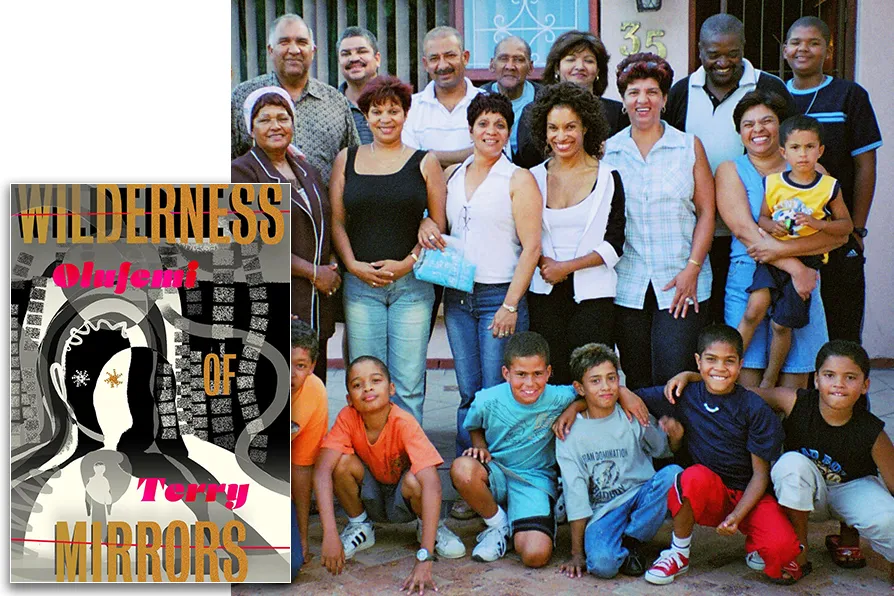 An extended mixed-race family with roots in Cape Town, Kimberley, and Pretoria (South Africa). [Pic: Henry M. Trotter/CC]
PAUL DONOVAN is fascinated by the debunking of the iconic British war hero
ALEX HALL recommends a searing panorama of our global predicament
Comics are not just superheroes and spandex – it can be public art, telling public stories, suggests HARRIET EARLE
ALEXEI SAYLE speaks to Angus Reid about a lifetime of protest, how to hone political art – and what to do now
The bard serenades the Diggers of Wigan and their festive followers





Wilderness of Mirrors
Olufemi Terry, Les Fugitives, £14.99
A DEBUT novel by Sierra Leone-born writer Olufemi Terry, this book is an absorbing perspective on the rapidly changing society of South Africa. Wilderness of Mirrors loosens out the rainbow collective of peoples to examine racial tensions held fast within its free-market economics.
Emile is the Creole son of an established political shadow-player. He is sent to the southern tip of Africa to keep an eye on relatives. A neurosurgeon in training, possibly on the autism spectrum, Emile’s experiences offer multiple refractions of otherness making up a rapidly changing society.
His displacement from his more sophisticated home city sharpens his focus both on the racial and class tensions he perceives, but also on his own identity and sexuality, similarly unknown territories for him.
The unnamed coastal city with its looming background of dark mountains is presented as a setting for primal and mysterious forces. An encounter with an unsettling stranger, Lucas Bolling, an Antillean German, “both and neither,” introduces animism and ibogaine “psychoactive” tea. Emile hallucinates his family partisanships, seeing himself in the fractured mirroring of his cousins’ dynamics.
Less successfully, the hallucinatory episode goes on to “unspooling a potted, lurching history” of South Africa in which images of indigenous slaughter move into abstract historical analysis: “And then the great leap forward to the onset of national peace talks: here are Blacks and Whites facing off across a wooden table… The Blacks and Whites alike understood they were expected to perform rituals of magnanimity and atonement, and neither side had any doubt over which role was theirs and what was at stake. Nothing less than rejoining the community of nations.”
The crux of the novel revolves around the post-partition dislodgement of the Creoles from their cozy buffer zone between ruling minority Whites and the segregated majority Blacks. Here the novel touches on the political thriller genre: a burgeoning movement of disaffected Creoles is being nurtured on “blood and soil fascism,” funded by the faux Fanon-like Bolling and headed by reluctant saviour Braeem Shaka, a recent political deportee from the US. Emile is drawn into a fugitive situation, but this is not the book’s real agenda.
The novel’s pinnacle, with characters hiding out in a mice-infested farmhouse, is a reckoning with South African political dynamics in the unspooling of extreme capitalism. Regarding the plight of the Creoles — “There’s not much sympathy for peoples that aren’t voraciously exploitative of the resources in their vicinity” — contemporary parallels are raised. Step forward the Israeli regime: the governing right enforcing racial partition and settler colonialism on suffering Palestinians while the world fails to rally around.
Closer to home too: far-right forcefields bankrolled by billionaires, stirring racial hatred to deliver cultural upheavals for the ultimate benefit of liberalising labour markets.
“Prosperity Gospel,” Bolling remarks, the great energy of developing societies directed towards “raising God and amassing wealth,” is linked to “Race business,” as Emile’s father notes.
The nuances of racial difference this book names are staggeringly varied: Whites and new Whites, dirty Whites, goras and indigenous Boesvolk, Creoles/Coloureds and Asians, and then Black Africans, including Muntu, or despised “munts”: internal migrants driven by poverty to provide cheap illegal labour, among the 29 million Black majority population of post-apartheid South Africa.
This is an ambitious book taking the reader to a world rarely encountered in European literary fields. There are influences apparent of Coetzee and Conrad, and of VS Naipaul, though the writing doesn’t reach to such skilfulness yet. But despite some clumsy sections and contrived plotting, this book represents an exciting new vision from a writer well worth watching.
