Councillor SAM WHEELER says there’s a tangible shift in mood on the left in the city whose mayor has recently become PM — but there’s no room for complacency



The labour reform that could win Lula re-election
By helping drive through a historic reduction in working hours, Brazil’s president has reconnected with organised labour in a way that the European left would do well to note, says SARA VIVACQUA
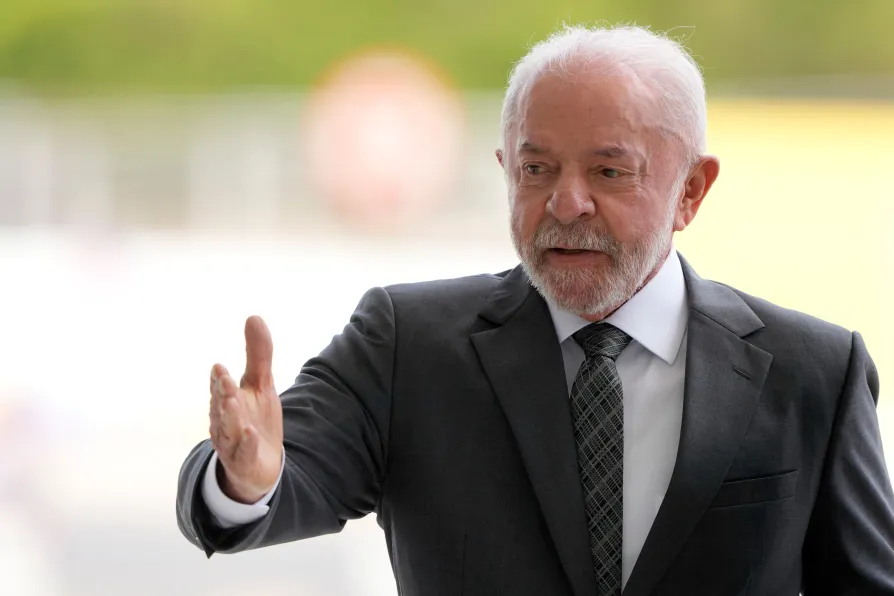
 Brazilian President Luiz Inacio Lula da Silva waves to the press before the arrival of Suriname President Jennifer Geerlings-Simons at Planalto Presidential Palace in Brasilia, Brazil, May 28, 2026
Communist Party leaders Alex Gordon and Lorraine Douglas deliver vital medicines in trip to besieged socialist island
TUC Cymru is playing a leading role in tackling far-right ideas in the workplace, says LAURA DOEL
A New Delhi press conference in which Sheikh Hasina and her son implied the new order in Bangladesh is a security threat to India has sparked fears she is planning a comeback. SIAM SAROWER JAMIL reports on the fallout
Two months of student unrest have forced out India’s education minister and rattled the BJP regime. Could this be the beginning of the end for Modi, asks Communist Party of India (Marxist) general secretary MA BABY
MAT COWARD says the heatwave is a testing time for gardeners — but he has some tips





A PIVOTAL event last week may shift Brazil’s next presidential election in October in President Lula’s favour.
For months, President Lula and Brazil’s left-wing parties have joined forces to build political pressure and make it impossible for the opposition to block a policy that could rearrange labour–capital relations in Brazil and change the lives of millions.
Despite not controlling Congress, Lula’s political vision and daring mobilisation appear to have finally paid off. Brazil’s Chamber of Deputies approved the amendment by 472 votes to 22 in the first round, and by 461 to 19 in the second. The proposal would end the six-day working schedule known as 6×1 and reduce the working week to five days (5×2), while preserving wages. The amendment required 308 votes.
Brazil has had a 44-hour weekly limit enshrined in its constitution since 1988. During the democratic transition, workers won a reduction from 48 to 44 hours, but the move to a 40-hour week was postponed. The message from Brazil’s elites was effectively: wait, not now, we will deal with it later. Thirty-eight years on, under unprecedented public pressure, the Chamber of Deputies has finally voted for the 40-hour week.
This demand did not begin as a top-down government reform. It grew out of a workers’ revolt, organised in particular around the Vida Alem do Trabalho (Life Beyond Work) movement, after a young retail worker’s TikTok complaint about exhaustion under the 6×1 schedule struck a chord at a national level.
Lula’s political instinct, and his sensitivity to Brazil’s poorest workers, led him to embrace the issue and reconnect with his strongest political identity and base: the former metalworker and trade union leader fighting for concrete improvements in workers’ lives.
The amendment passed by an astonishing margin, made possible by the strategic political isolation of the opposition. A cohesive party and civil-society movement turned the vote into a simple test: either you vote with the worker, or you are seen as standing against the worker. There was no third option, and no technical abstraction sufficient to escape public judgement.
This was certainly not an act of parliamentary virtue, but of parliamentary survival. The credit for that, however, belongs to Lula’s political sense: he understood that the pressure building outside Congress could be turned into a classic class struggle — and one that could be won.
Nor should this victory be read as a simple piece of labour-law reform. It can be seen as contributing to a structural reorganisation of capital and labour. Brazilian society has long perpetuated the legacy of slavery and the control of workers’ bodies by employers and big capital. Six working days a week, with long commutes and for low wages, have together made time of one’s own impossible for the majority.
Brazil’s statistics agency, IBGE, records that 1.3 million Brazilian workers spend more than two hours just getting to work, and another two hours returning home. In the south-east, the country’s most urbanised and industrialised region, almost 700,000 workers face this situation. It is a question of dignity: of a life not entirely dominated by a system of exploitation.
This hard-fought congressional victory is also a test case for how political stability can be built, and credibility in politics restored, through a long-forgotten alliance of the left: an alliance with the working class, which has proved more effective than any tactical arrangement with the elites.
Lula’s boldness may therefore offer lessons beyond Brazil — showing what the European parliamentary left has largely failed to do: win on a left-wing programme and then deliver concrete working-class gains, rather than governing through elite consensus, fiscal caution and accommodation to big capital.
In Barcelona, on the sidelines of the Brazil–Spain summit and the progressive mobilisation convened around Pedro Sanchez in April this year, Lula issued precisely such a warning. Progressive governments, he argued, lose credibility when they are elected on left-wing promises but go on to govern through austerity or to manage neoliberalism on its own terms. That, he suggested, is the political vacuum in which anti-politics and the far right flourish.
As Bolsonaro’s camp, business lobbies and conservative congresspeople moved to block and dilute the reform through amendments — a last-minute manoeuvre to stall the vote — they were forced to retreat to avoid haemorrhaging their own electoral base.
A Nexus poll found that 73 per cent of Brazilians support ending the 6×1 shift pattern provided there is no wage reduction, and 84 per cent back at least two days off per week.
A Lula government that until then had appeared demobilised — held hostage by a reactionary congressional majority that had ceded the tone of national politics to Bolsonarist revanchism — now seems to rise from the ashes. An administration that had drifted without political command or clear direction finds itself, where it seemed least possible, setting the national agenda on the very terrain that defines it most: a labour reform pushed through with the help of opposition votes.
This policy is being widely seen as capable of defining not only Lula’s re-election, but also of offering a counter-example — a way out of the political stagnation gripping the global North, where the left is still reckoning with the consequences of social-democratic erosion, recoils from socialist rhetoric and action, and is plagued by working-class disillusionment.
