Trade unions need to step up and force a turn in the policies of the labour movement to effectively confront the far-right threat, argues NICK WRIGHT


 Latest editorial

Khrushchev’s Secret Speech: the earthquake that shook world communism
70 years on from Khruschev’s closed-door address to the Communist Party of the Soviet Union’s 20th Congress, Kenny Coyle talks to academic and writer RICHARD SAKWA about the significance of this political bombshell, in which Stalin’s ‘cult of personality,’ abuse of power and mass repressions were denounced
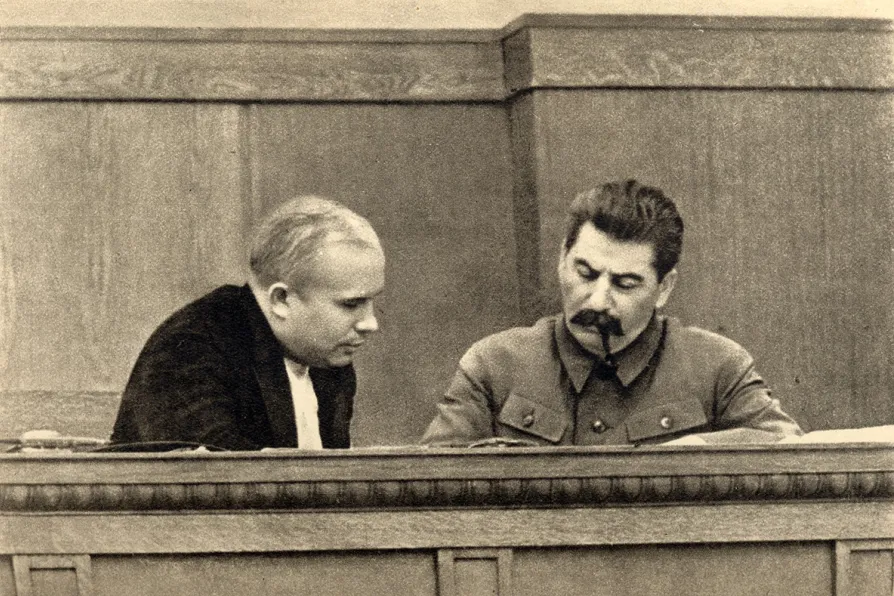 Nikita Khrushchev with Joseph Stalin, January 1936
As the 90th anniversary of the outbreak of the Spanish civil war is marked, Teesside campaigners will gather to remember the local men and women who stood against fascism, explains TONY FOX
Whatever differences exist among international sympathisers of the Bolivarian revolution about its current trajectory, they should unite against the imperialist power that is the source of an enforced retreat, argues ROGER D HARRIS
Washington’s inability to subjugate Iran is an example of how it is trying to preserve a regional order that no longer exists, argues RAMZY BAROUD
US financial instability is exposing the limits of a dollar-dominated global economy — and giving the Global South a historic chance to build an alternative, says MURAD QURESHI
Deprivation is a fundamental factor in criminal behaviour that must be addressed but, KENNY MacASKILL argues, there needs to a major rethink in sentencing to tackle overcrowding





ON FEBRUARY 24 1956, 10 days after it opened in Moscow, delegates to the Communist Party of the Soviet Union’s (CPSU) 20th Congress unanimously approved a resolution endorsing the political report given by CPSU general secretary Nikita Khrushchev.
The report was extensive, running to around 100 pages in English translation. However, in part three of the resolution several passages acted as a seismic foreshock — a warning tremor — signalling a coming earthquake in the form of a speech that was about to shake the communist world.
Without naming Stalin, the resolution said that: “The Congress fully approves the important work accomplished by the Central Committee in re-establishing the Leninist standards of Party life, promoting inner-Party democracy, introducing the principle of collective leadership based on a Marxist-Leninist policy, and in perfecting the methods of Party work … Thorough explanation of the Marxist-Leninist conception of the role of the individual in history was of great importance for raising the activity of Party members and the working people generally. The Congress considers that the Central Committee was absolutely right in combating the cult of the individual, which tended to disparage the role of the Party and the masses, to belittle the role of collective leadership in the Party, and not infrequently resulted in grave errors in its activities.”
The resolution was “approved unanimously.”
The following day, the 25th — 70 years ago today — during the final closed session of congress Khrushchev detailed these “grave errors” and named the “individual” to blame.
“The cult of the person of Stalin has been gradually growing, the cult which became at a certain specific stage the source of a whole series of exceedingly serious and grave perversions of Party principles, of Party democracy, of revolutionary legality.”
Khrushchev started by highlighting Marxist attitudes to the respective role of the individual and the masses in history, he then moved on to recalling Lenin’s opposition to Stalin remaining party general secretary, Stalin’s war leadership was questioned, and his remoteness from the daily life of Soviet people; he was accused of diplomatic blunders too. However, it was the accusations of fabricated trials, mass arrests, forced confessions and executions that naturally shook communists at home and abroad.
The CPSU leader claimed that: “Stalin originated the concept ‘enemy of the people.’ This term automatically rendered it unnecessary that the ideological errors of a man or men engaged in a controversy be proven; this term made possible the usage of the most cruel repression, violating all norms of revolutionary legality, against anyone who in any way disagreed with Stalin, against those who were only suspected of hostile intent, against those who had bad reputations. This concept ‘enemy of the people’ actually eliminated the possibility of any kind of ideological fight or the making of one’s views known on this or that issue, even those of a practical character.”
Khrushchev continued: “Arbitrary behaviour by one person encouraged and permitted arbitrariness in others. Mass arrests and deportations of many thousands of people, execution without trial and without normal investigation created conditions of insecurity, fear and even desperation.”
A whole generation of communists had largely believed in the authenticity of Stalin’s claims and publicly defended them, including for example the Morning Star’s predecessor the Daily Worker.
The speech’s impact was formidable. It was credited with triggering the Sino-Soviet split, exacerbating the crises in Poland and later Hungary. For some it was the opportunity to right wrongs, while for others it represented an inexcusable retreat in the face of the class enemy. Even today among the left, any discussion on the Secret Speech is likely to be an excuse for communists, Trotskyists, “anti-revisionists” and others to trade sectarian insults rather than to reassess the meaning and importance of the 20th Congress.
The very process by which the “Secret Speech” reached the West is itself shrouded in polemic. Although unpublished in the Soviet Union until 1989, its text was read out at meetings of CPSU members across the USSR.
Full copies were translated for other ruling communist parties and major non-ruling ones, while summaries were provided to others. It appears that the copy printed by the New York Times on June 5 1956 originated in Poland and arrived at the US State Department in Washington via Israel.
The Morning Star interviewed Richard Sakwa, emeritus professor at the University of Kent, one of the leading English-speaking academic experts on Soviet and post-Soviet political history, about his personal perspectives on the speech.
KC: How did the “Secret Speech” impact the left, and was this crisis a danger or opportunity for the Soviet Union?
Sakwa: My former PhD supervisor, RW Davis, who worked with EH Carr on the economic history of the Soviet Union, left the party [the Communist Party of Great Britain] as a result of the exposures in 1956. Obviously, they’d been aware of these issues, but that brought it to a head. So, I think it is a pivotal moment of opportunity. The unsatisfactory balance, if you like, or the political equilibrium, established in 1956, in the end turned out to be for the Soviet Union an inadequate one. Of course, the CPSU went further in 1961 at the 22nd party congress.”
KC: Why did Khrushchev make the speech in a closed session, which he must have suspected would be leaked, and indeed why keep it unpublished when he authorised it to be read out at party meetings within the Soviet Union and with a limited print distribution abroad?
Sakwa: It is a question I’ve often puzzled over. It was never going to be secret because it was circulated so widely. It was quite clear that it was not going to remain secret for long, but it’s been given this moniker of “Secret Speech.” So that’s the historical moment. It was shocking. If you read the transcript, it was an emotionally very charged session.
KC: Some have raised doubts over the accuracy of specific points in the Secret Speech along the lines of Khrushchev Lied (the title of a book by Grover Furr), while others suggest he didn’t go far enough in his criticism of the repression. How fair are those points?
Sakwa: The bigger question is how accurate were Khrushchev’s accusations? They were accurate. Of course, one of the big points is on the scale of repression. Khrushchev accepted that but he only focused on the purges of the party, not of state and other government officials. It was definitely partial, in that sense.
There is some attempt to exculpate him [Stalin], to blame Yezhov, of course, but no, all of this came from Stalin’s paranoia. And we know it because we have the daily lists being sent to him with that big blue tick across the names and so on. I think that this view that tries to minimise Stalin’s personal role in this is mistaken and the evidence shows it. But, you know, we’ve had some excellent studies of the 1930s to show the bottom-up element, the dynamics, which were more complicated, including within the party itself, especially after the assassination of Kirov in December 1934.
KC: What about criticisms of Stalin’s wartime role?
Sakwa: Khrushchev was a bit unfair in that I think most documents now show that Stalin at the beginning of the war made catastrophic mistakes, but he still took an active part in all strategic discussions, and later catastrophic mistakes were avoided. In other words, he became a better war leader as time passed. And, of course, he was a very effective negotiator with the Western interlocutors from the Tehran conference all the way through to Yalta and Potsdam.
In other words, Khrushchev battered Stalin’s ability as a war leader and as an international statesman. That’s one reason why Stalin has been partially, well, I won’t say rehabilitated, but his image has been slightly more burnished than it had been before. This is because of this diplomatic angle. Volume after volume of negotiations and of discussions have been published now, which show him to be very acute completely across the brief. That’s not to justify anything. It’s simply to say that he was one of the leading statesmen of the 20th century.
Further excerpts from this interview will be published in future editions of the Morning Star.
