IAN LAVERY MP warns that decades of neoliberal policies have left former industrial communities behind — but a renewed Labour commitment to working people could change the political landscape


How Hull’s women took on the trawler bosses – and won
After 58 fishermen were lost in the so-called ‘Triple Trawler Tragedy,’ four women led a grassroots revolt that forced the government to overhaul Britain’s deadly deep-sea fishing industry. MAT COWARD tells the story
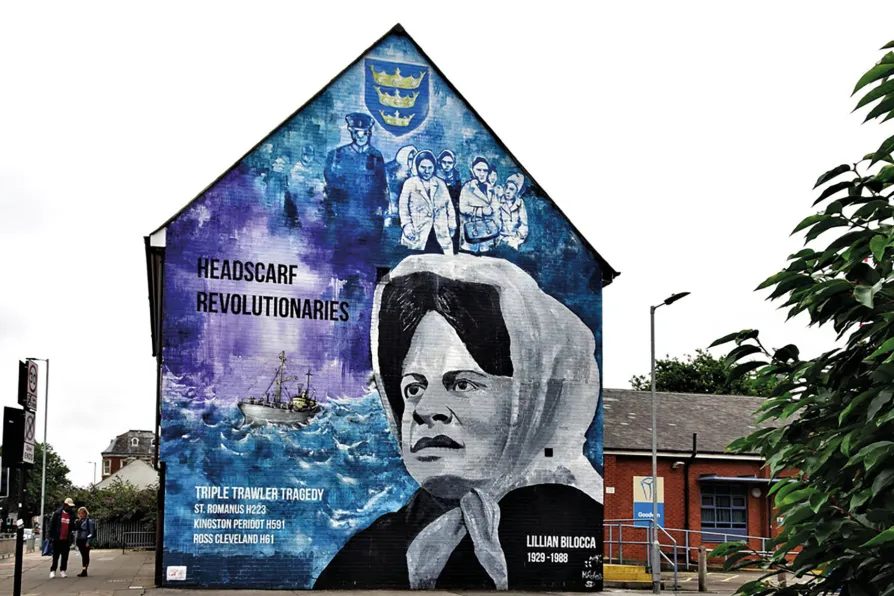
 Photo: Bernard Sharp/Creative Commons

PAOLO SANTALUCIA reports on how an Italian region defies US pressure to end a Cuban doctors programme
HENRY FOWLER outlines the GFTU’s new 2026-27 education programme and argues that investing in trade union education is essential to building worker power, developing leaders and strengthening collective action
We need a government that invests in saving lives not destroying them, argues SOPHIE BOLT
More expensive by weight than gold, saffron is surprisingly simple to grow. MAT COWARD explains
The public inquiry is the result of more than a decade of determined campaigning. Now, those who fought for justice want the full story of government involvement and police conduct to be told, says KATE FLANNERY
The Durham Miners’ Gala is a celebration of working-class culture, but also a call to action — to rebuild workers’ collective strength, says KIM JOHNSON MP





A GIANT cardboard cod toured the winter streets of Kingston Upon Hull. Written across it in blood-red paint were the words: “It’s not the fish you’re buying, it’s men’s lives.”
The winter of 1968 was a terrible one for the Yorkshire fishing port of Hull. In what newspapers called, with rather tasteless alliteration, The Triple Trawler Tragedy, three ships went down in less than a month, killing 58 local fishermen.
The St Romanus sank in the North Sea, the Kingston Peridot and the Ross Cleveland were both lost off Iceland. Even by the standards of deep-sea trawling, one of the most dangerous industries on Earth, this was shocking and made headlines throughout the nation.
For a group of women in Hessle Road, centre of the fishing community, it was too much to bear in silence. On February 2, before the third sinking, about 600 women gathered at a local hall to discuss how they could make the fishing bosses accept the need for safety reforms.
Incredibly — because this was 1968, after all, not 1868 — there was no requirement for trawlers to include a radio operator in the crew. Some ships were unable to call for help when they got into trouble.
Present at that historic rally was a young National Union of Seamen activist, John Prescott, who a little later helped build the cardboard cod and decades later became deputy prime minister of Britain. More significantly, four leaders emerged from among the Hessle Road women.
Retrospectively known as the Headscarf Revolutionaries, they went on to win a great victory — and to pay a great price.
A few days earlier, Lillian Bilocca (1929-88) had started a petition in support of a fisherman’s charter. Within 10 days it had 10,000 signatures. “Big Lil,” as the press inevitably called her, worked as a fish-gutter and, like just about everyone in Hessle Road in those days, had family ties to trawling.
Alongside her on the Hessle Road Women’s Committee was Yvonne Blenkinsop (1938-2022), a cabaret singer — it was her sound equipment that the meeting used. Yvonne’s trawlerman father had died of a heart attack when she was a teenager; at sea there was no hope of medical assistance. Mary Denness (1937-2017) is remembered as an eloquent speaker and effective campaigner. A former ship’s steward who married a trawler skipper, in later life she worked as matron at Eton College, where the children under her care included Princes Harry and William. Christine Smallbone, later Jensen (1939-2001) lost a brother in the triple trawler tragedy, but she didn’t yet know that when she joined the committee. A campaigner for strong unions in the industry, she ended up with an MBE for her lifetime’s work on trawler safety.
A deputation was sent from the meeting to meet the trawler owners, where they got no satisfaction. So the next day Mrs Bilocca and others gathered at the dock to prevent ships without radio operators from setting out. There are press photos of her being physically restrained by police officers as she attempted to jump aboard one vessel.
That was when she became Big Lil to the media, almost always described in the papers as weighing 17 stone (though how did they know? Surely no reporter actually asked her?) The crews of several ships refused to go out without radio men.
Bilocca was now a national figure, and one almost universally supported by public and press alike. The case she was making was plainly unanswerable, and her no-nonsense style of making it appealed widely.
But there was opposition to the women’s campaign, much of it from within the community. There were men who felt that the women were meddling in matters they “knew nowt about,” and women who felt they were bringing shame on the city by their brazen behaviour.
The leaders were only doing it to get on the telly, it was said. Some people argued that deep-sea fishing was always going to be dangerous, and futile but expensive attempts to make it safer would only end up costing jobs.
While celebrating her husband’s birthday in a restaurant, Yvonne Blenkinsop was punched in the face by a man. All four leaders received poison-pen letters and death threats from around the country, “coming through the post, pushed under the door at night and stuck on the house,” and at one time Bilocca was under police protection. Seen by employers as a militant, she lost her job and was blacklisted permanently from the entire fish industry.
The committee’s charter was far-reaching. As well as banning any ship going to sea without a qualified radio operator, the demands included that every voyage be fully crewed, improved training, proper safety equipment to be mandatory, and every fleet to have an accompanying mother ship which would carry medical facilities.
Union officials arranged a meeting on February 6 between the women’s leaders and senior ministers in London, where the women were met at the station by cheering crowds. The Labour government was sympathetic but even if it hadn’t been, the impetus behind the campaign was obviously impossible to resist without suffering major political damage.
Hull was the biggest news story in Britain, and a major story around the world. Blenkinsop later remembered asking the minister of state at the Board of Trade: “Are you actually going to do something, petal?” to which he replied “Yes, my dear, we are.”
In what must count as one of the most astonishingly rapid victories in any civil campaign, the government agreed to all the charter’s demands within a few hours. Fishing off Iceland was suspended pending safer weather, and scores of new safety measures were introduced.
Four days after its formation, the Hessle Road Women’s Committee had completely won its battle. In the years since their actions have saved the lives of an uncountable number of workers.
You can sign up for Mat Coward’s Rebel Britannia Substack at www.rebelbrit.substack.com for more strange strikes, peculiar protests, bizarre boycotts, unusual uprisings and different demos.
