ROB WARZYNIAK recalls the emblematic 1906 book, The Jungle, in its analysis of the crisis presently engulfing the US Food and Drug Administration


 Latest editorial

‘I doubled down and started my full fledged advocacy for Palestine’
CHRISTOPHE DOMEC speaks to CHRIS SMALLS, who helped set up the Amazon Labor Union, on how weak leadership debilitates union activism and dilutes their purpose
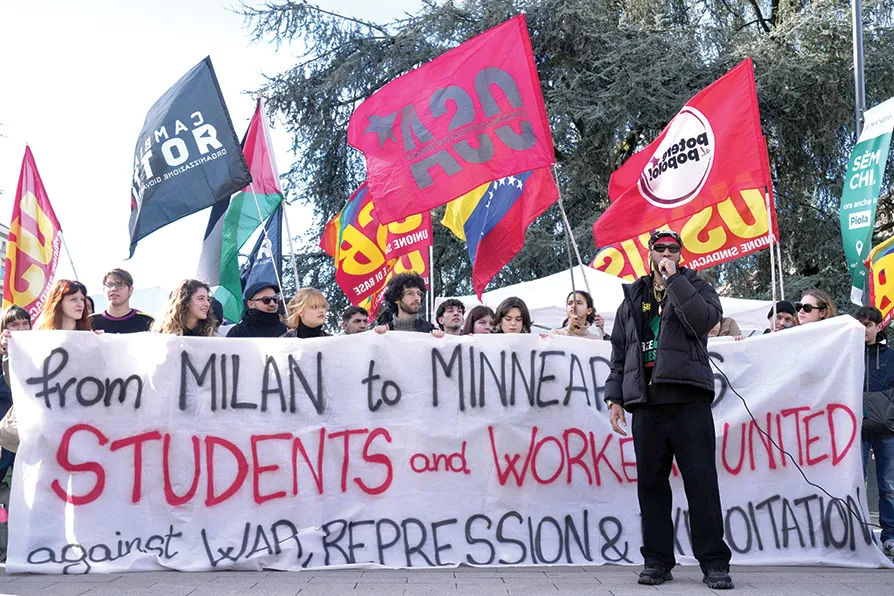 IRREPRESSIBLE: Chris Smalls speaks during a protest against ICE at the 2026 Winter Olympics, in Milan on February 6 2026
Welsh wanderings showcase fiery destruction, alternative water ways and revive memories of a local mining legend, writes MARK SEDDON
As thousands die in the eastern DRC, a global health emergency is being starved of funds, says S KRISHNASWAMY
MAT COWARD explains how in the 17th century a row over whether to kneel at communion became a battle over religion, class and royal power
Renewed illusions in social democratic reformism are sprouting as a result of Andy Burnham’s rhetoric, but material conditions are already intruding into the debate, argues NICK WRIGHT
Andy Burnham could learn a few lessons from a previous Labour government in the pre-privatisation era on how to tackle water shortages, writes KEITH FLETT





ONCE the face of a brief resurgence in the US labour movement, the founder of the first Amazon union on US soil, Chris Smalls, has now turned his attention to Palestine.
Back in 2022, when he and his comrades successfully organised the corporation’s JFK8 facility in Staten Island, he quickly became a national figure and was credited with inspiring a wave of worker mobilisation the country had not seen in decades.
Following the establishment of their Amazon Labour Union, the US National Labour Relations Board (NLRB) noted a 53 per cent increase in election petitions.
And more than 60 million workers wanted to join a union in that year alone, according to the Economic Policy Institute.
The moment was even recognised by then president Joe Biden, who received Smalls and other organisers at the White House to thank them for their “contributions” to the “momentum that [was] growing around the country”.
Their win announced a series of high profile strikes and union ballots, peaking the following year when during a United Auto Workers strike Biden became the first US president to ever join a picket line, standing with employees in Michigan demanding wage increases and improved retirement benefits from their employers.
Now, gone are the days when Smalls was lauded by centre-left media outlets and welcomed into the halls of power.
Ever since the October 7 attacks in 2023, Smalls has shifted his attention to “bridging the gap” between the workers’ movement and the struggle for a free Palestine.
It’s an important battle for unions to take on, he says. Organised labour has a vital role to play in on halting arms sales to Israel and blocking Western support for the brutal military assault on Gaza.
“I saw where people who supported me were drawing the line. It was a familiar feeling to me,” Smalls told to the Morning Star during a visit to London.
He was in Britain to meet with his comrades of the Global Sumud Flotilla, with whom he had travelled to Gaza in July 2025 in one of several attempts break the siege on Gaza to bring in life-saving food and medical supplies.
He explained that the response to his shift to centre Palestine in his activism was met critically by legacy media and certain sections of the internet.
“It was not so different than the propaganda that was used against us when we were fighting Amazon,” Smalls said. “When it came to Palestine, it was the same type of divisiveness we would see [in our union drive].
“I lost tens of thousands of followers when I shared that experience back in America,” he said recalling an earlier experience of posting Palestine-related content.
In the days following October 7, he shared stories of the vicious police repression he witnessed in Berlin, Germany against protesters taking part in a demonstration calling out Israel’s attack on Gaza.
“Despite losing all these followers. Despite the messages I was receiving. I doubled down and started my full fledged advocacy for Palestine.”
Smalls said it was only a few years before the genocide started in Gaza, during a “crash course” on the history of Palestine taught by political leader and thinker Mustafa Barghouti at a university in Canada, when he understood this was a “fight for what is right.”
“As a trade unionist, I signed up to fight. To be on the forefront, and sometimes that comes with controversy.”
Wearing a sweatshirt with the printed words “Blocchiamo Tutto” referring to the 2025 grassroots call in Italy for a general strike to block arms shipments to Israel, Smalls has never been one to mince words.
He has particularly harsh criticism for union leaders in western arms-producing countries, which he has called “complicit” in the attacks on Palestinians since the start of the genocide.
“What I’m seeing in the US, the complicity, the silence, and even the active fighting against rank and file members is truly disheartening.
“In the US, we are the number one culprit when it comes to weapons and money. Unions have to change course. They are supposed to be at the forefront of these fights.
“And to see them stand by and say nothing. It’s just disheartening. It’s disrespectful to the working class.
“I’m trying to be the conduit to really bridge that gap, to hold unions accountable. There’s nothing wrong with holding them accountable and that starts with the leadership.
“Unions are failing to meet these grassroots efforts. They’re failing to even be the shield they’re supposed to. That’s the oath that they take, to protect working-class people.”
To fight back against their inaction, he said, “people are the only thing that is going to save us.”
It’s a sort of refrain for the activist who has a natural distrust of politician-like figures, and sees strikes as the only way to push back against failing union leaders on the issue of Palestine and a worsening political climate back home.
Industrial action, he explained, is the only way to counter the backsliding conditions for workers’ rights since Trump took office for the second time in 2025.
“The only thing we can do is go on strike. And that’s the tough part. We can’t rely on the government. A lot of people believe that the legal system is going to give them a contract and it just doesn’t work that way.”
While acknowledging Trump’s more open attacks on workers and the NLRB, he said: “Biden made the public body useless, before Trump totally killed it.
“Before Trump dismantled it within his first or second week, there wasn’t much to even lean on. He is definitely anti-union as much as he tried to cling on to working-class talking points.
“But the Biden administration was not as pro-labour as everybody thinks. He used the Railroad Strike Act from 1945 to stop them from striking last year.”
He added: “You can’t forget that our union density in the US is in the single digits. And it’s been that way for decades.”
What about the openly socialist political figures like the newly elected mayor of New York City Zohran Mamdani? “Politicians will not be our saviours,” he responded.
“[Mamdani] can say ‘Free buses, free this, free that,’ all he wants. That doesn’t make him a socialist.
“[He] visited my union a week before I got on the flotilla anyway. Nothing. He said nothing [when I was detained], so on a personal level, I don’t give a damn about him.”
He points to his background as his guiding light to understand politics in the US. A story told in his first book When the Revolution Comes, which will be released in Britain on June 2 this year.
“People will see pieces of themselves in my fight and in my story,” he said. Whether a trade union organiser or not, he claims it will “resonate with people” and push them “to keep up the fight.”
“I [wrote it] to light a fire under them and motivate them.”
