


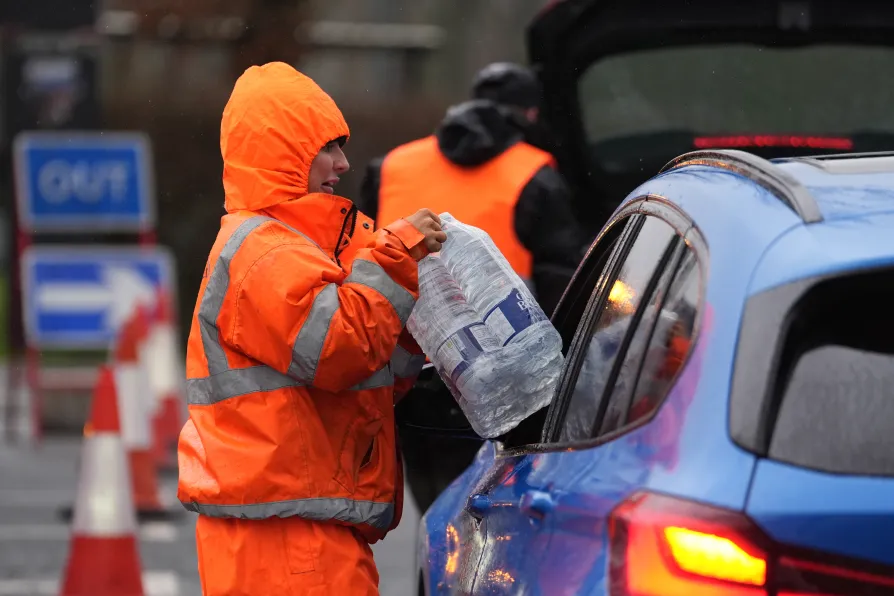
 A worker hands over bottled water at a water station in East Grinstead, after bad weather was blamed for more water outages in Kent and parts of Sussex, January 12, 2026





HOW much longer are people in south-east England expected to put up with the depredations of South East Water?
Seventeen communities across Sussex and Kent, including 30,000 households, were without a water supply today, in some cases for the fourth day running. And this comes after prolonged outages last year, notably in and around Tunbridge Wells.
There is no more basic human requirement than a water supply. Without it, society starts to crumble and, indeed, schools, libraries and health clinics have had to shut in affected areas while elderly residents have been asked to travel up to seventy miles to secure a bottled water supply.
The only thing not in short supply from South East Water is excuses, mainly around the weather — that and fat-cat payments of course.
As recently as 2023 the company was spending millions more on dividends and interest payments on debt — it was debt-free when privatised by Thatcher — than it was in investing in its crumbling infrastructure.
And bungling chief executive David Hinton was, almost unbelievably, paid a £115,000 bonus last year on top of his £400,000 salary.
This was despite not only South East Water’s wretched service delivery but also the fact that it had to turn to its owners — mainly overseas investment funds — for an extra £200 million in cash to stave off insolvency. The company is barely more stable than the effectively bankrupt Thames Water. Local MPs have unsurprisingly called on Hinton to resign.
A Commons committee announced today that it is recalling the company’s chair to give further evidence after it emerged that the independent Drinking Water Inspectorate’s account clashed with the corporate narrative over these outages.
Committee chair Alistair Carmichael is “deeply sceptical about the company’s version of events, and its board’s track record of holding the company to account. We would be failing in our duty if we now allowed them without challenge to mark their own homework.”
It is the government which is failing in its duty. It refuses to act with any sense of purpose over this crisis-ridden industry, the performance of which constitutes, among other things, a public health hazard.
All Water Minister Emma Hardy could intone was that she was “very concerned” and the situation was “entirely unacceptable.” She pledged to “hold meetings” in order “to restore supplies as quickly as possible.”
Such empty rhetoric will turn on no taps. The activities of privatised water companies is a scandal crying out for resolution. The justifiably angry of Tunbridge Wells, like people across the country, need the privateers kicked out of this vital service and water restored to public ownership as rapidly as possible.
The intervention by Labour MPs opposing permission for a new Chinese embassy in London is entirely misguided.
The proposed new building near Tower Bridge would consolidate a large number of Chinese official premises across London into one. And agreeing to this sensible move would doubtless expedite the permission Britian needs for its own planned reconstruction of its embassy in Beijing.
China is an increasingly important — and reliable — trade partner for Britain, and one a government trying to stimulate economic growth can ill-afford to alienate with Sinophobic posturing.
The “security concerns” invoked by the MPs are bogus. They cannot explain why they would be any more or less in the new building than they are in any case.
In fact, China does not threaten the proper conduct of international business, nor does it seek to interfere in Britain’s internal affairs. If those are the worries of the MPs they would be better off directing their attention to the new US embassy in Battersea.
